
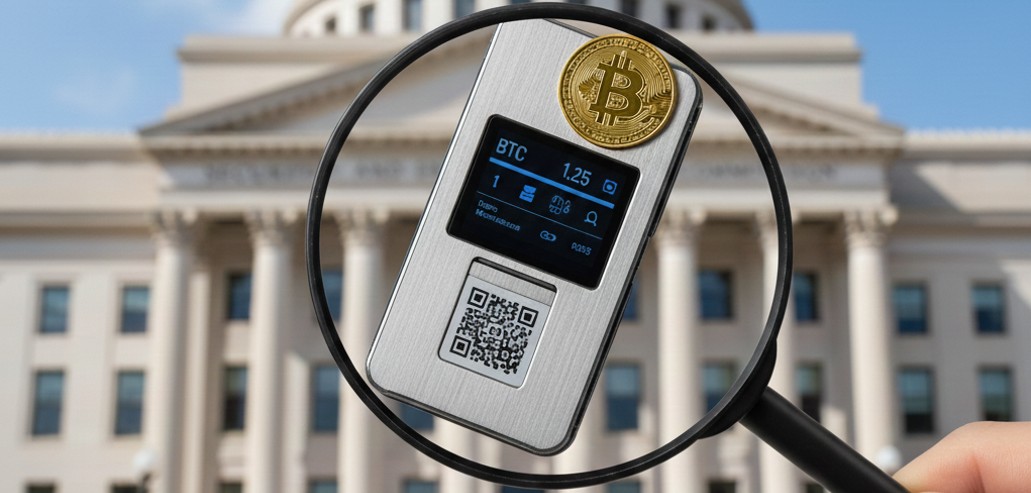
The SEC officially confirms that wallets do not store assets, they store private keys.
Self-custody is no longer a discourse, it becomes part of official financial education.
This article was written by Matías Mathey. The author has a diploma in cryptoeconomics, it is expert university in blockchain, DeFi, & NFT and self-custody. In addition, he is a speaker at {(₿)} Bitcoin.ar, an educator at Satoshi Bookstore (B4OS) and an official partner of Liana Wallet (wallet for inheritances).
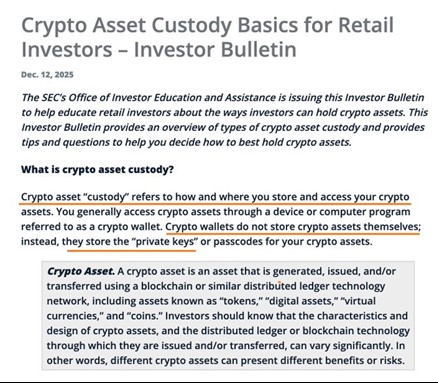
On December 12, 2025, the SEC published the bulletin “Fundamentals of Crypto Asset Custody for Retail Investors.” In it, the regulator explains something that the bitcoiner community has been teaching for more than a decade: wallets do not store cryptoassets, they store private keys. And whoever controls those keys, controls the asset.
This recognition is not minor. It does not change the regulatory framework from one day to the next, but it does mark a narrative turning point. For the first time, one of the world’s most influential financial institutions publicly validates the technical principle underlying self-custody. And when technique prevails over discourse, education wins a key battle.
What exactly does the SEC recognize?
He document defines “crypto asset custody” as how and where an investor stores and accesses their digital assets. So far, nothing new. But the central point appears when it clarifies that access is done through a cryptocurrency wallet and that these they do not store assetsbut the “private keys” that allow you to control them.
This distinction is fundamental. In the traditional financial system, ownership is mediated by institutions: banks, brokers, custodians. In bitcoin and other cryptoassets, ownership is cryptographic. It does not depend on internal accounting records or external permissions, but on the exclusive control of a private key.
That the SEC explains it in these terms implies something profound: it is recognizing that the asset does not “live” on the platform, nor in the app, nor in the exchange. It lives on the blockchain, and can only be moved by whoever has the corresponding keys.
From the narrative of fear to the narrative of understanding
For years, the regulatory and media focus was on warning about the risks of “losing the keys,” as if self-custody were a dangerous eccentricity reserved for experts. However, the bulletin itself admits that There are different custody modelseach with different benefits and risks, and understanding them is key to making informed decisions.
This aligns the institutional discourse with what bitcoiner education has been promoting: there are no magic solutions, but there are conscious decisions. Delegating custody reduces direct liability, but introduces counterparty risk. Assuming self-custody increases sovereignty, but requires education, discipline and good practices.
The change is subtle, but important: it is no longer about “protecting the investor from himself”, but about educate him so he understands what he is doing.
Why this matters more than it seems
We are not facing ideological support for Bitcoin or decentralization. We are facing something more powerful: the impossibility of denying technical reality. The SEC is not saying that self-custody is easy, or that it is for everyone. It is saying that it is real, that it exists, and that it works in a specific way.
And when a regulator accepts the logic of the system it is trying to regulate, the terrain of debate changes. Regulation can no longer be built ignoring how technology works. You can no longer talk about “custody” as if it were a bank safe.
This also reinforces a key idea: many of the historical cryptocurrency losses occurred not because of protocol failures, but because centralized custody models and poor user practices. Broken exchanges, blocked funds, frozen withdrawals. Not due to loss of keys, but due to delegating them.
Education as a vector of sovereignty
For those who educate self-custody, this document is a quiet victory. Not because he comes to “defend” Bitcoin, but because he recognizes that technical literacy is essential. Understanding what a private key is, how it is generated, how it is backed up and how it is protected is no longer optional: it is part of the ABC of the digital investor.
Self-custody is not a political stance. It is a logical consequence of a monetary system based on cryptography. And the more that is understood, the less room there is for simplified stories or magical solutions.
Finally, when I read the entire SEC document, I do not interpret it as a defense of Bitcoin, but as the recognition of a reality. I do not consider that self-custody is promoted, if it is admitted that the control of assets depends on the control of private keys.
That is just one fact that changes the framework of the debate. Talking about self-custody should be an axis of study, of communication for everyone. Bitcoin did not ask for permission to exist, and it does not need it to be understood, but self-custody is the responsibility of each person.
Disclaimer: The views and opinions expressed in this article belong to its author and do not necessarily reflect those of CriptoNoticias. The author’s opinion is for informational purposes and under no circumstances constitutes an investment recommendation or financial advice.