
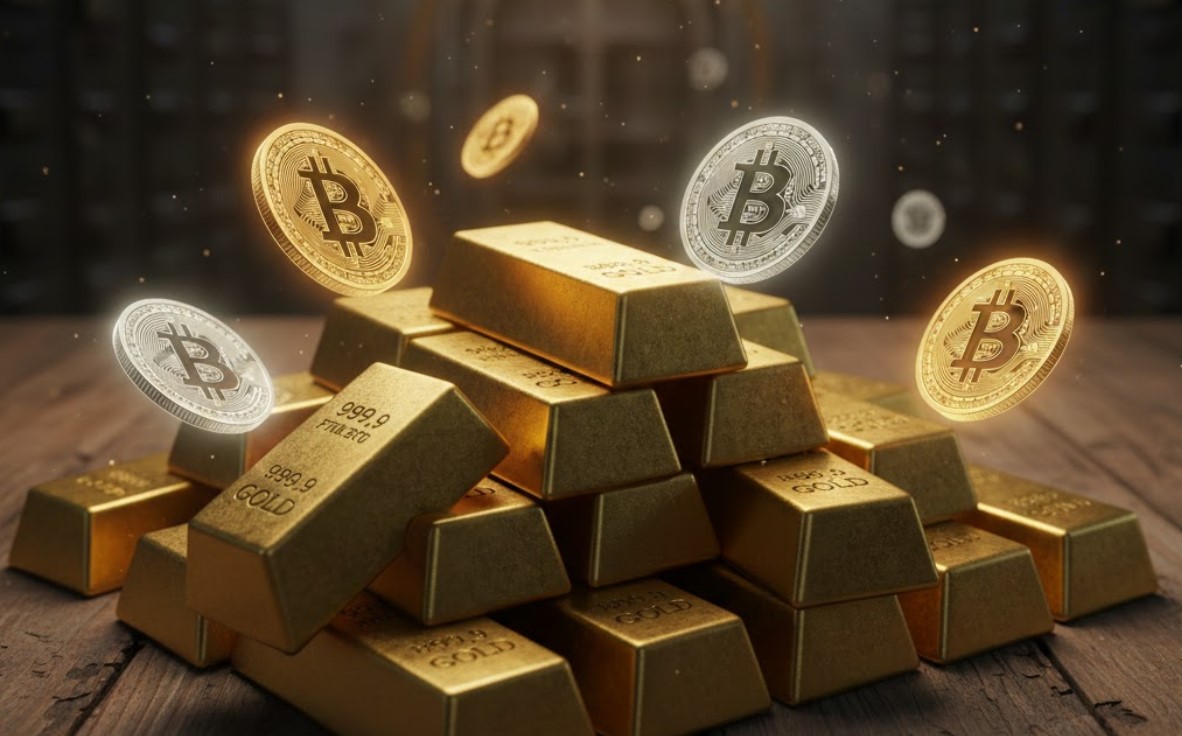
In gold, and not in “digital abstractions”, would be true wealth, according to Ghansham.
Since Bretton Woods, the role of gold has been transformed and ceased to be a monetary anchor.
The global financial market is going through a structural transformation where the search for safe havens has intensified. In this context, a recent publication released by the International Monetary Fund (IMF) highlights the validity of gold as the definitive reserve asset, according to its author.
The analysis, elaborated by Pratik Ghansham Salvi, professor at Ness Wadia College of Commerce, argues that Gold maintains enduring value that “digital abstractions” cannot replicatedespite the rise of bitcoin in the portfolio of modern investors.
The history of gold has been a constant adaptation to changes in the world order. According to Ghansham Salvi, the role of metal was radically transformed after the collapse of the Bretton Woods system.
That 1944 agreement, pegging the U.S. dollar to gold at $35 per ounce, represented the last vestige of a formal monetary anchor. When Richard Nixon suspended convertibility in 1971, metal did not lose its relevance, but rather began a metamorphosis.
In the decades that followed, the metal went from an accounting basis to an “investment haven: the unpaid asset in times of fear.” The graph that accompanies the analysis that is reviewed here by CriptoNoticias, shows a clear trend: gold has consistently tracked inflation and crises.
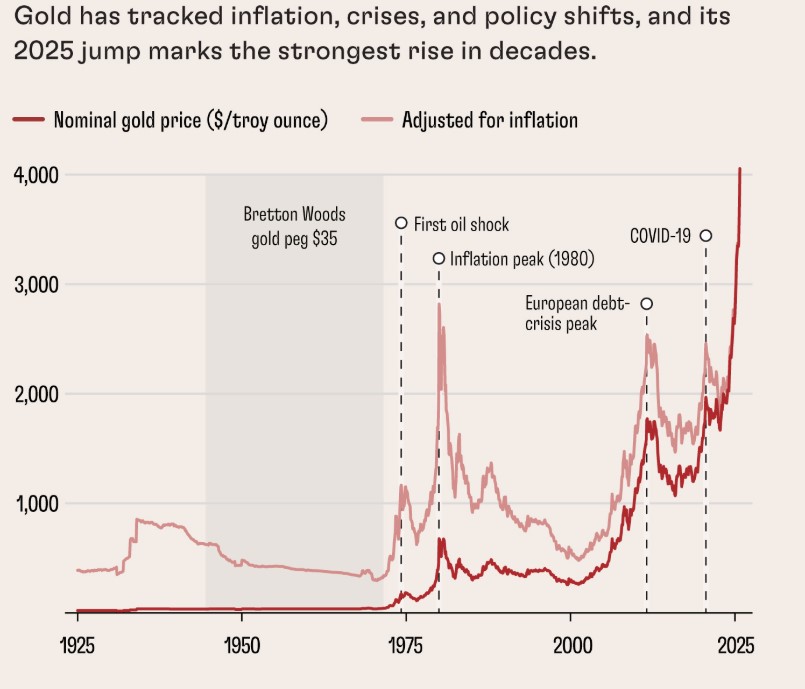
However, the jump recorded in 2025 marks the strongest rise in decades. This, with an increase of approximately 40%, exceeding $4,000 per ounce.
Bitcoin as “speculative belief” versus the memory of faith
The advancement of bitcoin as a financial alternative has reignited the debate over what constitutes real value in the modern economy. Although many defenders of the digital currency classify it as “digital gold” due to its algorithmic scarcity of 21 million units, Ghansham Salvi believes that the comparison is fundamentally incomplete and erroneous.
Bitcoin is volatile, intangible, and dependent on digital infrastructure. Gold, on the other hand, carries the weight of millennia of trust. It is a physical reality, immune to code flaws or regulatory prohibitions. If bitcoin represents the future of speculative belief, gold embodies the memory of collective faith. Both reveal that money, at its core, is a social construct: a shared story we tell about what matters.
Pratik Ghansham Salvi, university professor.
Compared to Ghansham Salvi’s position, it should be noted that the intangible nature of bitcoin is not a weakness, but rather its greatest technical strength. Unlike gold, whose purity and physical custody depend on third parties and expensive processes, bitcoin offers auditable real-time scarcity. This, through a protocol that, since its conception in 2009, has never suffered a critical failure in its code that compromises its integrity.
This technological resilience gives it a competitive advantage: its portability and immediate global divisibility, something impossible for physical metal. While gold requires heavy and centralized logistics infrastructure, Bitcoin’s decentralized network has proven immune to censorship and confiscation.
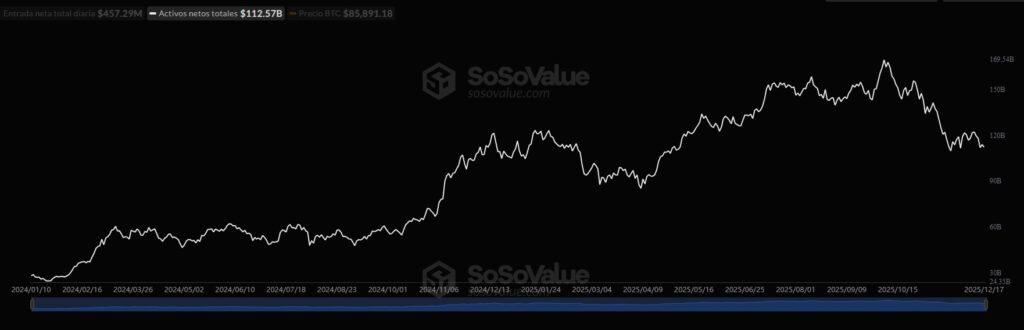
Such is the advantage of BTC that There has been massive institutional investment in that asset since January 2024when exchange-traded funds (ETFs) were approved and issued by large companies in the traditional financial system. Among them such as BlackRock, Grayscale and Wisdom Tree. Those vehicles have already invested $112.5 billion in BTC:
Still, for the Indian academic, the digital asset It is a proposal that lacks the historical consensus necessary to offer stability. In contrast, gold’s value is based on three immutable traits: physical scarcity, durability, and a trust rooted in human psychology.
He adds that this physical quality is his greatest strength. “Every ounce ever mined, some 210,000 metric tons, continues to exist in some form, whether in bullion, coins or jewelry. This almost physical permanence has no comparison with any financial asset,” he says.
Gold in the face of the digital future
Professor Ghansham Salvi’s analysis points out that, although financial technology moves towards the tokenization of assets or trading powered by artificial intelligence, the essence of gold remains unchanged beneath these technological layers.
For him, metal endures because institutional trust is fragile. While the digital currency continues its adoption process, gold remains the sovereign shield preferred by states. As he sees it, the precious metal is not a vehicle of active prosperity, but rather “it is insurance against the absence of prosperity.”
In this scenario, bitcoin represents the commitment to a new system. While, in the words of Ghansham Salvi, gold remains the physical guarantee that, whatever happens to the world’s digital infrastructure, “true wealth is both memory and money.”
It is worth clarifying that the website makes it clear that Salvi’s opinions “do not necessarily reflect IMF policy.” In any case, they seem to be aligned with the historically critical stance towards bitcoin that the financial body has had.