
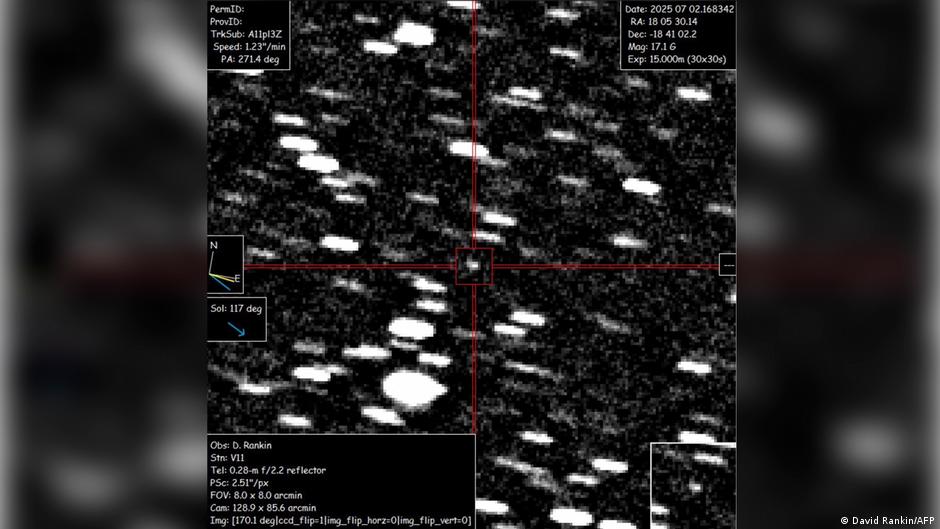
In the early morning hours of Friday, December 19, you may be able to spot a visitor from another solar system in the sky – with a serious pair of binoculars. Comet 3I/ATLAS flew by Earth at a distance of 270 million kilometers (168 million miles). That was its closest approach to our planet.
From here, the comet will continue its journey and pass by Jupiter in early 2026 before crossing the orbits of Saturn, Uranus and Neptune by 2028 and then leaving our solar system.
Facts about 3i/ATLAS
Beyond the fact that it is the third known interstellar object to enter our solar system, “we don’t know very much,” said ATLAS co-principal investigator Larry DeNew. a telescope in chile Which was seen by 3I/ATLAS on July 1, 2025.
It’s not exactly reassuring when scientists say “we don’t know,” but at least it’s honest.
Astronomers know that 3I/ATLAS is a comet that was about 670 million kilometers (416 million miles) from the Sun when it was first observed. There is no threat to planet Earth from this.
The comet is believed to be about 20 kilometers (12.4 miles) wide and traveling at about 60 kilometers per second (an impressive 134,000 miles per hour).
This data allowed astronomers with the Asteroid Terrestrial-Impact Final Warning System in Chile to see it. When they noticed the object on an unusual trajectory, they immediately began tracking and measuring it.
Then, other astronomers based at telescopes in Hawaii and Australia began monitoring the object’s flight progress and confirmed it as an interstellar comet.
Only the third interstellar object to reach our solar system
Comet 3I/ATLAS passed through the heliosphere to enter our Solar System. The heliosphere is a barrier that protects us from interstellar winds and radiation.
However, the heliosphere is an imperfect barrier – some interstellar radiation passes through it, and it clearly does not prevent icy spacewalkers like 3I/ATLAS.
However, interstellar objects are considered quite rare in our solar system. The first known interstellar objects were 1I/’Oumuamua, discovered in 2017, and 2I/Borisov, discovered in 2019.
“This is only the third interstellar [object] “The detections could happen at any time, so an accurate forecast of the expected frequency is not possible at this point,” Richard Moisel, head of the European Space Agency’s Planetary Defense Office, wrote in an email to DW.
But telescopes have become more technologically advanced and scientists now scan the night sky continuously. So we may start to see more of them.
“The Legacy Survey in Space and Time at the Vera Rubins Telescope in Chile came online this year. It is more efficient than existing surveys and is expected to detect many new interstellar objects over the next 10 years,” said Michael Kuypers, Moisel’s colleague at ESA.
Kuypers is a Comet Interceptor Project scientist. Comet Interceptor is a spacecraft that will rest in a “parking orbit” and intercept distant comets and asteroids if they come too close to Earth. It is planned to launch in 2029.
Where did Comet 3I/ATLAS come from?
The short (and obvious) answer is that comets, such as 3I/ATLAS, 1I/’Oumuamua and 2I/Borisov, come from other planetary systems.
Like comets and asteroids within our solar system, interstellar objects are thought to be untouched samples from elsewhere in our galaxy, the Milky Way, if not fragments from the beginning of the universe.
Moisel said this new object “came roughly from the direction of the Galactic Center region,” which, as the name suggests, is toward the center of the galaxy. But astronomers do not know its exact origin or “home star”.
Based on its brightness, 3I/ATLAS appears to be larger than the other two stray comets – 1I/‘Oumuamua and 2I/Borisov – which are thought to have entered our solar system from a different region of the galaxy.
Astronomers continue to monitor 3I/ATLAS to assess its structure and behavior. You can see it from Earth — but you “need a big telescope” to see it, Jonathan McDowell of the Harvard-Smithsonian Center for Astrophysics wrote in an email to DW.
Edited by: Fred Schwaler, Carla Bleiker
Editor’s note: This article was originally published on July 4, 2025 and was updated with information about the comet that will fly by Earth on December 19, 2025.