
The expected increase of 25 basis points occurred, so the market reacted calmly.
Western stock exchanges will open mid-morning and there could be strong movements.
The Bank of Japan’s decision to raise interest rates marks a milestone in global monetary policy that indirectly impacts the price of bitcoin (BTC).
The Japanese monetary authority increased rates in the short term by 25 basis points, going from 0.5% to 0.75%, which represents the highest level recorded since 1995.
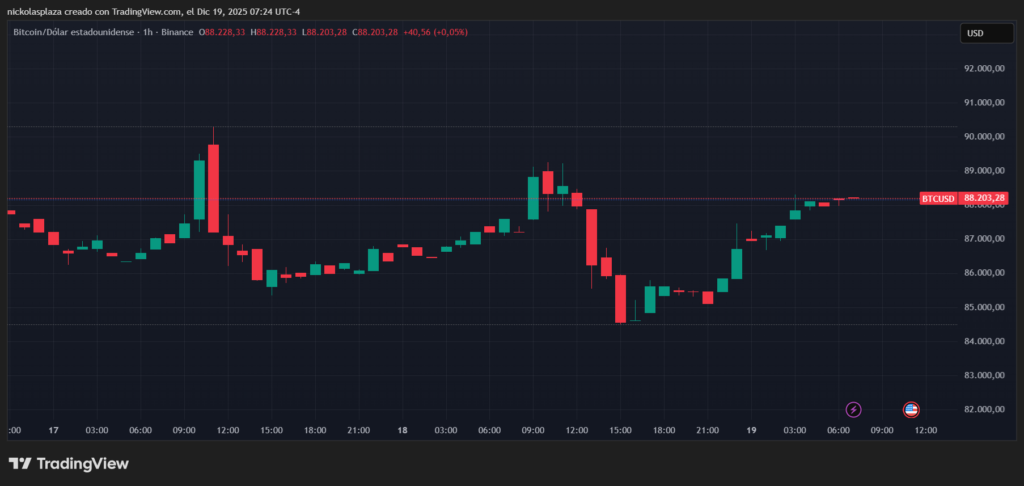
Because this adjustment was within expectations, the market has reacted with notable calm, allowing bitcoin to register an increase of 3% in the last 24 hours. This can be seen in the following graph.
Despite the initial stability, the increase in rates in Japan puts financial arbitrage mechanisms such as the «carry trade«, as CriptoNoticias has explained.
A more expensive financing environment in the Asian nation could reduce global liquidity and generate selling pressures on digital assets.
However, true volatility is expected to manifest once Western stock exchanges begin operations at mid-morning, which will define the course of assets considered “risk”, such as stock stocks, given the new configuration of international capital. If there is a big drop in the capital market, it could “infect” bitcoin.
The pressure exerted by the Bank of Japan is currently offset by macroeconomic data from the United States, where inflation showed a drop of 40 basis points, standing at 2.7% year-on-year, after reaching 3% in September.
This decrease places to the consumer price index (CPI) at its lowest point since March 2021approaching the 2% target of the United States Federal Reserve (FED).
Falling inflation is generally favorable for bitcoin, as it weakens the dollar and increases the likelihood that financial authorities will adopt more expansionary monetary policies, incentivizing investment in assets with limited supply.