
The United States has announced an $11.1 billion (€9.45 billion) arms package which, if completed, would be Washington’s largest-ever arms sale to Taiwan.
The defense package is a welcome boost for Taipei, which faces growing military pressure from China.
The announcement has appealed to Beijing, which opposes any arms sales to Taiwan and claims the democratically self-ruled island as its own territory.
“We demand that the US immediately stop ‘arming Taiwan’.” [and] “Stop ignoring and supporting Taiwan independence” separatist forces, a spokesman for China’s Taiwan Affairs Office said Thursday.
The deal comes amid growing questions in Taiwan about US security commitments, spurred by President Donald Trump’s trade strategies and negotiating tactics.
In response to the latest arms sale, which still requires congressional approval, Taipei said it was “sincerely grateful” to Washington, and said the deal underlined the “close Taiwan-US partnership”.
Despite having no formal diplomatic relations with Taiwan, the US remains the island’s most important international supporter and is required by law to provide it with self-defense weapons.
What does the package consist of?
The deal, the second arms sale to Taiwan in Donald Trump’s second term, includes eight separate purchases, ranging from HIMARS rocket systems and anti-tank missiles to suicide drones.
“From an operational perspective this is an important package,” David Sachs, fellow in Asia studies at the Council on Foreign Relations (CFR), told DW.
Sachs said the arms sales are “focused on giving Taiwan the ability to repel Chinese aggression” rather than countering gray-zone coercion or responding to the blockade.
In recent years, China has increased military pressure on Taiwan through frequent aircraft incursions, naval patrols and coast guard activity.
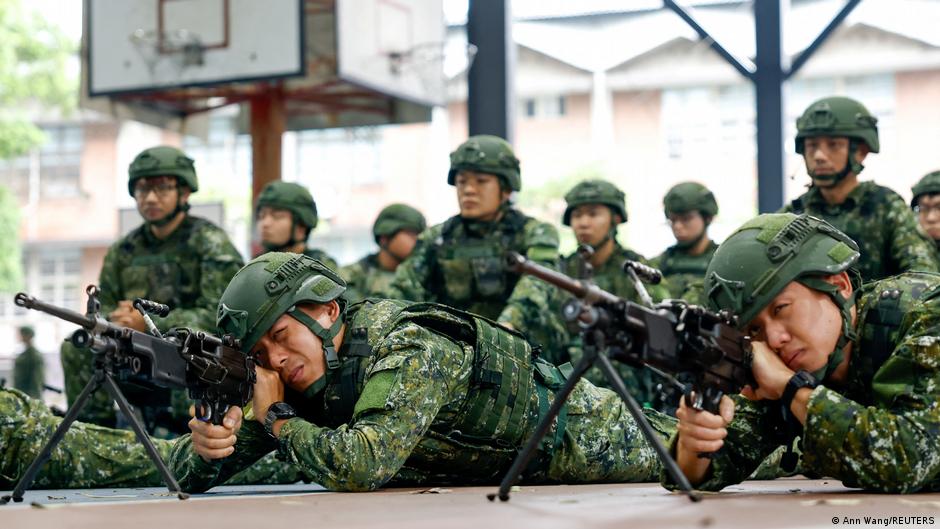
Facing a much larger Chinese military, Taiwan is under increasing pressure from Washington to boost its self-defense, with an emphasis on developing asymmetric capabilities through mobile and low-cost weapons systems.
Noting the weapons included in the package, Sachs told DW that “it shows that Taiwan has accepted the idea that it needs to prioritize [Chinese invasion] The scenarios and asymmetric capabilities that this requires.”
What signals have been sent to Taipei and Beijing?
In the past year, concerns have grown in Taiwan about whether the Trump administration might consider the island as a bargaining chip in negotiations with Beijing on trade issues.
“This package of arms sales is the largest [US] “History should help dispel some of those concerns,” Sachs told DW.
The US has long viewed cross-Strait relations with “strategic ambiguity” over whether it would intervene militarily and come to Taipei’s aid if China launched an invasion.
Washington’s policy is aimed at deterring Beijing, as well as preventing Taiwan from declaring formal independence.
one in New National Security Strategy It was released before the announcement of a massive arms deal with Taiwan, with the Trump administration believed to have downplayed ideological differences with Beijing.
The document focuses more on trade competition, arguing that economic stability, led by the US, is the best basis for countering China in the Indo-Pacific.
Sachs told DW that Trump’s policy over the past year has shown that the US “will continue to support tough deterrence in the Indo-Pacific and the Taiwan Strait” but will “do less to show symbolic political support of Taiwan.”
Taiwan’s recent efforts to strengthen its self-defense
In response to the latest US arms sales, Taiwan’s presidential office reiterated the island’s commitment to increase defense spending to more than 3% of GDP next year and to 5% by 2030.
Last month, Taiwanese President Lai Ching-te outlined a plan to invest an additional $40 billion in a special defense budget over the next eight years, which still requires opposition approval in parliament.
A recent report by Taiwan’s Defense Ministry also revealed that the army is adopting a “decentralized” command structure in view of a possible surprise attack by China.
Under the new structure, if the army is attacked suddenly, units will carry out operations or executive missions without waiting for orders.
While the concept has been implemented in annual military exercises, Su Tzu-yun, a research fellow at the military-backed National Defense and Security Research Institute in Taipei, said this is the first time the military is putting it into practice in actual operations.
“If China were to take military action against Taiwan, it would certainly carry out what is known as a decapitation strike, which aims to eliminate command and control and paralyze the leadership,” Su said.
A decentralized command structure could help improve “Taiwan’s survivability and ability to respond to a surprise attack,” he said.
Arthur Ding, professor emeritus at National Chengchi University in Taipei, told DW that it remains to be seen whether any U.S. training for Taiwanese troops will include this decentralized approach.
He also said that no matter in which area Taiwan is making military preparations, Beijing will keep a close eye on it.
DW correspondent Yu-Chun Chou contributed to this report.
Edited by: Carl Sexton