
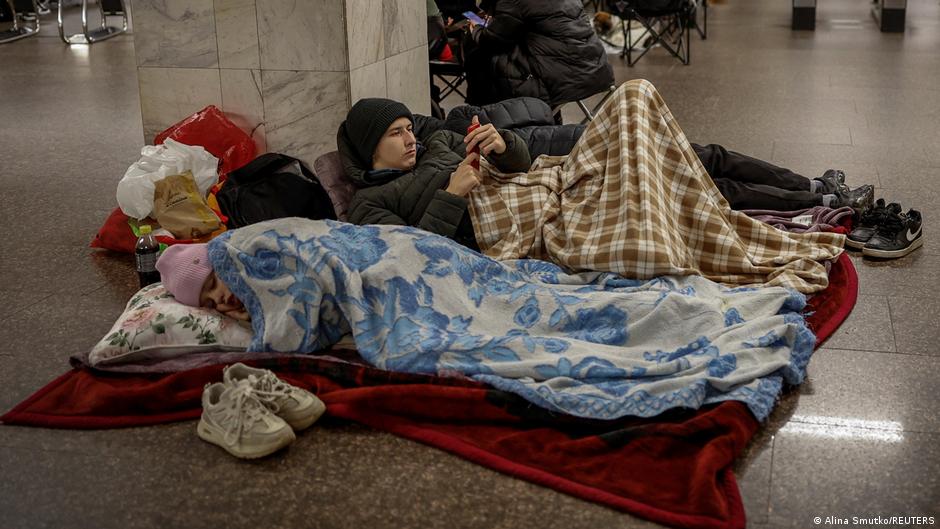
While US, Ukrainian and European politicians and diplomats are sorting out the details of the peace proposal put forward by the US, Ukrainians in the war-torn country are also discussing the future and what kind of agreement would be acceptable. Which “red lines” should not be crossed under any circumstances?
no regional concessions
According to several surveys, most Ukrainians do not want to accept a peace plan that involves territorial concessions and does not provide security guarantees. A study by the Ukrainian non-profit, New Europe Center, found that about 65% of the population believes that Ukraine should not engage in negotiations with Russia without security guarantees, and more than 86% are convinced that stabilizing the front line would only delay another Russian offensive.
A poll conducted by the Kyiv International Institute of Sociology (KIIS) shows that 75% of Ukrainians reject the plan proposed by the US, which envisages the withdrawal of Ukrainian troops from Donbass and limiting the size of Ukraine’s military. “The majority is ready to negotiate and end the war through diplomatic means and even make difficult compromises,” KIIS executive director Anton Hrushetsky told DW. “However, most people reject those plans as a surrender.” Thus, he explained, a good majority of Ukrainians were willing to endure the war as long as necessary.
Ukrainian society’s pressure on the government
This clear stance in Ukrainian society is beneficial for the Ukrainian government. Oleksiy Haran of the Ilko Kucheriv Democratic Initiatives Foundation said this is not a new phenomenon. “Even under President Petro Poroshenko, the public had drawn clear red lines that could not be crossed. Today, public opinion is helping [Ukrainian President] Volodymyr Zelensky must resist US pressure and make clear what the Ukrainian people will not accept. Public opinion is an argument for Zelensky in negotiations with the US. He may point out that dissent could destabilize Ukraine and provoke conflict within the country – and that’s exactly what it is. [Russian President] Vladimir Putin wants.”
Thus, he predicted, the Ukrainian government would not sign any agreements that could trigger protests. Oleh Sakjan, co-founder of the National Platform for Resilience and Cohesion, a Ukrainian civic initiative, pointed out that the recent corruption scandal surrounding the president had weakened him and strengthened the role of the public as a form of security in the negotiations. “Zelensky’s options for compromise have become even more limited,” he told DW. “In the US, some people were happy with the scandal and hoped that Zelensky would now be more willing to compromise on a peace deal,” he said, adding that in fact, the opposite had happened. Ukrainian society, he explained, is leaving Zelensky little room for maneuver in negotiations.
Population ready to protest against ‘prescribed peace’
Polls also show that Ukrainians are ready to protest against the unfairly decreed peace. According to a study conducted by the New Europe Centre, half of all Ukrainians would take to the streets if their government made compromises they found unacceptable. Sakjan said that Ukrainian society has an important role when it comes to rejecting unacceptable agreements and that the government was aware of society’s red lines due to several surveys.
These would include failure to provide adequate security guarantees, regional concessions and holding elections without proper security measures, he said. However, he clarified that if this were “the only bitter pill of the agreement” the population would be willing to accept the country abandoning its bid to join NATO. To make this possible, he said, the agreement would have to include guarantees analogous to those provided by Article 5 of the North Atlantic Treaty, which obliges NATO members to support allies in the event of attack.
Zelensky government must engage in ‘honest talks’
Oleksandr Sushko of the International Renaissance Foundation, a Ukrainian NGO, told DW that the key question is how the elections match the political reality faced by the Ukrainian government in the negotiation process.
“Ukrainian society takes the question of the price of peace very seriously. Despite all the tragedies of the war and the huge losses inflicted on Ukraine by the daily continuation of hostilities, Ukrainians clearly want the outcome not to jeopardize the sovereignty, independence and fundamental pillars of the state, especially its defense capabilities,” Sushko said, adding that relations between the government and the population will be tested by the search for compromise.
To prevent internal tensions from escalating, he recommended that the government engage in honest dialogue with the population on security guarantees, limiting the size of the army, and other sensitive issues, especially if these were already the subject of substantive negotiations.
This article was originally published in Ukrainian.