
Investors use cheap yen to buy higher-yielding, riskier assets.
If credit becomes more expensive in Tokyo, capital is forced to sell its holdings.
At first glance, there appears to be no logical connection between the bureaucratic decisions of the Bank of Japan in Tokyo and the price of bitcoin (BTC) in global markets.
However, in the world of globalized finance, these two distant points are united by an invisible but powerful thread: liquidity and the mechanism known as carry trade.
To understand this phenomenon, You have to imagine Japan as a great source of economic financing. For decades, the country maintained interest rates close to zero or even negative. This meant that borrowing money in yen was extremely cheap. Large investors took advantage of this situation to request massive loans in the Japanese currency.
This is where bitcoin comes in. Those investors didn’t keep the yen; They converted them to dollars or other currencies to invest in assets that offered a much higher return, such as technology stocks or digital assets.
This strategy of “borrowing cheap to invest expensive” is what is called carry trade. In essence, part of bitcoin’s price rise in recent years has been fueled by this constant flow of cheap capital from Asia.
What happened recently is that Japan decided to turn off that tap a bit. As CriptoNoticias reported this morning, By raising the interest rate to 0.75% (its highest since 1995), the cost of those loans increased. For many investors, the operation is no longer so profitable.
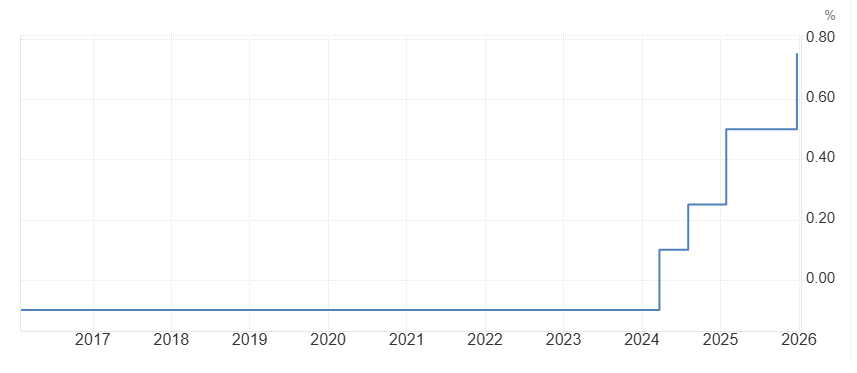
The interest rate in Japan opens a risky scenario for bitcoin
What is the risk of this scenario? If the cost of money rises too quickly, investors could be forced to sell their most liquid and volatile assets — such as bitcoin — to pay off their yen debts.
It is an effect of communicating vessels: If liquidity is withdrawn at one end (Japan), the level drops at the other (digital asset market).
Fortunately, in this recent case, the market did not collapse (at least, for now) because another factor came into play: the United States economy. The low inflation reported in the US (2.7%) suggests that the dollar could weaken, which counterbalances the Japanese situation.
Bitcoin, being a global asset, constantly moves in this balance of forces between the cost of money, monetary policy and many other global macroeconomic factors.