
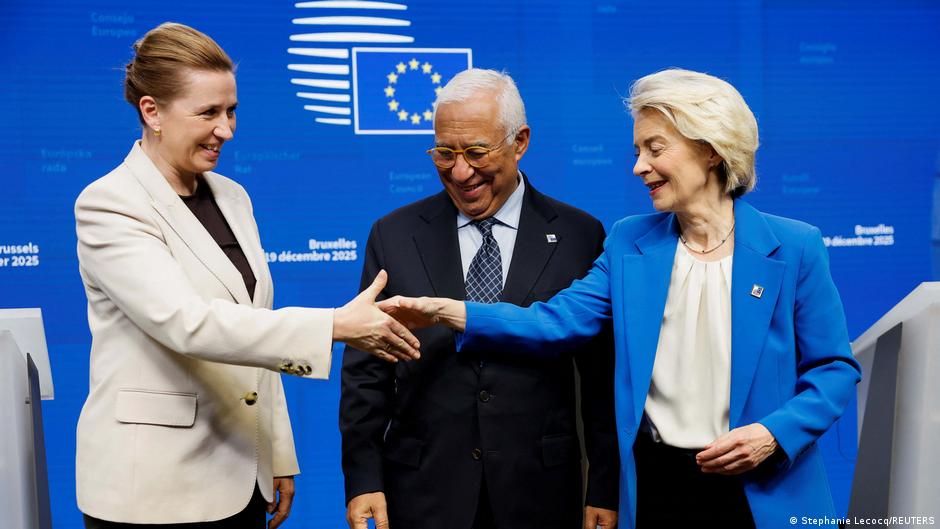
After more than 16 hours of talks, EU leaders left Brussels on Friday with the deal they had promised: a €90 billion ($105 billion) loan to Ukraine to cover most of Kyiv’s financial needs for 2026 and 2027. For a country warning of a severe budgetary shortfall caused by the ongoing war – as early as next spring, the agreement provides a vital lifeline.
“We committed, we delivered,” European Council President Antonio Costa said after the summit. It was a relief to be able to present the results in the early hours of Friday morning.
At the same time, the summit highlighted the increasing difficulty for the EU to translate political ambition into common action, especially when legal risks, diverging national interests and geopolitical pressures collide.
joint borrowing against frozen assets
Rather than using Russia’s frozen assets, the final agreement relies on joint EU borrowing. The money will be raised from financial markets supported by the EU budget and given to Ukraine in the form of interest-free loans. Kiev would have to repay it only after Russia paid war reparations. However, it is unclear whether Russia will ever agree to pay compensation.
Relying on joint borrowing was not the preferred option of the European Commission and several major capitals such as Berlin, which for months had insisted on using Russia’s frozen central bank assets. These assets are mostly held at Euroclear, a Belgium-based financial services firm. The idea was to finance Ukraine while avoiding new burdens on EU taxpayers and increasing pressure on Moscow.
That plan failed mainly due to concerns raised by Belgium. As Euroclear’s host country, Brussels argued that it faced disproportionate legal and financial risks if Russia retaliated or pursued litigation. Belgian Prime Minister Bart de Wever demanded far-reaching guarantees from other EU states, which France, Italy and others were unwilling to meet.
What does this mean for Europe’s ability to function?
The divestiture, as well as the current agreement, reveal a more fundamental question: If the legal and political obstacles to the use of Russian assets are too great now, under what conditions might they become manageable later?
In an interview with DW, Jana Kobzova, co-director of the European Security Program at the European Council on Foreign Relations (ECFR), was equally critical. “We had the option to use our influence vis-a-vis the Russians and the Americans, and we didn’t,” he said. This, Kobzova argued, called into question Europe’s ability to function as an independent and influential global player.
Tinatin Akhvalediani, a researcher at the Brussels-based Center for European Policy Studies (CEPS), agreed that the outcome was not the optimal solution, but argued that it preserved the EU’s credibility as a political actor capable of taking decisions and financing Ukraine even when under pressure., “Ukraine would get the money and that was the most important thing,” he said.
Members of the European Parliament were more critical. Iratke García Pérez, first vice-president of the Socialists and Democrats group, said the agreement “falls short” because it does not establish a sustainable funding model and leaves the financial burden on the EU rather than transferring it to Russia. He argues that although the €90 billion loan is “necessary, it cannot be the final solution.”
Unity, but with objections
The outcome of the summit allowed all parties to claim partial success. Ukraine received the funds, with proponents of legal caution avoiding a precedent-setting use of frozen assets, and others maintaining that the assets in question remained frozen and could, in theory, be used to repay debts in the future if Russia refuses to pay reparations.
But questions remain regarding unity. Three member states – Hungary, Slovakia and the Czech Republic – achieved exemption from financial guarantees linked to loans. Although they will not block the package, they will not take direct responsibility for it either.
These opt-outs underline what many analysts see as a trend towards a more fragmented form of EU solidarity. Rather than all 27 countries making decisions together and sharing risks equally, alliances are increasingly being formed on a case-by-case basis.
Akhvalediani explained that the EU is looking for agility in a rapidly changing world. He argued that a deal – even if imperfect – was better than paralysis. “We may not have complete unity in all 27 member states, but we have unity in most of them, and that at least allows the EU to function,” he explained.
EU’s role in the world is under question
The decision comes at a time when European leaders are seeking to influence any future peace talks over Ukraine, especially as the United States is sending mixed signals about its long-term commitment.
Both experts agree that continued financial assistance strengthens Europe’s claim to relevance in the peace process. However, Russia’s failure to mobilize frozen assets weakens the EU’s leverage and hinders its ability to transform from a simple “payer” to a real “player”, as Akhveldiani put it.
This has strategic consequences, ECFR’s Kobzova said, as Russian President Vladimir Putin will continue to view European leaders as secondary actors. “He is willing to talk with them on trade, but not on security. On top of that, he is very keen to keep them out and the Americans in,” he told DW.
Beyond Ukraine: EU leadership under strain
The Ukraine funding debate was not the only issue that proved divisive at the summit. Plans to finalize the long-negotiated Mercosur trade deal with the South American country have been delayed again following objections from France and Italy.
The postponement prompted criticism from former EU Trade Commissioner Cecilia Malmstrom, who said the EU had “missed an opportunity to show strength and unity,” stressing that the agreement “is not only about trade but also about geopolitics.”
Under the Ukraine agreement, the European Commission is now expected to move rapidly to issue EU-backed bonds on the financial markets, using the EU budget as a guarantee. Once approved by member states, funds could begin flowing into Kyiv as early as 2026, providing projected financing over the next two years.
For now, the immediate crisis has been brought under control. Ukraine has the funding, and the EU escaped complete failure to agree. But the summit also left a bigger question: whether Europe can match its strategic ambitions with the unity and tools needed to act decisively in an increasingly complex geopolitical landscape.
Edited by: Maren Sass