
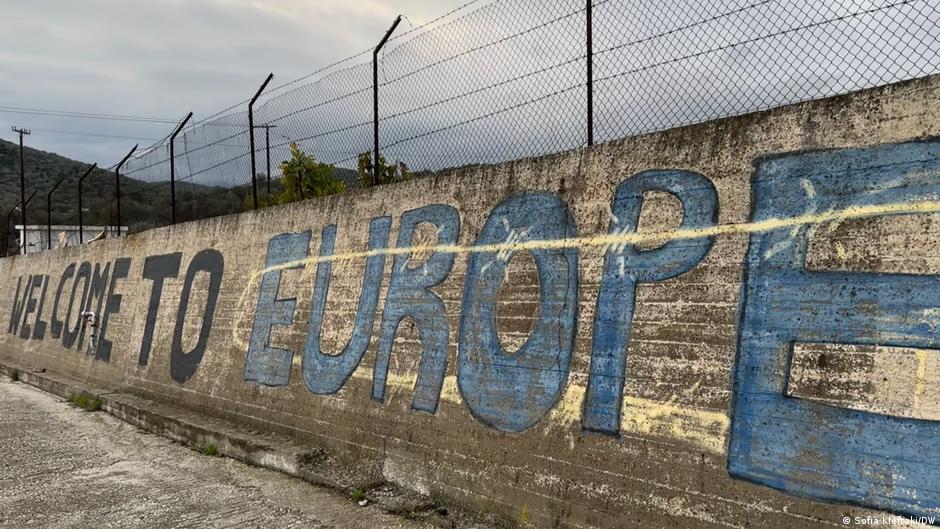
Barbed wire still surrounds the site where Moria’s refugee camp once stood.
Excavators have begun clearing the area that was once the entrance to the camp.
Although the site is no longer in use, evidence of what used to be the largest refugee camp in Europe is everywhere.
Faded graffiti is still visible on the exterior walls: “Cemetery,” “#Memoria,” “Welcome to Europe” with two stars and sad faces.
Burnt shoes, signs written in Arabic outlining measures to stop the spread of COVID-19, bandages and charred medical supplies are scattered amid the debris and ash.
In the middle of it all, a tree stands: green and intact, it rises like a ray of resilience from the scene of destruction around it.
What happened in Moria refugee camp?
DW visited the site in early December, just days after Hurricane Adele struck Lesbos and on the second day of a trial known as the Mardini Trial, where 24 aid workers are accused of helping migrants enter Greece illegally.
The trial is a reminder of how closely Moorea’s past is still linked to the island’s present.
Located just outside the city of Mytilene, the capital of Lesbos, the Moria camp was built in 2013 and became Europe’s largest refugee facility before it was destroyed by fire in September 2020.
The camp made worldwide headlines in 2015 due to the dire living conditions there, which were strongly criticized by refugees, NGOs, and even the European Court of Human Rights.
Designed to hold fewer than 3,000 people, it became dangerously overcrowded during the 2015 refugee crisis, when Lesbos saw a sudden and massive increase in the number of refugees from Afghanistan, Iraq and Syria crossing the sea from nearby Turkey to enter Greece, an EU member state.
At the time of the fire five years later, it sheltered more than 12,000 refugees in tents and temporary structures.
A new beginning?
On Google Maps, Moria is listed as “Remains and ruins of the burnt Moria camp.” It is marked as permanently closed and classified as a historic site. There is only one review: a five-star rating left by a tourist guide.
Now, the site – once synonymous with despair – is ready for a makeover that seeks to bring hope and a positive new beginning.
Plans are underway to build a music school on the site of the former camp. This is a symbolic effort to “turn the page” on the site’s past and transform the image of Moria from a place of tragedy to one of learning and creativity.
Although there is still no firm timeline for the project, partly due to financial constraints, local officials told DW that from the beginning of discussions about what to build on the site, it has been clear that the new building of the Lesbos Music School will be located here.
more than just a gesture
“Our school is spread out in temporary locations,” said school director Irini Zanelli. He told DW that the school “lacks space for proper education, a yard to accommodate all the students, and rehearsal rooms.”
According to Zanelli, the new building is not just a gesture; This is necessary as the school has been suffering from chronic problems related to its facilities for a long time.
Zanelli told DW that the building next to the OUED (Greek Manpower Employment Organization) could have been renovated for a music school. She says it is regrettable that the building was not made available, even though it would have been the quickest and simplest solution.
At present they do not have any detailed information about the construction plan of the new building.
When DW asked the Greek Asylum and Migration Ministry about the choice of Moria for the planned music school, a spokesperson referred questions to local authorities.
conscious break with the past
For the Lesbos Municipality, the project represents a conscious break with the past.
Repurposing a site filled with difficult and painful memories is nothing new. Indeed, this is an approach that has been adopted repeatedly in many countries.
The goal of such (usually political) decisions is largely strategic, namely to restore a sense of “normality” and, at least temporarily, to remove the burden of memory from the public mind.
However, for those who have lived on or near such sites, revival does not mean forgetting.
In this specific case, the decision to “turn a page” on Moria seems to signal something different: the need to develop a conscious policy for managing the memory of the refugee crisis, both for Greek society and for the refugees themselves.
“We are reclaiming this land for education and culture,” a representative of the municipality told DW. He added, “Now is the time to replace the images of suffering with something constructive.”
Are there still refugee camps in Lesbos?
Despite this conscious effort to turn a page, the effects of the 2015 refugee crisis are visible across the island.
The words “Close Moria, destroy fascism” can be seen on a court building where aid workers are on trial, while someone scrawled “Greece kills immigrants” on the wall of a bus station in Mytilene.
And there are still refugees in Lesbos.
Kara Tepe Camp is just a short walk from the charred remains of Moria and is so close that the past still seems clearly present.
The facility currently houses 1,202 people, which is about 31% of its capacity and significantly less than in previous years.
Outside the camp, people can be seen walking or cycling in slippers from a large supermarket nearby to Kara Tepe. At the entrance, a group of young men barely eighteen show DW their blue passports, which allow them to travel to countries that have signed the Geneva Refugee Convention.
The new Vastriya Camp is expected to open in early summer 2026. Although it was initially approved after the Moria fire and was scheduled to be completed in 2021, progress was slowed due to legal challenges and environmental concerns.
Vastria is located within a pine forest, a landscape that is prized for its natural beauty but is also known for the danger of forest fires – a common occurrence in Greece, especially in the summer months.
what happens next?
According to the Greek Ministry of Migration and Asylum, the Vastria camp is 95% depleted. The ministry spokesperson also confirmed to DW that it is still unclear whether Kara Tepe residents will be transferred to the new facility.
In a February 2025 press release, then-Asylum Minister Nicos Panagiotopoulos clarified that Kara Tepe would be closed after Vastriya opened, and the relocation of its residents had not yet been determined.
The minister emphasizes that the new facility and the relocation of migrants inland are intended to support both the island’s local communities and its economic development. This underlines how Lesbos is playing a central role in migration management, even as the island seeks to transform the legacy of Morea into places of learning and creativity.
On Lesbos, the trauma of Morea still resonates. Stories of migration are written into the landscape and everyday interactions, making them impossible to ignore.
It is not possible to say whether the construction of a music school can erase the painful memories. Still, for the first time since the fire, something is being built not to limit people on the site, but to create opportunities.
Edited by: Angiel Flanagan