
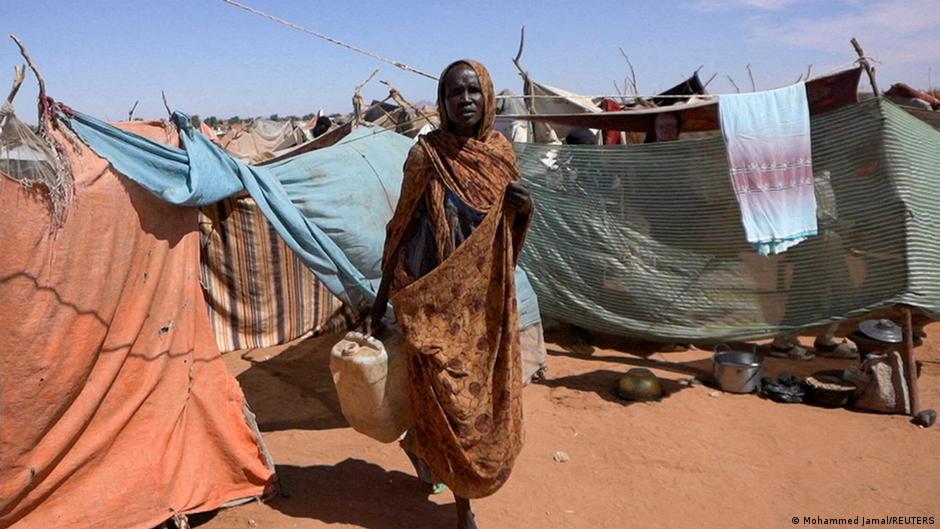
The ongoing war in Sudan is the most neglected global crisis in 2025, a survey concluded this week among 22 global aid organizations. The war-torn country has also been ranked first among the “world’s top 10 crises that cannot be ignored in 2026” by the International Rescue Committee.
Throughout 2025, the situation in the African country continues to deteriorate since the war began in April 2023. At the time, there was a disagreement between generals of the Sudanese Armed Forces, or SAF, and the paramilitary Rapid Support Forces, or RSF, over the integration of paramilitary forces into the national army. Since then, oil- and gold-rich Sudan, with its vast agricultural lands, has turned into what the United Nations and other aid organizations call the world’s largest humanitarian and displacement crisis.
According to the United Nations, about 14 million people are displaced in Sudan and neighboring countries.
The estimated death toll ranges from 40,000 to 250,000 people. More accurate or updated figures are inaccessible as fighting continues, satellite-based Internet communications are curtailed, and many aid organizations and observers have left the country.
“The Sudan crisis should be front-page news every day,” Abdurrahman Sharif, humanitarian director of Save the Children, said in a statement.
New hotspot: Kordofan
Fighting between the RSF and SAF meanwhile is centered on the region of Kordofan, where Sudanese forces control several towns that are surrounded by the paramilitary RSF.
Kordofan is also the last region separating the army-held areas in the north and centre, including the Sudanese capital Khartoum and RSF-controlled areas in Sudan’s West Darfur region and parts of the south.
“Recently, violence in Kordofan has increased dramatically,” confirms Jan Sebastian Friedrich-Rust, executive director of the German section of the NGO Action Against Hunger.
“Communities under siege in Dilling and Kadugli [in South Kordofan] Blocking access to vital humanitarian aid,” he told DW, adding that people are left with nothing to eat and no access to medicine.
“Famine has been declared [Darfur’s] El-Fashr and Kadugli, and 20 other locations in Darfur and Kordofan are at serious risk of famine by January 2026,” he said.
The dire situation is also reflected in the latest Sudan update of the Integrated Food Security Phase Classification (IPC). As of mid-December, the IPC estimates that 21.2 million people – almost half of Sudan’s population – are facing severe food insecurity.
This number is likely to increase considering the United Nations World Food Program (WFP). announcedLast Friday it said that since January, rations in Sudan need to be reduced to the “absolute minimum to survive” due to lack of funds.
“If the world does not take immediate action diplomatically, financially and morally, an already devastating situation will worsen and millions of Sudanese and their neighbors will pay the price,” Mamadou Dianne Balde, the UN refugee agency’s regional director for Eastern and Southern Africa, warned in a statement this week.
Civilians ‘at the center of war’
Action Against Hunger’s Friedrich-Rust is also concerned that Kordofan is set to become another al-Fashr, where RSF committed mass atrocities during its takeover in November.
Meanwhile, Yale University’s Humanitarian Research Lab (HRL), which uses satellite imagery to monitor atrocities, warned in a new report that RSF militias “destroyed and concealed evidence of their widespread mass killings.”
Of the 150 groups of objects matching human remains that HRL initially identified, approximately 60 are no longer visible. Instead, eight Earth disturbances appeared near the sites of mass murder, HRL said.
“The reality is that both sides of the conflict and their allies are not only failing to protect civilians, but targeting civilians is at the heart of their war,” Philippe Damm, EU advocacy director at Human Rights Watch, told DW.
He said, “Although most sexual violence, attacks on hospitals, aid workers and the use of explosive weapons in densely populated areas fall under the responsibility of the RSF, the SAF also commits large-scale violations against civilians.”
For example, the SAF has stepped up mass detentions against those suspected of collaborating with or supporting the RSF, Dam told DW on Thursday.
He warned that these detentions appeared to be extremely arbitrary as humanitarian workers were among those targeted.
“We have also received reports of a number of deaths in SAF-run prisons and we are seeing the re-emergence of the death penalty,” Dam said, expressing concern.
In his view, now is the time for the EU to step up, take stronger action and address the crimes that both sides continue to commit.
“I find it shocking that RSF leader General Mohammed Dagalo, known as Hemedti, has not yet been sanctioned by the EU, despite clear links between his responsibility and the crimes committed that we and others can identify,” Dam said.
He also appealed to the EU to address supporters of the conflict. While the SAF is primarily supported by Egypt, the RSF is reportedly supported by the UAE, even though Abu Dhabi denies any involvement.
EU help not enough
In December, the EU began delivering 100 tonnes of humanitarian aid to the Sudanese region of Darfur. The commission said the air bridge would be finished in January 2026 and cost €3.5 million ($4.1 million), funded by the EU’s humanitarian budget.
Jan Sebastian Friedrich-Rust of Action Against Hunger welcomes the initiative, but warns that it is nothing more than a drop in the ocean.
He said the end of USAID and cuts in foreign aid by European countries, including Germany, have forced life-saving programs like local soup kitchens to close.
“The need for aid is great, but so far only 35% of the financial resources needed for humanitarian assistance have been made available,” he told DW.
Edited by Ben Knight