
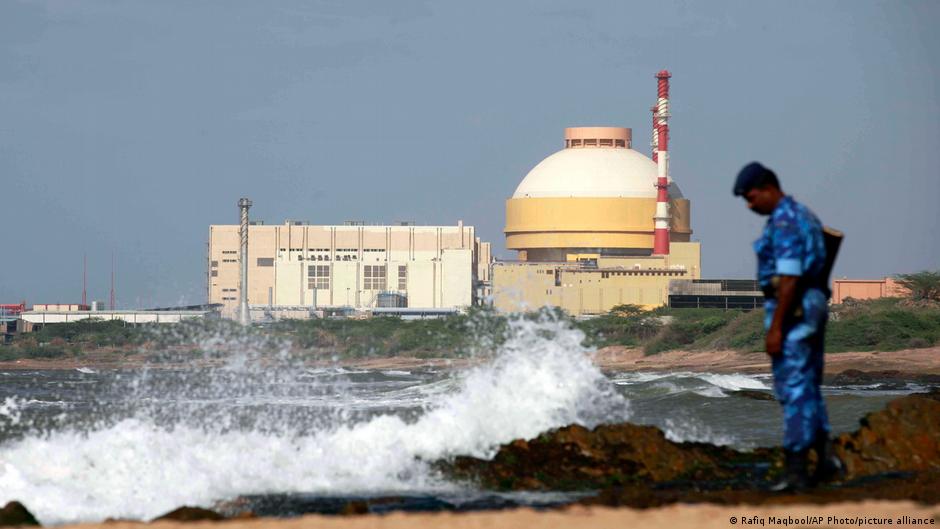
India’s parliament last week approved legislation that opens up nuclear power generation to private and foreign companies.
The historic Atomic Energy Act marks a major change for New Delhi as it moves to increase nuclear power and reduce dependence on fossil fuels to meet climate goals.
India is trying to increase its nuclear power capacity tenfold to 100 gigawatts by 2047, enough to power about 60 million Indian homes per year and necessary to achieve carbon neutrality by 2070.
Reaching this goal requires an investment of approximately 20 trillion Indian rupees ($226 billion/€193 billion), which the new law aims to achieve from private sources.
Indian Prime Minister Narendra Modi said this is “a transformative moment for our technology landscape” and also opens up “many opportunities” for the private sector.
Major Indian conglomerates including Tata Power, Adani Power and Reliance Industries have already indicated their interest in entering the country’s tightly controlled civil nuclear power sector.
Nuclear reform raises security concerns
Along with the optimism, many experts warned of potential challenges, from liability limits and regulatory oversight to safety standards, that could complicate India’s nuclear power ambitions.
Ajay Bisaria, India’s former ambassador to Pakistan, said the law removes legal barriers that had kept out American and French companies since 2010, enabling India to diversify beyond Russia.
“This reform moves India-US nuclear cooperation from a political gesture to a commercial reality. Joint Statement on Large Reactors and SMRs [small modular reactors] “Now that they can be translated into actual projects, improvements in India-US relations in 2026 are expected to provide further momentum,” Bisaria told DW.
“Licensing timelines, localization requirements, nuclear material safeguards for imported fuel, financing constraints and questions about regulatory capacity are issues.”
US interest in India’s nuclear transformation questioned
Opposition parties have alleged that India’s new law – called “Shanti” (शंती in Hindi, short for Sustainable Use of Nuclear Energy Advances to Transform India) – was rushed through to meet US demands.
The Indian reform coincides with the signing of the National Defense Authorization Act (NDAA) by US President Donald Trump on December 18.
The NDAA, a comprehensive defense policy bill, includes provisions mandating a joint US-India consultation mechanism to align New Delhi’s domestic nuclear liability rules with international norms.
India balances security with investment promotion
Jairam Ramesh, a senior member of India’s main opposition Indian National Congress party, claimed that recent changes to the country’s nuclear liability framework were pushed through Parliament to align domestic legislation with US interests.
The Government of India believes that nuclear reform is driven by India’s energy security needs and clean energy commitments.
Sameer Patil, director of the Center for Security, Strategy and Technology at the Observer Research Foundation, a think tank, said the policy change is a necessary structural reform to unlock private investment for India’s nuclear ambitions.
“However, there are several challenges such as lack of indigenous supply of fuel supply being a main concern. This makes the region and the country vulnerable to uncertainties of geopolitics,” Patil told DW.
“In my opinion the question of security and inspection is clearly a compromise between encouraging business participation and implementing appropriate security measures.”
Patil said the existing provisions of the nuclear law may seem inadequate considering the potential damage from a nuclear accident, but they are sufficient to maintain private companies’ interest in India’s nuclear expansion plans.
Doubt on the role of private sector
However, a government official familiar with the nuclear sector, speaking on condition of anonymity, expressed skepticism.
“India’s nuclear industry has consistently missed targets and the private sector’s track record of abandoning high-risk ventures like gas and hydropower raises questions about maintaining capital-intensive nuclear commitments with weak liability protections,” the official told DW.
Anil Wadhwa, a former diplomat with significant experience in nuclear and disarmament issues, told DW that India faces implementation challenges to realize its ambitious goal.
“Supply side issues include poor domestic uranium quality, the need for skilled workforce development, and inadequate manufacturing capacity for reactor components,” Wadhwa said.
Safety cap and supply gap under fire
Wadhwa said that debate is going on on serious issues.
Wadhwa questioned, “Is the liability limit of 15 billion Indian rupees ($168 million/€143 million) sufficient for major accidents, whether the regulatory body, the Atomic Energy Regulatory Board, has sufficient independence from the government, and how to appropriately balance commercial incentives with safety standards.”
The cleanup and compensation for Japan’s Fukushima disaster in 2011 cost more than $200 billion, more than 1,200 times India’s proposed liability limit.
The total economic impact of the Chernobyl accident, taking into account long-term health costs, evacuations, and contaminated land loss, exceeded $700 billion.
For foreign companies, Wadhwa said, India’s earlier Civil Liability for Nuclear Damage Act (CLNDA) of 2010 had allowed operators to sue suppliers for equipment defects, unlike global norms where only operators bear liability.
“This law fundamentally improves it by bringing it closer to international standards,” Wadhwa said.
“Foreign ownership is capped at 49%, with operational and licensing requirements in place, but the bill creates pathways to participation that did not previously exist, marking significant progress from previous restrictive regimes.”
Edited by: Keith Walker