
In mid-December, newly appointed chief executive of Deutsche Bahn (DB) Evelyn Palla unveiled a sweeping restructuring plan for Germany’s state-owned rail operator, which will take effect in 2026.
After receiving approval from DB’s supervisory board on December 10, Palla said the company would eliminate about 30% of its executive positions as part of an effort to streamline management, decentralize decision making and improve punctuality and efficiency by making the organization more agile.
The overhaul comes at a low point for Deutsche Bahn’s performance. This autumn, punctuality fell to a new record low, with only 55% of long-distance trains arriving less than six minutes late – the company’s official definition of “on time”.
Punctuality has been deteriorating for several years, making DB one of the weakest performers in Europe. For passengers, delays and cancellations have become a daily experience, especially in densely populated areas, where passengers now consider themselves lucky if every second train arrives on time.
cross border embarrassment
The crisis took an international dimension in the summer of 2024, when Switzerland banned Deutsche Bahn trains from its rail network, citing concerns that continued delays would disrupt Swiss timetables.
The decision, in clear words, exposed Germany’s decades-long failure to adequately invest in its rail system and prevent the deterioration of its transportation infrastructure.
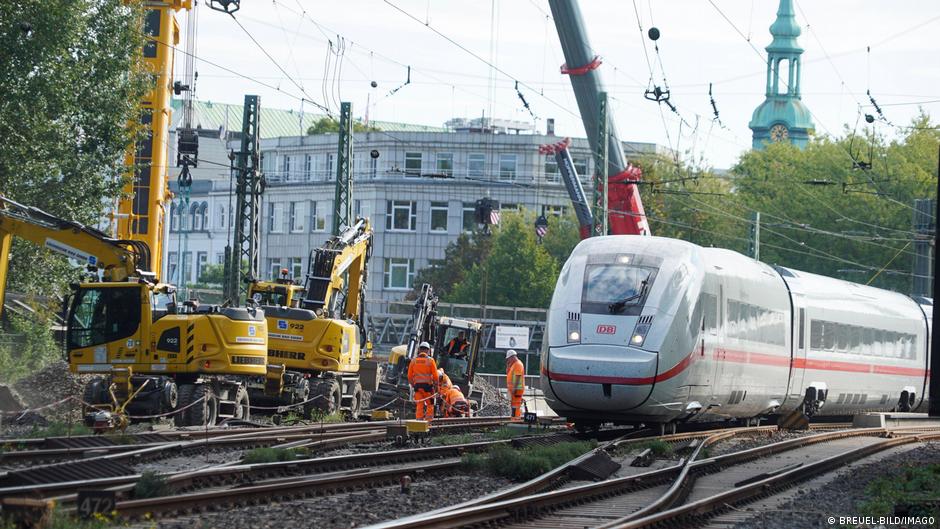
According to the German Transport Ministry, about half of the country’s rail tracks are in mediocre, poor or poor condition. About a fifth of the infrastructure will need to be replaced in the medium term, while some elements – including signal boxes more than 100 years old – require immediate attention.
three decades of decay
Over the past 30 years, Germany has spent only a fraction of what neighboring countries like Switzerland and Austria have invested in maintaining and upgrading their rail networks.
At the same time, the German rail system has shrunk despite increased demand, and more people travel long distances for work. The result is a network carrying more traffic on fewer tracks – many of them dilapidated – a combination that is at the heart of Deutsche Bahn’s problems.
Jens Kaminski, an experienced train driver who has worked for DB since 1994, remembers a very different era. At that time, the German phrase “Punktlich wie die Bahn” (“punctual like the train”) was still commonly used in Germany.
“In those days, when you walked through the village, people welcomed you like a firefighter – like a hero,” Kaminski told DW. “Today it’s more like: Oh, he’s a train driver. You’re nothing.”
Another saying was popular among railway employees: The timetable is the law. Kaminsky recalls why things were “different” during those years.
“We had 12 guys on standby at the depot. If something went wrong – malfunction, anything – they would come over and fix it. No problem. Today, the standby crews are gone. Too expensive.”
From reform to layoff
Kaminsky’s career closely mirrors the modern history of Deutsche Bahn. They began work in 1994, the same year the rail operators of East and West Germany merged to form Deutsche Bahn AG, just four years after reunification.
The new company was intended to embody market-oriented reforms. As a wholly state-owned stock corporation, the DB was tasked with becoming competitive and profitable with the long-term goal of listing shares on the stock exchange.
This was followed by aggressive cost cutting. Investments in both infrastructure and employees were reduced to make the company more attractive to investors.
“That’s when the real job cuts started,” Kaminski said. “Tracks were closed – even passing tracks that were essential. It was radical.”
The initial public offering never succeeded and the German government remains DB’s sole shareholder.
Auditors sound the alarm
Germany’s Federal Court of Audit has repeatedly criticized Berlin for failing to fulfill its responsibilities as the owner of a rail operator.
In their most recent report, auditors wrote, “For three decades, the federal government has failed to address major railway policy issues.”
Further, he added: “Deutsche Bahn has long failed to meet customer expectations for punctuality and reliability. The company is in a constant state of crisis and requires improvement.”
The court also pointed to the government’s constitutional obligation to maintain rail infrastructure as a public good and ensure reliable train services.
a swiss counter example
Switzerland faced similar challenges in the 1990s but took a different approach. Like Germany, it transformed its rail operator into a corporation, with the state as the sole shareholder.
Unlike Germany, it made clear that the primary purpose of the rail system was public service, not profit.
Peter Fugliesteller, former supervisor of Swiss rail operator SBB, says the purpose of rail infrastructure should not be “profit generating”.
“The goal is to deliver efficiency and timeliness – benefits for everyone,” he told German regional broadcaster WDR. He said that running a railway requires a management philosophy focused on reliability rather than financial returns.
Fuglistaller said, “Germany invests much less in its railways than Switzerland. If you invest much less, you cannot expect the same quality.”
Data shows that 90% of Swiss trains now run on time – a standard that the country strictly enforces, as evidenced by the ban on German trains running more than 15 minutes late.
there’s a long road ahead
Germany’s neglect of rail is often linked to its strong car culture. Over the past three decades, successive governments have invested almost twice as much in roads and autobahns (highways) as in rail infrastructure.
Still, signs of change are emerging. Palla is the first female CEO of Deutsche Bahn and the first chief executive to hold a train driver’s license. Major investments are already underway.
Of the €500 billion ($585 billion) new loan taken out by Germany’s new government to modernize the military and public infrastructure, about €150 billion is earmarked for the rail system.
However, change will not come soon for passengers. Construction and repairs are expected to cause additional disruption in the near term – meaning that even before trains can run more reliably, delays are likely to get worse.
Edited by: Uwe Hessler
Want the full story? Listen to DW’s new podcast series: Deleland: Germany and the Missing Magic
soon apple podcasts, spotify, youtube Or and somewhere else You get your podcast.