
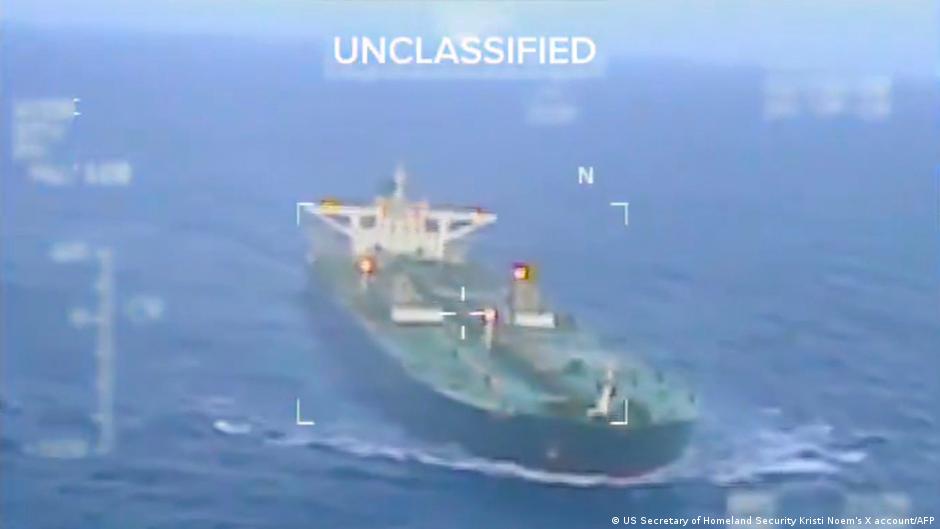
The actions of the US fleet in the Caribbean are increasingly causing concern. It’s not just alleged drug boats that are in the sights of US warships; They have also been targeting oil tankers since the beginning of December.
Experts’ assessments of Venezuela’s role in drug trafficking vary, but they all agree that oil exports are extremely important for the South American country. Venezuela’s economy may be in ruins, but it sits on the world’s largest known oil reserves, estimated at more than 300 billion barrels.
It can be safely assumed that these mineral resources also play a role in the strategic views of oil-friendly US President Donald Trump. For his Venezuelan counterpart Nicolas Maduro, they act as a lubricant for foreign relations.
But the intensity of the US conflict with Venezuela cannot be explained by oil alone. It also includes many other interests. Along with the US, the other two great world powers, China and Russia, are pursuing their respective goals in the country.
What are China’s geopolitical goals in Venezuela?
Venezuelan oil recently accounted for only 4% of Chinese oil imports, but this share is growing. The Reuters news agency quoted two market analysts as predicting that maximum daily import volumes will reach a new high this December.
China is set to import more than 600,000 barrels per day from Venezuela, the majority of its daily output. For China, Venezuela is an important oil source, primarily because it strengthens Beijing’s energy independence amid a global tug-of-war over crude. Venezuela’s oil mix is particularly well placed to do this, because the West has sanctioned it.
In return, a lot of Chinese money flows into Venezuela, including in the form of credits. According to various estimates, Caracas owes Beijing between $60 billion and $70 billion.
Venezuela is also a market for Chinese technology. Many of its weapons are Chinese-made, and its telecommunications infrastructure is largely based on Chinese components.
In September, Maduro introduced a new Huawei cellphone at a press conference in Caracas. He announced that Chinese President Xi Jinping had personally gifted him “the best phone in the world” and that US intelligence services could not possibly hack it.
Venezuela’s authoritarian-nationalist socialism is compatible with China’s state ideology. By verbally condemning the US seizure of oil tankers, as it did recently, Xi’s government could present itself as an ally. It also probably serves to keep the United States busy in its own backyard.
For more than a decade now, US presidents have been increasingly focused on the Indo-Pacific region, where China also wants to become the dominant power and is becoming increasingly aggressive in asserting its claim to Taiwan. So if the US is forced to pay more attention to the situation in Venezuela or Cuba it plays into China’s hands.
What interests does Russia have in Venezuela?
Presumably, it is also beneficial for Russia to increase its influence on allies in Latin America, challenging US dominance in the region. President Vladimir Putin first met Venezuelan President Hugo Chávez in 2001, after which Russia became Venezuela’s largest arms supplier. Putin started war with Georgia in 2008; The following year, Chávez supported Putin when Venezuela was one of the few countries, along with Nicaragua and Nauru, to recognize the independence of the breakaway regions of Abkhazia and South Ossetia.
After Chávez’s death in 2013, Maduro tried to maintain the country’s close ties with Russia. His power came under serious threat after the elections in 2019, when Juan Guaidó, then president of the National Assembly, declared himself the rightful interim president. Minutes later, Guaido received the support of the United States.
In his first term itself, Trump got a chance to get rid of Maduro. But then Russia sent two military planes carrying troops and equipment.
“In a way, Moscow saved Maduro,” Vladimir Ruvinsky, a political scientist at Colombia’s ICESI University, told DW. “For the first time since the Cuban Missile Crisis, the United States was forced to negotiate directly with Russia on the situation in Latin America.”
However, in the current crisis, Ruvinsky does not think Russia will decisively support Maduro. So far, support from the Kremlin has been only verbal.
Where is America going?
In a post on Truth Social in mid-December, Trump demanded that Venezuela return all “oil, land, and other assets that they stole from us in the past.” This may be a reference to the expropriations that occurred when the Venezuelan oil industry was nationalized in 2007 – not all American companies were compensated. Only Chevron is still active in the country by special arrangement.
Oil production in neighboring Guyana is much more attractive to American companies. Venezuela also claims Essequibo, a region bordering Guyana. As far as US oil interests are concerned, there are two strong arguments in favor of removing Maduro from power.
In his first term, Trump significantly expanded sanctions imposed by his predecessor Barack Obama and launched his first test of strength with Maduro. His security adviser at the time, John Bolton, described Venezuela, along with Cuba and Nicaragua, as the “triangle of terror”.
Bolton was removed by Trump after US support for Juan Guaido failed to achieve its goal. But Trump still hopes for regime change in Venezuela and is now more determined than ever.
This article has been translated from German.