
Bitcoin would no longer be considered experimental, but would be normalized as an asset.
Ethereum would consolidate itself as an institutional infrastructure for stablecoins and tokenization.
In 2026, the cryptocurrency industry enters a stage defined by the consolidation of infrastructure, regulatory maturity, and the advancement of institutional integration. According to CoinShares, the new cycle is marked by the shift “from the speculative narrative to the utility narrative,” a change that reorganizes both the demand for bitcoin (BTC) and the direction of technological investment in the sector.
In your report annual, which is now reviewed by CriptoNoticias, CoinShares describes a scenario in which bitcoin will definitively lose its label as a technological experiment and will align with the behavioral patterns of a conventional financial asset. This will make BTC conditioned by the same macroeconomic forces that govern traditional markets.
At the same time, the associated infrastructure—especially stablecoins, tokenization, and settlement networks— will move towards transversal adoption between banks, technology companies and global businesses, according to that company.
For CoinShares, 2026 will be a pivotal year. One in which the trends that emerged in 2024 and were affirmed in 2025 will be consolidated in a hybrid ecosystem where financial institutions, decentralized protocols and AI-based applications will coexist.
This process redefines not only the demand for bitcoin, but also the role of Ethereum, Solana, miners and venture capital.
The axes of this new panorama are detailed below.
1. Bitcoin and macroeconomics
CoinShares states that in 2026 “bitcoin will complete its transition from a perceived experimental asset to a normalized one within institutional portfolios.” This process, he maintains, is driven by a clearer regulatory environment, the expansion of the options market and the strengthening of flows linked to bitcoin ETFs traded in the US. The firm summarizes this change with a forceful phrase: “Bitcoin becomes normal.”
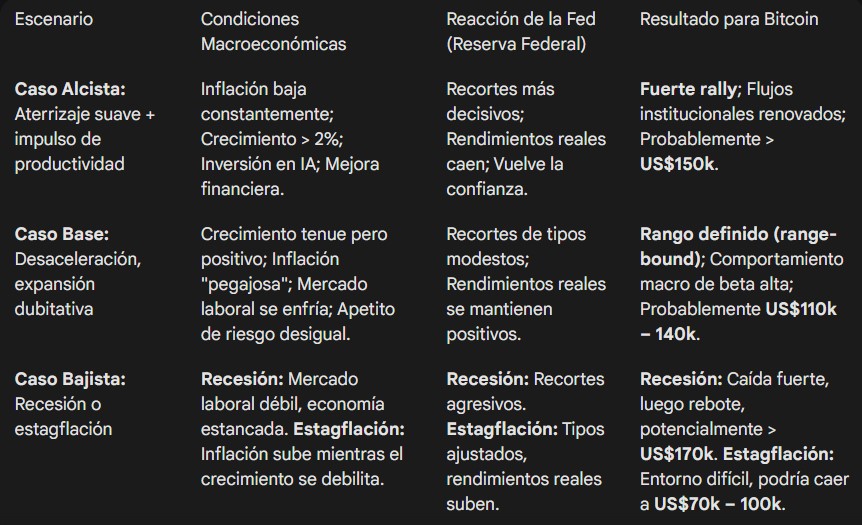
The report’s macroeconomic analysis sets out three possible scenarios and explains how each would shape institutional demand. In the optimistic scenario, CoinShares describes “a combination of soft landing, AI-driven productivity improvement, and more decisive rate cuts.” A framework that—according to the firm— would encourage risk taking and would put bitcoin above USD 150,000.
In the base scenario, the most probable, the entity projects “subdued growth, positive real returns and a prudent Federal Reserve (FED).” That would translate into more stable market behaviortaking bitcoin to $110,000 – $140,000 next year.
The bearish scenario is defined as “the threat of stagflation or recession with rising real yields,” an environment that would pressure ETFs and strengthen defensive flows. Here, BTC would reach USD 70,000 – 100,000 dollars.
2. Hybrid finances (HyFi) and stablecoins
CoinShares dedicates a segment of its report to the consolidation of stablecoins as payment infrastructure and the arrival of hybrid finance (HyFi).
The entity explains that this is shaped by the tokenization of real-world assets, stablecoins as digital settlement avenues, institutional activity on public networks, rapidly expanding ETF markets, and the rise of revenue-generating on-chain financial applications.
“Each of these areas are evolving rapidly and together they demonstrate the extent to which traditional financial systems are beginning to interact deeply with decentralized network-based networks.”
CoinShares, analysis and research firm.
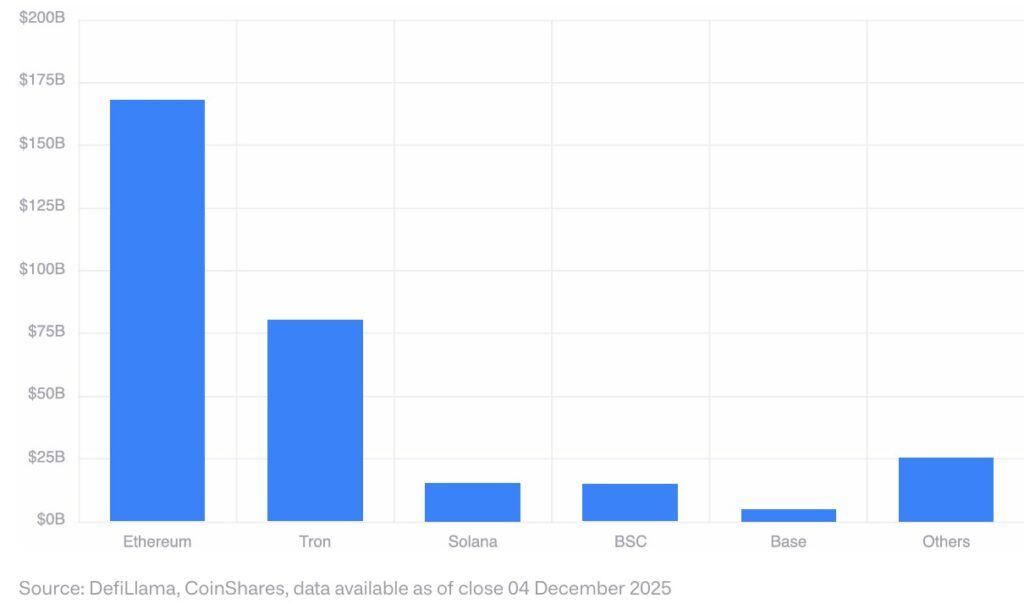
However, the report highlights stablecoins as a pillar of hybrid finance. This, remembering that this market already has a capitalization that exceeds USD 300,000 million, with large exponents such as Ethereum and Solana controlling the sector. This is how they show it:
CoinShares highlights that stablecoins “already rival Visa and Mastercard in aggregate volume.” At the same time, it predicts that the US GENIUS Act will transform this growth into sustainable expansion in 2026. This, as it will establish a regulatory framework based on 1:1 support, mandatory audits and guaranteed redemption rights.
For the analysis firm, the result of all of the above is clear: “Stablecoins will become a central component of the global payments system.”
Likewise, CoinShares highlights that asset tokenization (RWA) plays a leading role in hybrid finance. The report maintains that tokenized Treasuries and private credit “will move from pilots to commercial operations at scale.” This, while tokenized deposits will multiply.
3. The race for decentralized networks
The report states that Ethereum “has ceased to be an experimental laboratory and has become an institutional infrastructure,” especially due to its role in the issuance of stablecoins and regulated tokenization. CoinShares highlights that the network and its second-layer solutions already function as “the backbone of regulated digital assets,” a role that—according to the firm— It will be reinforced in 2026 with improvements in efficiency and safety.
Regarding Solana, CoinShares maintains that in 2026 “it will consolidate itself as the leading platform for consumer, payments and high-frequency applications.” According to them, the network is positioned to compete “not just with Ethereum, but with traditional financial networks in specific use cases.”
The document also notes a shift toward specialized networks in 2026. CoinShares states that “general purpose chains will lose ground to architectures designed for specific functions.” And they cite Hyperliquid as an example of specialization in derivatives, having processed over $2.8 trillion in cumulative trading volume and generating an annualized revenue rate of over $1.15 billion.
4. Mining and infrastructure
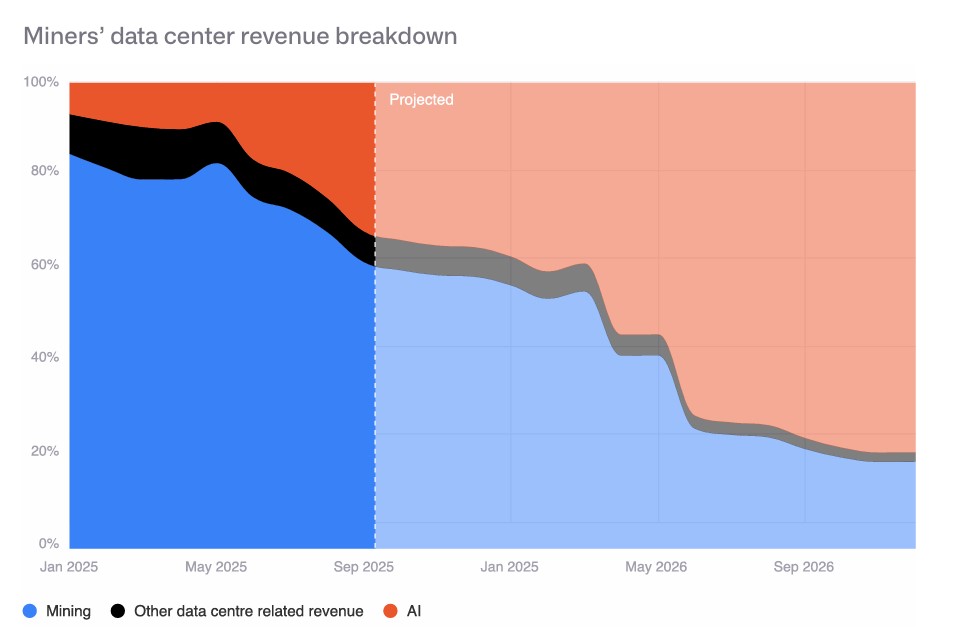
CoinShares describes a profound change in the mining industry. According to the report, “miners have begun an aggressive diversification into high-performance computing (HPC) and artificial intelligence.” It, driven by the need to stabilize income and improve margins.
The firm assures that for many companies “revenues from mining will fall to less than 20% of the total”, given the growing weight of HPC contracts. This is how they reflect it:
The report maintains that Digital mining will become more industrial and concentrated. CoinShares claims that “ASIC manufacturers and sovereign states will dominate large-scale mining.” This, while small players will resort to modular models based on idle energy.
He also anticipates that some countries will use digital mining “as a strategic tool to manage energy resources and monetary reserves.”
5. Venture capital and emerging issues
CoinShares notes that venture capital returned to the sector thanks to an improvement in global financial conditions. The firm reports that “2025 recorded the highest levels of investment since 2022”, with a shift towards projects with concrete utility.
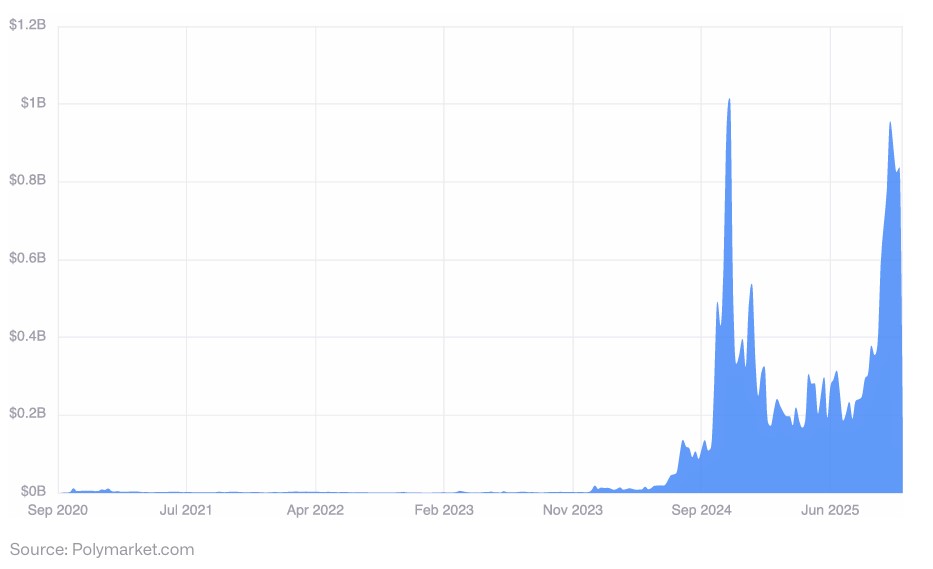
In this framework, prediction markets occupy a special place. CoinShares describes Polymarket as “a more accurate probability source than traditional surveys.” This, added to the fact that this cryptocurrency betting platform maintained a weekly trading volume that was close to USD 1,000 million, as seen in the following graph:
The report projects significant growth in applications where AI agents interact on public networks. CoinShares claims that these will “turn open infrastructure into native terrain for automated trading.”
He also foresees renewed interest in projects focused on expanding the usefulness of the Bitcoin protocol, especially in upper layers oriented to infrastructure.
6. Regulation
The report concludes that regulatory fragmentation will continue. CoinShares explains that “the United States will continue to be the main capital center, despite the lack of a unified framework.” This, while Europe “will maintain an advantage in regulatory clarity thanks to MiCA.”
Asia is moving, according to the firm, towards “prudential regimes aligned with Basel”, and the United Kingdom continues to build its own model.
Full integration of bitcoin and cryptocurrencies in 2026
CoinShares projections for 2026 describe an inflection point rather than a simple trend reversal. The integration of bitcoin into the traditional financial architecture, the rise of stablecoins as a new global settlement layer, and the consolidation of Ethereum and Solana into distinct functions reveal that the ecosystem no longer operates on the margins, but rather within the heart of the economic system.
The report states, in essence, that The sector abandons its status as an experiment to become infrastructure. This transition does not imply the absence of risks nor does it eliminate the tensions generated by regulatory fragmentation, macroeconomic evolution or technological dependence. But it does suggest that the foundations built over the last decade are beginning to support a growing volume of real economic activity.
For CoinShares, 2026 will be the year in which the discussion stops revolving around whether digital assets can be integrated into the financial system and focuses on how, when and at what pace they will do so.