
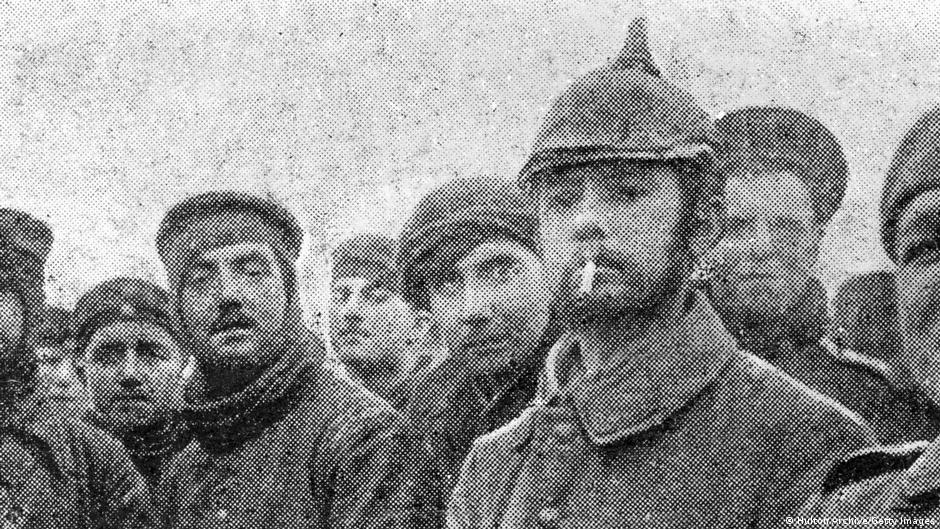
December 1914. World War I had been going on for five months. Millions of soldiers faced each other in the trenches of the Western Front, sometimes just 30 meters apart, amid landmines and barbed wire fences. The war zone extended from the English Channel through Belgium and France to the Swiss border.
As the war progressed, the soldiers huddled in their dugouts, where rats, lice, cold, and spoiled food left them exhausted and death looming over them. Beyond the trenches, between enemy lines, lies the muddy hell of No Man’s Land, where the bodies of fallen comrades lie just out of reach.
disillusionment at the front
The war had already taken hundreds of thousands of lives – English, French, Belgian and German – blown to pieces by hand grenades, riddled by machine-gun fire and wounded in hand-to-hand bayonet fighting. Many German soldiers rushed into battle believing victory was at hand. They thought they would be home to their families by Christmas – at least that’s what German Emperor Wilhelm II had promised. The French and British also believed their leaders when they said that the troops would soon return home. But disillusionment soon surfaced. Every day, people were facing death, even on 24 December. How can one get into the Christmas spirit under such circumstances?
‘Silent Night, Holy Night’
Then something unexpected happened. In the middle of a cold December night, a German soldier in the trenches near the Belgian city of Ypres begins to sing “Silent Night”. More and more men became involved. The British on the other side of No Man’s Land could not believe their ears. “Silent Night” was also famous in England.
At first, the British did not trust the “Huns”, as they derogatorily called the Germans, and wondered if they were being led into a trap. But then they clapped and started singing along. The Germans responded with calls of “Merry Christmas” and shouted, “We don’t shoot, you don’t shoot!” The first brave soldiers from both sides came out of the trenches, stood among the bodies of their dead comrades and joined hands.
Similar scenes played out across much of the Western Front. At Fleurbach, near the English Channel, German soldiers set up decorated Christmas trees on the banks of their trenches. The bright light comes from candles, not muzzle flashes.
Christmas tree, gifts and football
The German High Command delivered thousands of trees to the front lines to boost morale. Leaders knew how difficult it was for soldiers to be away from their loved ones on Christmas Eve.
Typically, making bright candlelight visible to the enemy violates strict restrictions, and makes it impossible for snipers to move unnoticed into no man’s land. That night, none of it mattered.
On December 28, 1914, Joseph Wenzel of the Bavarian Reserve Infantry Regiment 16 wrote to his parents, “What I am about to tell you sounds incredible, but it is true.” Amidst the trenches, bitter rivals stood around a Christmas tree and singing Christmas carols. I will never forget this scene as long as I live.
That night thousands of soldiers exchanged small gifts, exchanging corned beef for sausage or Dresden Stollen for plum pudding. They shared wine, rum and cigarettes and showed each other photographs of their brides, wives and children. Uniform buttons were exchanged as souvenirs. Most of the men were British and German, but some French soldiers also joined the truce, and brought out their stores of champagne for Christmas.
He also played football using German spiked helmets and British field caps as goalposts. A hard ball of straw or tin could often be used as a ball, although in some places the British managed to produce genuine leather. A soldier of the Scots Guards wrote to his parents, “We sent someone on a bicycle to the rear, to our reserve position,” and he brought the ball back.
a short-term ceasefire
There was something else dearer to the hearts of men on both sides: the chance to bury comrades who had fallen in no man’s land. These were moments of humanity in a brutal war.
Young officer Alfred Dougan Chater wrote to his mother, “I don’t know how long this will last.” “At any rate, we are having another truce on New Year’s Day, because the Germans want to see how the pictures came out!”
Not everyone on the Western Front was in a mood to make friends with the enemy. In some areas the fighting never stopped. This is exactly what senior officials on both sides wanted. He was a staunch opponent of the Christmas Truce and believed that such displays of friendship should never be repeated, even being viewed as treason.
“It is terrible,” a German soldier later wrote home, “that one day you can converse with each other so peacefully, and the next day you have to kill each other.”
Peace over war – a pipe dream?
World War I ultimately cost the lives of approximately 9 million soldiers along with countless civilians. Joseph Wenzel was killed in battle on 6 May 1917 – two and a half years after writing to his parents: “Christmas 1914 is one I will never forget.” More than 100 years later, wars still rage around the world – in Ukraine, Sudan and Congo. Yet the soldiers of 1914 showed how simple peace could be: lay down your weapons and go to your enemy. Or is it just a pipe dream?
This article was originally written in German.