
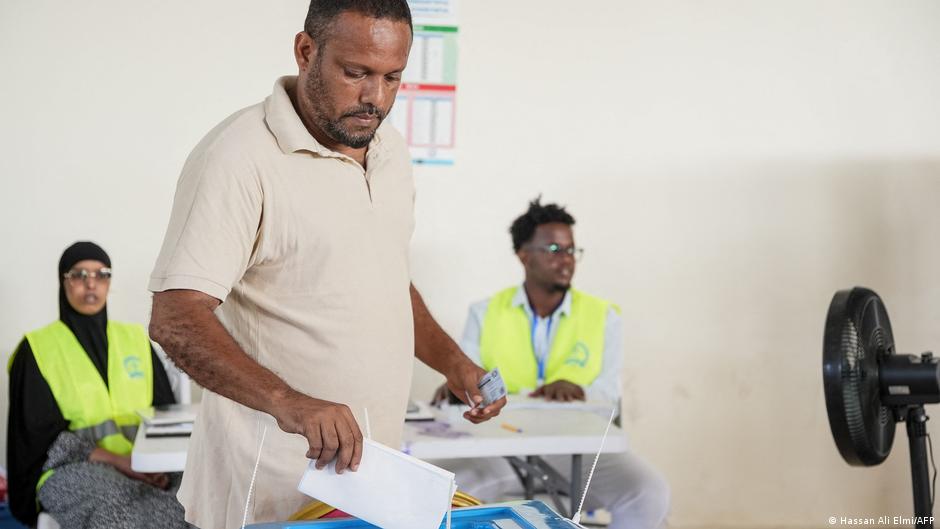
More than 10,000 security personnel have been deployed in Somalia’s capital, Mogadishu, as hundreds of thousands of voters are expected to turn out to the polls in the country’s first direct elections in decades.
The local vote in the capital city marks the re-introduction of the “one-person, one-vote” principle for the entire African country.
“This is my first time to vote,” AD Issac Abdi, 65, told Reuters news agency. “I am very happy and came here early in the morning with other mothers,” she said.
“The poll shows that Somalia is on its feet and moving forward,” National Election Commission member Abib Hayer told Reuters. “After the local elections, elections can and will be held across the country.”
Al-Shabab is seen as a threat to nationwide elections
Despite these claims, many are questioning the feasibility of nationwide elections in the county which is still battling an Islamist insurgency. The powerful al-Shabaab militia controls large swathes of Somalia’s territory and has also launched deadly attacks in the capital. Due to security concerns, Somali authorities closed Mogadishu Airport and closed roads to vehicle traffic on election day.
The last direct vote was held in 1969, before dictator Siad Barre took power. After Barre’s fall in 1991 the country switched to a clan-based power sharing system, where clan representatives elect legislators who in turn select the country’s president. Universal suffrage was only legally restored last year, and the Mogadishu vote in 2025 has been delayed three times.
Now, the city with a population of about 30 lakh is set to directly elect its local representatives from over 1,600 candidates fielded by 20 political parties.
Elections ‘stage-managed’ in Mogadishu
However, some opposition parties have criticized the Mogadishu vote as a ploy to keep President Hassan Sheikh Mohamud in power, calling the process flawed and one-sided.
“There is almost zero civilian participation in this. It is mostly a government and security forces operation,” security analyst Samira Gaid was quoted as saying by AFP news agency.
He described the process as “stage-managed” to make the poor, war-torn nation “look like a democracy.”
With parliament’s mandate ending in May 2026 and President Mohammed’s first term ending in April, the country’s political elite is divided over direct elections. This summer, Mohammed struck a deal with some opposition leaders that parliamentary representatives would be directly elected, but the presidency would still be decided in parliament, which his rivals see as an attempt by the president to boost his own re-election chances.
Some Somali states have threatened to run their own election processes if agreement is not reached.
Edited by: Louis Olofse