

Pippin (PIPPIN), a memecoin operating on the Solana network, defies the market’s bearish trend and registers a weekly rise of more than 30%.
Thanks to this momentum, it enters the top 100 by capitalization and becomes the cryptocurrency with the highest gains of the week within that group.
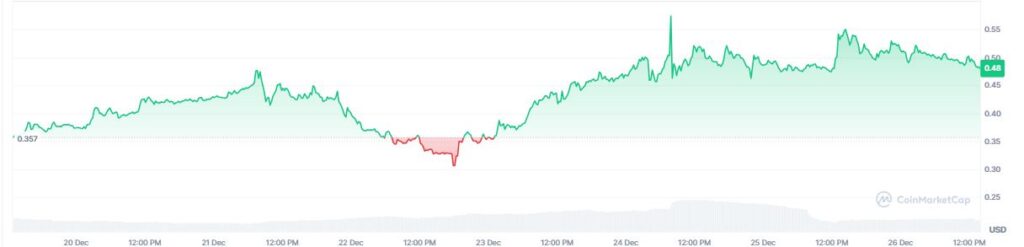
At the time of publication of this article, memecoin is trading above $0.48as seen in the following graph:
Pippin was born as a creative experiment by venture capital investor Yohei Nakajimacreator of the autonomous agent capable of managing tasks and objectives independently, called BabyAGI.
Using ChatGPT 4, Nakajima generated an SVG image. It is a vector-based format that allows the image to be scaled to any size, without losing quality, of the unicorn called Pippin, along with its personality and backstory.
This image evolved into an autonomous AI agent capable of posting on X (Twitter), drawing, interacting, and living in a “simulated world.”
The community launched the token on Pump.fun, a memecoin creation platform. Nakajima endorsed him publicly buying a part, which gave it legitimacy within the Solana ecosystem.
The total supply is approx. 1 billion tokens, with almost 999 million in circulation.
What is happening with the price of this asset?
Researchers at Bubblemaps, an on-chain data research platform, they warned that PIPPIN presents a high risk to investors due to the concentration of tokens.A small group of insiders controls 80% of the supplyvalued at 380 million dollars. This suggests that the price could have been artificially inflated.
Bubblemaps researchers identified 16 new wallets that show suspicious behavior similar to those previously observed in PIPPIN.
These addresses appear to be coordinated, as they received funds from the HTX exchange on very tight deadlines. This suggests an organized funding pattern.
It should be noted that HTX is one of the largest cryptocurrency exchanges on the market, which was previously known as Huobi, as explained by CriptoNoticias.
Furthermore, the researchers indicated that each wallet received very similar amounts of sunny (SUN)which reinforces the idea that these transfers were not random.
Before these operations, the accounts had no previous activity. A fact that It adds to the evidence that allows us to speculate that they were created specifically for this purpose.
Lastly, wallets withdrew a large percentage of PIPPIN from centralized exchanges (CEX), possibly to consolidate control over the tokens or prepare strategic moves in the market.
All of this, for Bubblemaps researchers, points to possible manipulation by a coordinated group of insidersincreasing the risk for other investors.