

There are 5 XRP ETFs in the US market.
The magnitude of these funds is small, compared to the total capitalization of the asset.
Exchange-traded funds (ETFs) based on the XRP cryptocurrency have managed to raise $1.14 billion in net capital since their arrival in the US market.
Despite this constant flow of institutional investment, the cryptocurrency issued by the company Ripple has not reflected a proportional impact on its market price, maintaining a lateral performance in recent days.
Currently, five investment products dominate this offer on Wall Street, being managed by the firms Canary Capital, 21Shares, Bitwise, Grayscale and Franklin Templeton, as reported by CriptoNoticias.
The dynamism of these financial instruments is evidenced by a streak of 28 consecutive days of capital inflowsas seen in the image.
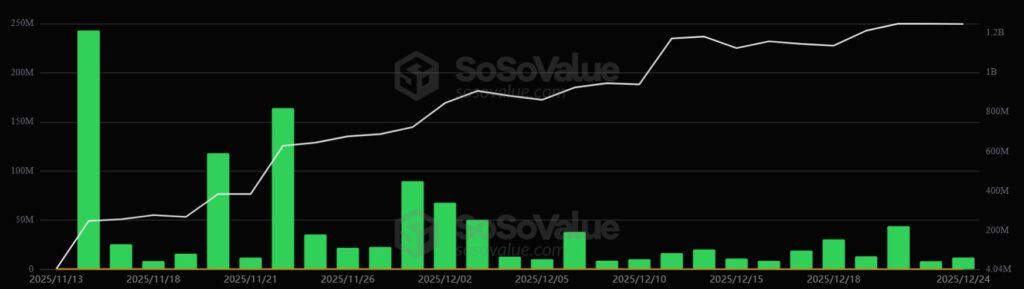
This movement has been led by the Canary XRP ETF, which registers an accumulated net flow of $385 million. In total, The assets under management of these funds total 1,250 million dollarsa figure that, although significant in terms of stock market adoption, represents only 0.98% of the total circulating supply, which amounts to 99 billion units of the digital currency.
This marginal proportion explains why the buying pressure in the markets has not translated into a substantial increase in the price of XRP, which stands at $1.83 after a slight advance of 2% weekly.
The magnitude of the funds is still small compared to the total capitalization of the asset, which means that the volume traded in the ETFs is not enough to displace the global liquidity of XRP. While institutional adoption on Wall Street remains in an early phase, the spot market continues to be governed by supply and demand dynamics much larger than current capacity absorption of listed funds.