
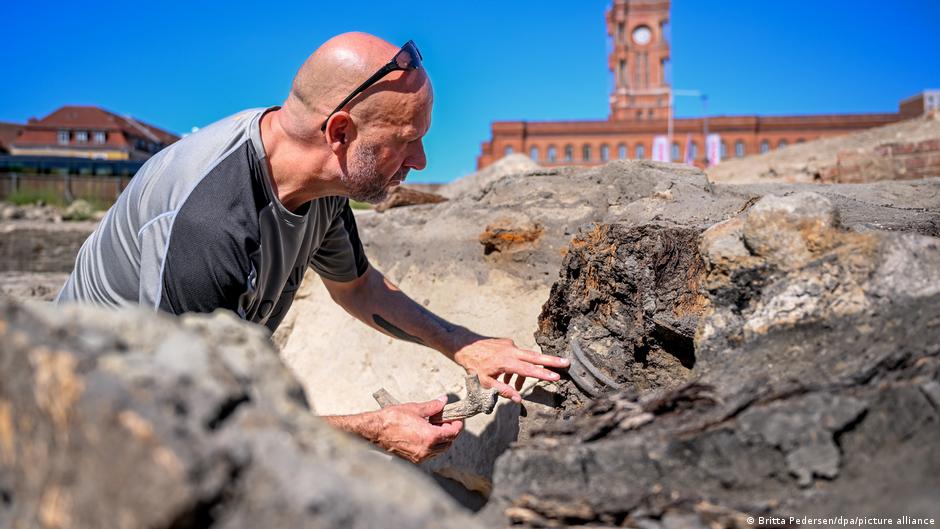
What’s the story behind the sawed-off goat skulls repeatedly found in the ground beneath Berlin? There are often small things that reveal something about times gone by, says archaeologist Eberhard Volker of the State Office for the Protection of Historical Monuments. He and his colleagues suspect that goat brains were a popular snack in medieval times.
Volker is leading excavations at the Molkenmarkt in the historic center of Berlin. Digging out the past with shovel, trowel and brush. At a depth of four meters, researchers reach the Middle Ages: the birthplace of Berlin. The city’s ground level has risen by exactly four meters in 800 years due to debris and debris from the fire. “This is where Berlin began,” he says, pointing to the mounds of earth behind him.
toilet treasure
Mölkenmarkt is one of Germany’s largest inner-city excavations – a giant hole covering more than 22,000 square metres. Once the asphalt and concrete are removed, archaeologists can begin carefully digging up the earth beneath. They have been working here since 2019, digging Earth’s secrets out of the ground. Researchers have already located 750,000 individual objects.
Eberhard Volker holds a thick wooden plate, a rare find. It has been well preserved but the smell is terrible. This is no surprise when you consider that it spent centuries in a toilet, a medieval cesspool. Even after 800 years, the smell of feces still clings to it. When deprived of oxygen, organic materials such as wood, cloth and leather resist decay. That’s why archaeologists often find their greatest treasures in old latrines or dry wells, which also served as dustbins for medieval cities.
Volker’s favorite find is a small clay statue of St. Catherine, who, according to legend, was tortured and beheaded for her Christian faith. It probably adorned the home altar to protect the family from bad luck.
An item of particular value is a rare gold ring with a garnet. Perhaps while they were fetching water it slipped from someone’s finger and fell into the well? And an obscure brown piece of silk is evidence of trade with China in the early years of Berlin’s existence. Apart from this, a bone flute of 14th century has also been found.
Petrie: House of Berlin’s Treasures
Molkenmarkt is considered to be the oldest market in Berlin. Volker and his colleagues are bringing to light a hidden archive of Berlin’s history. Archaeologists regularly conduct guided tours of the site. Interest is very high and they are always fully booked.
Archaeologists are being allowed to investigate the soil for the next two years, before filling the huge excavation site and building on it. Everything Volcker found has been subject to thorough scientific documentation, analysis and interpretation, creating a vast data repository of Berlin’s past.
But where to keep them all? Turns out, the objects don’t have to travel far. In fact, only a few hundred meters away from PETRI, a new museum that opened in the summer of 2025. It was built on the walls of the medieval St Peter’s Church, which was heavily damaged during World War II and later demolished, and a Latin school, the foundations of which are on display in the basement.
PETRI is already popular with both school groups and foreign tourists. This is a chance for Berlin to show that it has other stories to tell besides the usual ones about the Golden Twenties, the Nazi era and the building of the Berlin Wall. The history of Berlin is also medieval. An unknown side of the city, which is important to know in depth.
Like other museums, PETRI also exhibits objects in glass cases – for example, a child’s shoe from the Middle Ages. But this goes one step further. Through large windows, visitors can watch restorers doing their work in open workshops. As well as breathing life into a forgotten chapter of the city’s history, the museum also aims to spark interest in archaeology.
A new resting place for the dead
Down in the basement, the museum has a surprise up its sleeve: a fresh bouquet of flowers has been placed against a wall, and above it are the words: “May the angels lead you to heaven.” There was once an ancient cemetery in the St. Peter’s Church complex. The remains of hundreds of people were exhumed during excavations and have now been ceremoniously reburied in an ossuary: here, the skeletal remains of some of Berlin’s first inhabitants are stored in drawers. And they tell life stories, even if anonymous ones. A book of the dead records their fate: decaying teeth, a complex fracture, another who died too young.
When is Berlin’s birthday?
Scientific bone analysis has revealed that Berlin is much older than previously thought. The city’s 800th birthday is scheduled to be celebrated in 2037, but it is quite clear that this milestone birthday was actually celebrated several decades earlier.
The PETRI roof terrace overlooks the bustling traffic and Berlin’s built-up city centre. Just a few meters below lie the city’s medieval roots, destroyed by history. With the Molkenmarkt excavations and the Petrie Museum, archaeologists like Eberhard Völker are hard at work bringing one of the city’s untold stories to light, piece by piece.
This article was originally written in German.