

The bitcoin (BTC) market is going through a profound reconfiguration phase. Currently, bitcoin ETF investors and spot market buyers show very different behaviors in the face of volatility.
While BTC price registers a decline of 36% Since its historical maximum, the capital managed within ETFs has barely lost 9%. This implies that ETF holders have not fallen significantly under the pressure exerted by the price of the crypto asset.
The following graph shows that the cumulative flow of ETFs (black line) and net outflows (red bars) contrast with net inflows (green bars), which remain moderate. Cumulative net inflows reached an all-time high near $62 billion in October; Subsequently, outflows in November and December totaled $5.6 billion.
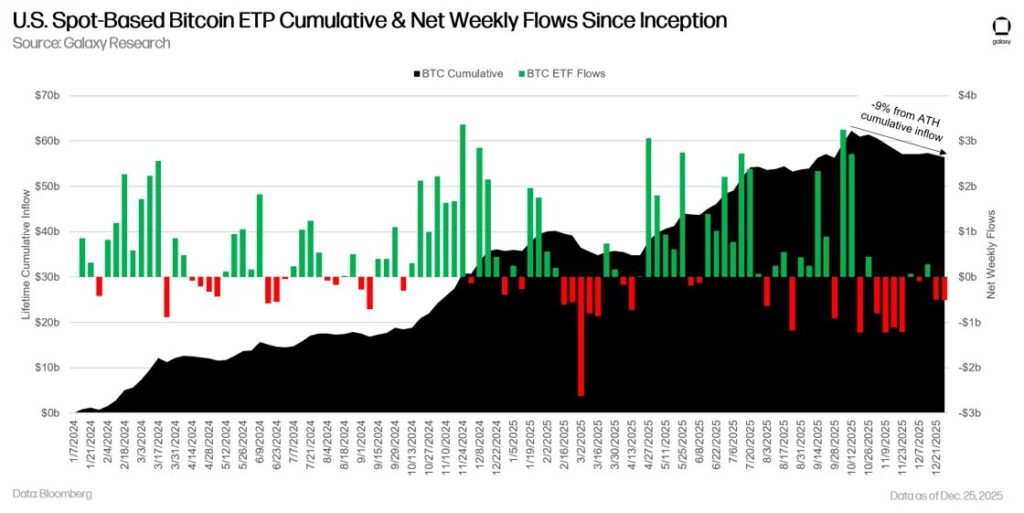
Behavior of bitcoin ETF investors and buyers
The divergence seen in the chart above suggests that institutional capital and investors trading through traditional brokerage accounts They act as a “strong hand” that absorbs volatility without giving in to panic where spot buyers come in.
For their part, BTC buyers in the spot market, which usually include speculators with greater leverage, prove to be more likely to liquidate their positions in the face of uncertainty. The historical behavior of these participants reflects a shorter time horizon, which increases selling pressure during corrections to protect profits or avoid forced liquidations.
This capital rotation suggests that former holders and native speculators are selling their BTC, while institutional investors use the ETF as their primary vehicle. This despite reporting weak performance so far in December, as reported by CriptoNoticias.
By treating digital currency as a rebalancing component within diversified portfolios alongside stocks and bonds, this sector shows less emotional friction. The resilience of institutional flows projects a favorable outlook for the medium term and consolidates a demand that is not easily undone in the face of cyclical market corrections.