
At the end of a small street in the Beirut neighborhood of Ras Beirut, a faded poster points the way. If you follow the sign, go up a steep path to the left and go through a heavy door, you will find yourself among tall bookshelves. Unpublished volumes about novels, political analysis, culture and history of the region.
A few steps further, around the corner you will enter another room. And here the atmosphere changes, it becomes more dense and colorful. This is where poster heaven begins. Vibrant colors, so many faces, and typographies spanning over a century of trends in print.
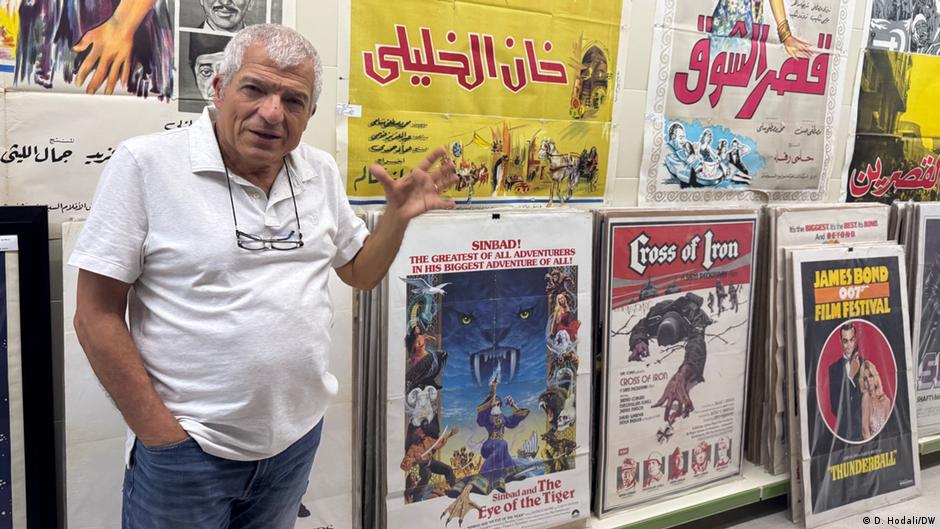
There, at the back of the shop, sits Abboudi Bou Jaoude, friendly, easy-going, always ready to tell a story. Behind them were Lebanese and Egyptian film posters from the 1960s and 70s, along with posters from Iraq, Tunisia and Morocco. In between are magnets, postcards and coasters. A collection, but one that is alive and ready to evoke memories.
“This store is an archive not just for Lebanon, but for the entire region,” says Bou Jaoude. With over 20,000 posters, his collection is considered to be the largest of its kind in the region. Many posters now hang in private homes – and even in the nearby Café Cali, where film lovers drink espresso while gazing at the faces of the iconic Lebanese singer Fairuz or the young Saba.
a life in cinema
“I was going to the cinema since I was six,” says the 66-year-old. “My father always took me with him, he was the director of various cinemas in Bourj Hammoud, a predominantly Armenian suburb of Beirut.” While other children played football, Bou Jaoude was sitting in the dark enjoying his town’s cinema.
Around the age of 14, he began collecting cinematic memorabilia, initially unconsciously, as he always found posters from theaters. This was in the early 1970s.
He said, “Like many teenagers at that time, I was not particularly interested in Arab films, I was more interested in foreign films. But I liked reading Arabic books.”
Beirut, the region’s former film capital
To understand why Bou Jaouady’s collection is so unique, it is important to learn about the role that Lebanon played in Arab cinema.
Officially, the first Lebanese film was made in 1929, but local production long remained in the shadow of the Egyptian film industry. With Lebanon’s independence and economic boom, this changed. The 1960s were a golden age and Beirut became a regional center of literature and film. In 1965, UNESCO opened the Arab Cinema Center in Beirut, a regional center for film and the first of its kind in the Arab world. In 1971, Beirut hosted the first International Film Festival in the region.
Beirut also had more than 300 cinemas, where new films were played every week. “For many people, the cinema was the first destination,” says Bou Jaoude. “Before the Civil War, people went to the cinema every week.”
It all ended abruptly with the civil war, which lasted from 1975 to 1990 and almost destroyed the cinema landscape. Bau Jaude preserved what was left – film by film, poster by poster. Decades later, he compiled this knowledge into a book, a comprehensive documentation of Lebanese cinema through posters from 1929 to 1979.
a collection of arab societies
He never imagined that one day he would be considered one of the most important collectors in the field. He says that he did not understand the importance of these posters until the 1990s. “At the beginning of my collection, I didn’t realize what I was contributing.”
Today he sees every poster as a historical document. “These posters are an expression of what society wanted at that time, what it was interested in and what it wanted to see in cinema, what it dreamed of.”
Yet his collection includes much more than just Lebanese film posters. During his work as a publisher – he founded Al Furat Publishing House in 2000 – he regularly traveled to the region.
One of their most valuable sub-collections comes from Iraq; He has about 4,000 posters from there. “I always made sure to take an extra two or three days to see the local cinema (n): The man who saved L… Mess. And there, I would always ask if I could get a poster.”
Other posters in his collection come from places such as Tunisia, Morocco, Libya and the Palestinian refugee camp in Yarmouk, Syria. In the 1960s, when Egyptian films were banned in Syria, small cinemas carefully preserved their posters. “The employees would often sell them to me for a few lira.”
Sometimes he found posters that were long lost in the country from which they came. Egyptian films were banned in Iraq during the time of former Egyptian President Gamal Abdel Nasser. He explains, “So the reels of the film were smuggled through Lebanon to make it look like the film came from here.”
Between nostalgia and identity
Many visitors to the store are young Lebanese looking for something that connects them to a past they know only from stories, he notes. Others no longer live in the country. “Many people have moved abroad and are looking for something that reminds them of home or tells them something about their parents’ or grandparents’ past.”
He often sees the reaction on the faces of people who saw films in theaters or heard about them from their families. “When people come here and see the poster of singer and actress Fairuz, they remember a time when many people pushed aside. People have forgotten a lot because of the war.”
When asked if he had a favorite poster, he smiled almost apologetically. “I can’t decide, but I especially like posters from the 1960s and 70s.” This sounds like the answer to the person who knows every movie, every color, every crease of the poster and wants to preserve them all.
If you go back to the road to Ras Beirut, you miss some part of this place. The feeling that the past never disappears, as long as someone protects it. That’s what Bou Jaoude is doing, if quietly, modestly, in a shop that is more a cultural and emotional archive than a business.
This article was originally published in German.