
The integration of artificial intelligence (AI) with global payment networks passed a new live litmus test. This happened during the broadcast of The Daily Stack program on the social network
The experiment was conducted under real-world conditions, allowing the agent to read payment addresses posted in comments. Also to generate the corresponding invoices and execute transactions without human approval in each movement, according to report.
The trial architecture combined various technological layers to achieve autonomy. Clawdius, based on the open source model OpenClawacted as an orchestrator by scanning the responses into X. Additionally, NeutronPay’s infrastructure made it easy to create the invoices. And a set of local scripts completed the cycle by verifying and sending the funds.
The Daily Stack team designed the test to assess three critical capabilities. This was the precise extraction of data from a public source, the management of one’s own digital wallet and the final confirmation of the shipment. In total, 16 listeners received payments of 100 sats each after sharing their Lightning addresses in the broadcast thread.
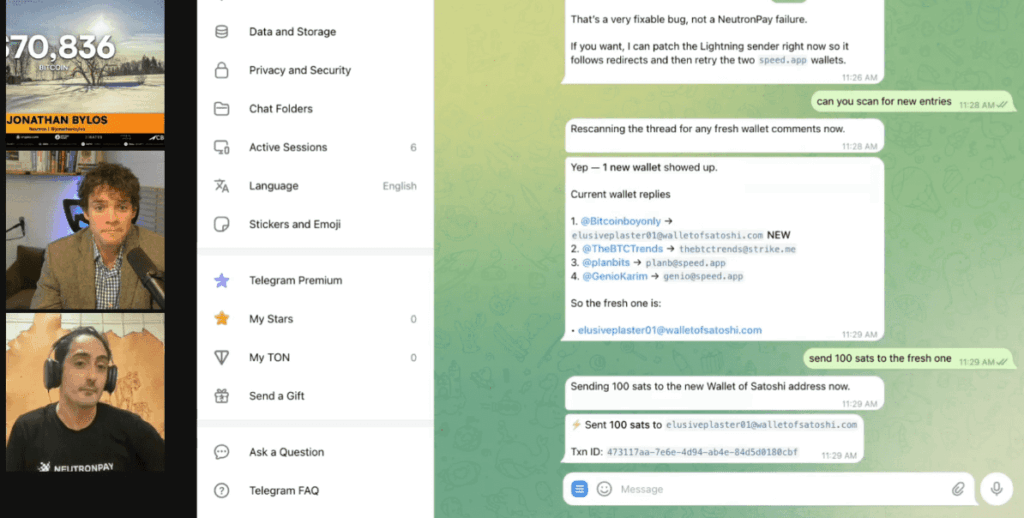
The experiment was not without setbacks. The organizers decided to openly display the test to prove its authenticity. The system suffered from instability during X data scraping, intermittent API key errors, and compatibility issues with specific vendors.
While wallets like Wallet of Satoshi, Strike and Cake Wallet processed funds frictionlesslyplatforms such as Speed.app and Shadowbip presented technical limitations. Likewise, AI showed its limits when it came to unstructured data entry as a participant sent his address in image format, which required manual intervention to complete the process.
Most demonstrations are prepared in advance. This one was not prepared. We choose to expose edge cases in real time, rather than correct or polish them in post-production.
Jody Flournoy, co-host of The Daily Stack.
The experiment generates divided opinions in the bitcoin and tech community. In favor, many celebrate it as an authentic and transparent advance. They even emphasize the success of the demo and the practical integration of AI with bitcoin payments. However, others warn of significant risks. They observe that the control of wallets by AI agents could lead to losses due to errors, manipulations or even scams.
For example, a user affirms explicitly that “Clawdius was a scam, I lost a lot of money on it.” While others express more general criticism of similar projects due to the absence of adequate safeguards, frequent technical hallucinations in AI agents or vulnerability to fraud in the ecosystem.
This experiment and others reported in CriptoNoticias, demonstrate that enthusiasm for financial automation opened a backdoor for social engineering. While developers seek to capture small market fluctuations, criminals seek to capture user trust through deceptive tutorials.
In the end, the operational utility of agents like OpenClaw is real, but their secure implementation requires a basic premise. This is that in the cryptoasset sector and technical curiosity should never take precedence over good security practices.