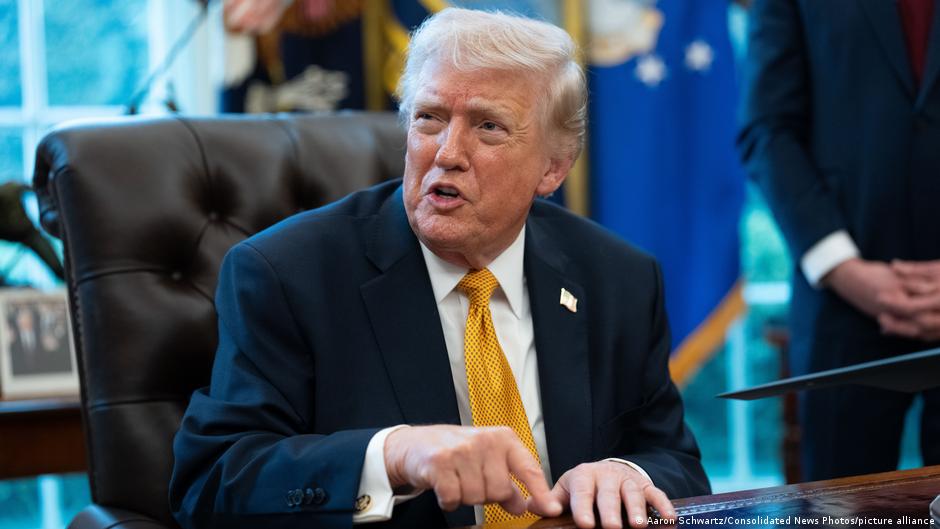
US President Donald Trump has asked China to postpone his planned visit to Beijing due to the Iran war. “I think it’s important for me to be here,” Trump said Monday in Washington. The move comes as the US-Israel war with Iran expands and the United States faces increasing military and economic pressure. The conflict could reshape Washington’s priorities and strain delicate relations with China.
Trump was scheduled to stay in Beijing from March 31 to April 2. His visit was highly anticipated due to the deep strategic and commercial rivalry between the United States and China, a rivalry that has intensified under Trump’s tariff campaign.
On Tuesday, Trump said the trip would take place “in five or six weeks.” He said, “We are working with China. They have no problem with it.” On Sunday, he suggested the timing may depend on whether China helps open the Strait of Hormuz, which Iran has effectively closed in response to US-Israeli attacks.
No agenda yet?
“Both China and the United States will continue to maintain communication regarding President Trump’s visit to China,” Chinese Foreign Ministry spokesman Lin Jian said at a news conference on Wednesday.
This will be Trump’s first visit to China in his second term and was originally intended to stabilize relations after years of tensions over trade, technology and the military balance in the Indo-Pacific.
John Seaman of the Center for Asian Studies at the French Institute of International Relations (IFRI) told DW that the delay sends a clear signal. “Postponing the long-awaited visit to Beijing certainly suggests that Trump is becoming bogged down in the Middle East, as the US has often done in the past, and thus he is losing focus on China.”
Seaman said that despite plans for a meeting between US and Chinese officials in Paris, the trip has not yet been fully prepared. “Such a trip requires months of serious planning and negotiation,” he said. “Xi Jinping is not a makeshift leader. It is likely that such a poorly prepared visit would not have achieved much. Delaying it gives both sides more time to sort things out.”
“Iran may be part of the story, but it’s not just Iran. The main factor in the postponement is Paris, where the two sides met and could not reach a consensus about what Trump and Xi will talk about in Beijing,” Klaus Soong, an analyst at the Mercator Institute for China Studies (MERICS), told DW.
The delay has revived concerns in China about Trump’s credibility as a negotiating partner. “In Beijing’s view, the postponement shows that mutual trust is eroding,” Soong said. “Trump’s unpredictability is definitely something Beijing is worried about.”
Reshaping Iran was among the priorities
According to the US military, at least 200 soldiers have been injured since the attacks on Iran began on February 28. Thirteen US service members are killed. US-based Iran human rights group HRANA said on Monday that more than 3,000 people have been killed inside Iran so far.
This conflict is spreading throughout the Middle East. Iran has launched missile attacks on Gulf countries that host US bases. The Strait of Hormuz, one of the world’s most important energy routes, is now effectively closed to oil exports due to fears of mines and attacks. Only “dark transit”, ships with automatic identification systems, possibly linked to Iran, are still operating.
Global shipping and energy prices have soared. Trump has asked major importers, including China, to send naval assistance. But analysts say Beijing, which views Tehran as a partner, is highly unlikely to get involved.
“Beijing knows that time is not on the US side. They can sit back and wait,” Soong said. “If the war drags on and the Strait of Hormuz remains closed, oil reserves will soon run out. This will put a lot of pressure on Trump, especially since he is facing midterm elections.”
China, the biggest buyer of Iranian oil, may be less vulnerable to the crisis as it is said to have the world’s largest oil reserves. It also continues to import oil from Iran, Soong said. This gives Beijing leverage in negotiations with Washington.
peace in trade war
The summit in Beijing was aimed at stabilizing the trade and technology truce Trump and Xi agreed to in Busan for the end of 2025. “There is a balance, but it is a balance of intimidation,” Soong said. “This is a break, not the end of the competition.”
China had responded to Trump’s tariffs and US export controls on computer chips by imposing controls on rare-earth exports to the United States. It kept some of these restrictions in place even after Washington withdrew the tariffs.
Trump now wants progress on farm purchases before the midterms. More Chinese imports of American poultry, beef and crops could help him court farm-state voters. “But it would also be good for China if it reaches a deal with Trump to ease economic pressure on its export-oriented economy,” Soong said. Beijing wants lower tariffs and fewer US export controls.
Tension increased regarding Taiwan
Security issues are increasing pressure. Reuters reported last week that a $14 billion arms package for Taiwan was ready for Trump’s approval. This can be announced after his visit to China. The package is expected to include advanced air-defense systems.
Beijing views this as an act of provocation, Soong said. “For the Chinese government, it is a blow to whatever positive environment both sides have tried to create. And Beijing cannot expect Trump to say he opposes Taiwan’s independence – its core interest.”
Beijing says Taiwan is part of China and has warned it will use force if necessary to bring the island under its control.
Iran has not yet been able to change global rivalries, but it highlights a trend, Soong said. “This is not a turning point yet. But it shows that during Trump’s second term, we may see a shift in US-China competition as the US becomes less popular and less able to mobilize allies.”