
Gold fell 2.25% and silver 4.88% in three hours.
Bitcoin has been affected trading below USD 70,000.
The precious metals market experienced a massive contraction during trading today, March 19, when gold and silver erased approximately $912 billion from their total capitalization in a span of just three hours.
this fall that subtracted 715,000 million dollars from gold and 196,000 million from silver (according to calculations made by CriptoNoticias based on market capitalization and asset prices) responds to a tightening of expectations regarding the monetary policy of the United States Federal Reserve (FED).
During this period, the price of gold fell 2.25%, going from $4,715 to $4,609 per ounce, which marked the breaking of the technical support of $4,700. For its part, silver registered a decline of 4.88%, falling from $71.50 to $68.01 per ounce.
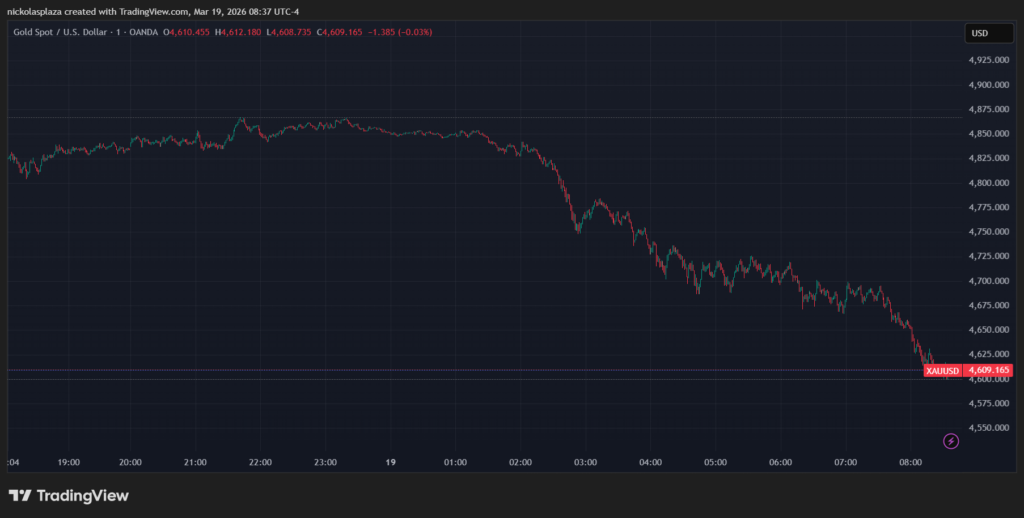
The bearish dynamic has intensified since the gold metal reached its all-time high of $5,600 on January 29, accumulating a loss close to $1,000 per ounce since then.
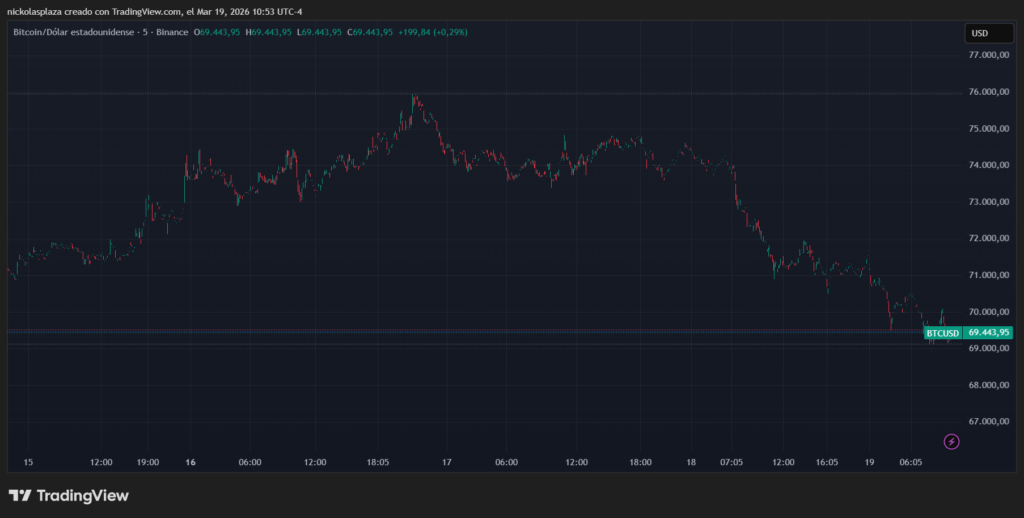
In this context, bitcoin (BTC) also fell in price, momentarily trading below $70,000, reflecting a shared sensitivity to the macroeconomic scenario of the United States.
Interest rates and inflation pressure
The main trigger for this movement lies in the restrictive stance of the monetary authorities of the United States, the world’s main financial power. FED Chairman Jerome Powell warned yesterday that interest rates would remain at 3.75% year-on-year. “If we don’t see that economic progress, then they won’t see the rate cut,” the official said.
Powell also warned that he will not reduce interest rates if the economy does not show clear signs of progress in the fight against inflation, as reported by CriptoNoticias. This determination arises after learning that wholesale inflation in the United States registered a year-on-year increase of 3.9% in February 2026, a figure that not only exceeded the 3.7% anticipated by the market consensus, but also accelerated compared to the revised 3.5% in January.
When rates remain high, investors often migrate towards fixed income instruments, such as Treasury bonds, which offer guaranteed returns and become more attractive compared to physically holding metals. In addition, high rates tend to strengthen the dollar, which makes the acquisition of gold more expensive for buyers who use other currencies, thus reducing its overall demand.
In this scenario, the economist Peter Schiff pointed out that gold and silver are falling again as investors realize that rising inflation rules out the possibility of cutting interest rates. In Schiff’s view, markets are not correctly assessing long-term risks: “But they don’t realize that as long as the Fed keeps rates stable, inflation will skyrocket. By the time it acts, not even a 6% interest rate will be enough to control it.
Geopolitical conflicts and the asset market
The uncertainty is aggravated by the escalation of war in the Middle East, which began on February 28, which has affected energy infrastructures in Iran and Qatar. Although these events traditionally boost safe-haven assets, the rise in oil to $112 per barrel has generated the opposite effect by fueling expectations of persistent inflation.
All this puts pressure on metals and bitcoin, generally considered a “risk” asset. whose price reacted downward from $75,884 on Monday, March 16up to $69,433 on the current day.
For influencer and trader David Battaglia, gold is repeating the pattern you experienced bitcoin in the crypto winter of 2022. This reading is supported by the theory of fractals, which suggests that Price structures tend to repeat over different time scales and assets when the psychological conditions of investors are similar.
Battaglia identifies three key stages in this process of technical deterioration that begins with “a retail-fueled parabolic rise in exchange-traded funds and China, followed by the formation of two peaks identical to those of the digital currency that signal the exhaustion of buyers.”
Under this interpretation, the market moves by “pure mimicry” following technical patterns regardless of fundamentals, which would lead to a final phase of liquidations due to the “bankruptcy of investors and central banks who will sell gold to defend fiat money.”
“Markets repeat themselves, that’s why we can predict them with technical analysis, thus managing our portfolios,” said Battaglia. At the end of his analysis, he warned that, following previous gold cycles that must be repeated as fractals by the law of technical analysis, a 50% correction and a bear market with a minimum duration of between 10 and 30 years could be expected.