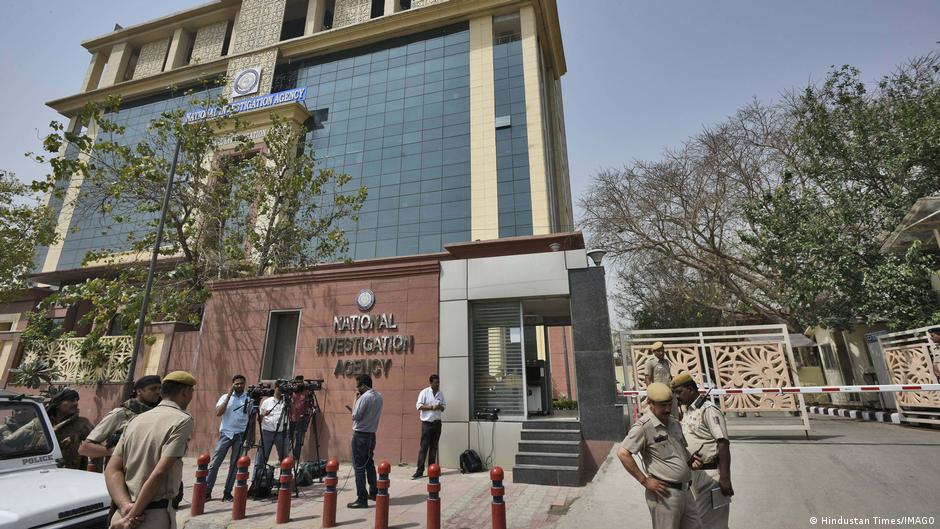
High-profile investigations against foreign nationals are intensifying in India. Six Ukrainian nationals and an American are accused of violating the country’s anti-terrorism laws and have been detained by the National Investigation Agency (NIA). He will be kept in custody for questioning till March 27.
NIA sources told DW that the case could also take a political turn as it is possible that Russia may have provided information about Ukrainian citizens to New Delhi.
Ukrainians and American nationals were arrested at the airports of Calcutta, Lucknow and Delhi on 13 March. Little is publicly known about him. According to NIA and court documents seen by DW, the Ukrainians are named Petro H., Taras S., Ivan S., Marian S., Maxim H. and Victor K. Are.
DW adheres to the German media code of conduct under which media outlets do not publish the full names of suspects.
Matthew V., a US citizen, reportedly participated in the Iraq War and the Libyan Civil War after 2011, as well as the war in Ukraine. He also founded a Washington-based security consulting firm called Sons of Liberty International. According to its website the company is non-profit and “provides free security consulting and training services to vulnerable populations so they can defend themselves against terrorist and insurgent groups.” The website says the company was also involved in training troops in Ukraine who are fighting Russia in the war there.
Indian officials: Detained Ukrainians are part of a larger network
According to the NIA report and its remand presentations before the court, the group entered India legally on tourist visas, but then traveled eastwards to Mizoram state, a region where special permits are required for foreign nationals, which they did not have.
From there, they entered Myanmar illegally through informal routes at the India-Myanmar border, investigators allege.
Investigators suggest that the seven arrested may be part of a larger network. According to their information at least 14 Ukrainian citizens entered India on tourist visas on different dates, traveled to the Indian city of Guwahati and then to Mizoram without the required permits.
From illegal border crossing to terrorism charges?
The Ukrainians and Americans detained by the NIA were initially charged only with unauthorized presence in India’s Mizoram state and allegedly illegally crossing the India-Myanmar border. However, at a court hearing on March 16, prosecutors laid out additional charges, stating that the detainees were involved in training armed groups based in Myanmar as well as in operating drones and in the illegal import of large consignments of drones from Europe to Myanmar through India.
Investigators said the training focused on drone warfare, including assembly, deployment and jamming techniques.
Armed insurgent activity along the India-Myanmar border dates back to the 1960s, when Indian insurgent groups used Myanmar’s remote border areas as bases for operations, including attacks on Indian security forces as well as arms and drug smuggling.
The 2021 military coup in Myanmar strengthened ethnic armed organizations in areas such as Chin State, bordering India’s Mizoram. India views it as a security concern given the porous 510-kilometre (317 mi) border, which enables the movement of fighters, weapons and illicit networks across the border.
Ukraine has supplied armored personnel carriers and other military equipment to Myanmar since 2015 and continues to do so after the military coup in 2021. In September 2021, human rights activists in Myanmar urged Kiev to stop its military cooperation with the junta.
Did Russia leak intelligence?
According to DW’s sources in the NIA, Russian officials may have shared intelligence about foreign nationals. The Ukrainian Embassy in India also pointed to the “potentially planned and politically motivated nature of the case”.
In a statement published on its website, the embassy rejected “any hint about the possible involvement of the Ukrainian state in supporting terrorist activities” and said Ukraine “has no interest in any activity that could pose a threat to the security of India.”
“Ukraine is a state that faces the consequences of Russian terrorism on a daily basis and, for this reason, takes a principled and uncompromising stance in combating all forms of terrorism,” the statement said.
There was an immediate response from Moscow. Russian Foreign Ministry spokeswoman Maria Zakharova accused the Ukrainian Foreign Ministry of “remaining silent on violations of India’s anti-terrorism law by its citizens” and “baselessly accusing some Indian and Russian news agencies of deliberately falsifying facts.”
Ukraine’s Foreign Ministry reported that, so far, there was no evidence linking the detained Ukrainians to any illegal activity in India or Myanmar.
It also said that despite established international norms, Kyiv was not officially informed about the arrests. In response to a request from DW on March 18, the ministry said that Ukrainian consuls were not allowed access to the detainees. Although diplomats helped organize legal representation and attended court hearings, they were not given the opportunity to speak directly to the detainees, the ministry said.
Pramod Kumar Dubey, the lawyer for the detained US citizen, also rejected the allegations and called the detention illegal, citing violation of the Vienna Convention on Consular Relations.
NIA source: Case brings together two wars
Meanwhile, India’s security establishment is taking the matter seriously. “This episode ultimately emphasizes that conflicts that appear geographically distant are no longer isolated from each other,” a senior NIA official told DW on condition of anonymity.
“The movement of combatants, the transfer of technology, and the emergence of informal logistics networks are increasingly tying together different theaters that are difficult to track and difficult to regulate,” he said.
This article was originally written in Ukrainian.