Australia and the European Union agreed to a new trade deal after eight years of negotiations.
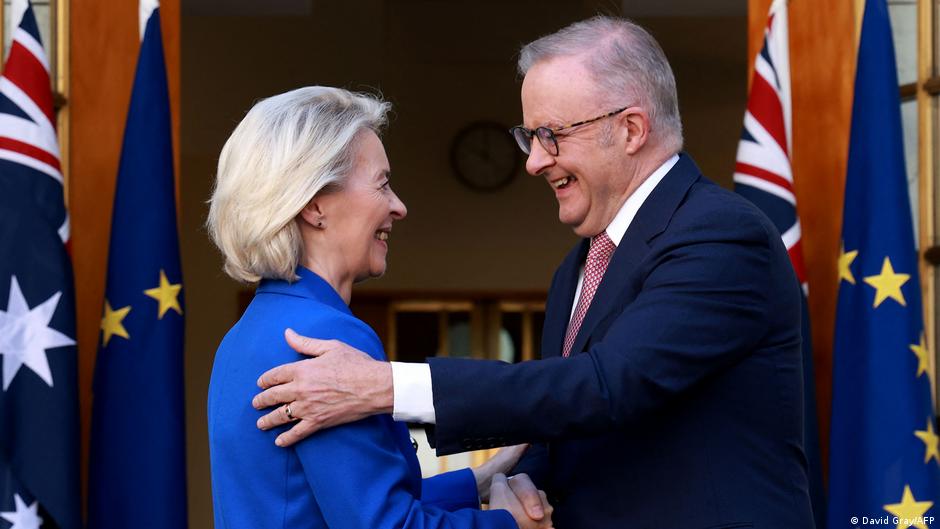
EU chief Ursula von der Leyen and Australian Prime Minister Anthony Albanese announced the agreement at a ceremony in the Australian capital, Canberra.
This is the latest trade agreement signed by the EU to diversify trade as Europe faces challenges from the United States and China.
Albanese and von der Leyen also agreed on a security and defense partnership.
“The EU and Australia may be far apart geographically but we couldn’t be closer in terms of how we see the world,” European Commission President Ursula von der Leyen said after meeting Prime Minister Anthony Albanese in Canberra.
“With these dynamic new partnerships on security and defence, as well as on trade, we are moving even closer together.”
Albanese described the deal as a “pivotal moment” for Australia.
The European Union is Australia’s third largest two-way trading partner and second largest source of foreign investment.
What’s in the new EU-Australia trade deal?
The agreement will remove more than 99% of tariffs on EU goods exports to Australia, cutting duties for companies by €1 billion ($1.16 billion) a year, according to the AFP news agency.
Australian tariffs will be zero for wine, sparkling wine, fruit and vegetables and chocolate from day one, and zero for cheese in year three.
European carmakers will benefit from Australia raising the luxury car tax cap on electric vehicles, with three-quarters of EVs now eligible for exemption.
Australia will also reduce tariffs on imports of critical minerals.
According to a European Commission press release, the agreement could lead to a 33% increase in EU exports to Australia over the next decade, with the strongest growth seen in daily goods, motor vehicles and chemicals.
The agreement reached resolved major bottlenecks in EU market access for Australian beef.
For beef, the EU will open two tariff rate quotas totaling 30,600 tonnes. This includes duty-free entry for 55% of grass-fed beef, while 45% will enter with a reduced duty of 7.5%.
However, it will be phased in over five years to protect EU farmers.
Australian media previously reported that the local livestock industry was originally pushing for 50,000 tons per year duty-free.
The EU will allow a quota of 25,000 tonnes of Australian grass-fed sheep and goat meat to be phased in over seven years.
EU to allow Australia to use protected names
Negotiations have stalled in the past over the right of Australian wine and cheese producers to use names such as Prosecco, Parmesan and Feta on locally produced products.
These are protected product names (known as protected designations of origin) in the European Union and can generally only be used on products coming from specific regions and made in a certain way.
But Australia will be allowed to continue using certain geographical designations, such as Feta and Gruyère, where producers have used it for at least five years.
Australian winemakers will be allowed to make and export Italian-style sparkling wine under the ‘Prosecco’ label, but will have to stop using it for export after 10 years.
Australian Trade Minister Don Farrell said in early March that the trade deal would add 10 billion Australian dollars ($7.1 billion, €6 billion) to Australia’s trade in the first year.
The agreement is expected to be formally signed after getting approval from the European Council and the Parliament of Australia.
edited by: