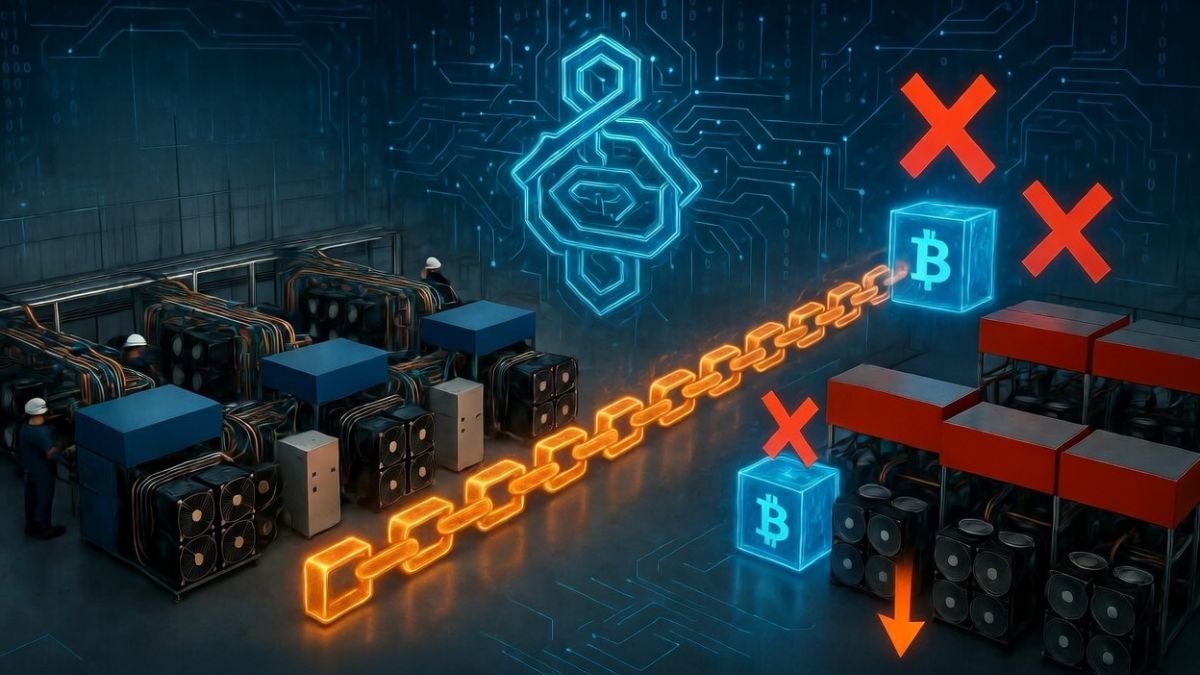
Transactions in the obsolete blocks were rolled back and had to be confirmed again.
According to developer callebtc, the 6-confirmation rule “works well with decentralization.”
The Bitcoin network experienced a two-block reorganization on March 23, an event that occurs when two miners find a valid block almost at the same time, the network briefly splits into two competing chains and the losing one is discarded from the permanent record, returning some of the validated transactions to the mempool, those few that had not been included in the winning chain.
In this framework, the chain that was ‘victorious’ was the one processed by the largest pool in the world, Foundry USA, who found seven blocks in a row.
at the height 941881, two mining pools processed a valid block almost at the same time. AntPool recorded theirs at 15:49:35 UTC and Foundry USA theirs at 15:49:47 UTC. Both blocks are technically valid, but Bitcoin can only have one chain. The network briefly split into two competing branches, each continuing to grow in parallel.
On a technical level, the construction of a new block requires targeting the identifier of the previous block, in this case, the miners would decide which block to target, and the chain that grows the most will be the winner.
That fork extended for a second consecutive block before being resolved since behind the block found by AntPool, the ViaBTC platform did the same, making the event a reorganization of two blocks, making this event quite rare to see on the Bitcoin network.
Foundry USA ended up mining seven consecutive blocks, accumulated more work than the rival chain and won. As a result, the blocks 941881 and 941882 of AntPool and ViaBTC became obsolete and were forever discarded from Bitcoin’s history, along with the rewards those pools would have received.
Was it an attack? how did it happen?
The short answer is no. Such a reorganization can occur naturally when two miners mine a block almost at the same time.
In these cases, it is crucial to communicate with the rest of the network quickly. So that latency differences in block propagationthat is, how quickly a newly mined block reaches the rest of the network, can determine which chain grows the fastest. In March 2023, CriptoNoticias reported another event in which Bitcoin suffered a reorganization of two blocks, so it is not the first time this has occurred.
In this regard, the developer known in X as @0xB10C speculum with the possibility of“selfish mining” (selfish mining) by Foundry USA, a strategy in which a pool retains mined blocks to gain an advantage over competitors. However, there is no evidence in the source to support that interpretation.
Through the selfish mininga pool secretly retains the blocks it finds, instead of publishing them immediately to the network. With this practice, a pool tries to build a private chain longer than the public one and reveal it at the opportune moment to invalidate the blocks of other miners, increasing its own rewards at the expense of the competition.
A report last February claims to have found no traces of this practice in Bitcoin. The difficulty of executing it without leaving verifiable traces and the reputational risk for a pool the size of Foundry mean that speculation, although technically plausible, lacks evidence in this case.
Does mining concentration invalidate the 6 confirmations rule?
The fact that it was not an attack does not close the debate. The March 23 shakeup exposes something more structural: what happens to Bitcoin’s security guarantees when a single pool concentrates a dominant portion of the global hashrate, regardless of its intentions.
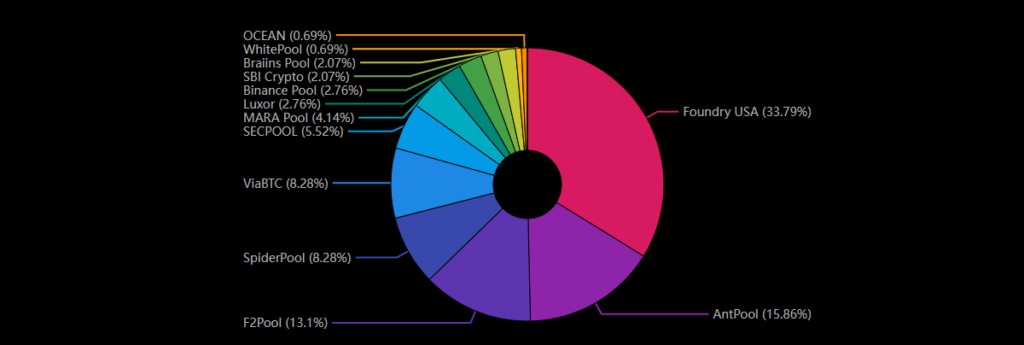
Foundry USA controls approximately between 34% of global Bitcoin hashrate currently, being the largest mining platform of its type. With that ratio, mining seven consecutive blocks is not an impossible result due to pure probability, although it is rare. The streak does not prove manipulation, but it does illustrate how much weight a single pool has on the network.
As reported by CriptoNoticias, in January 2025 Foundry USA also managed to mine 7 blocks in a row, eloquent proof of its prevalence over the rest of the pools.
A block reorganization is a relatively common event on the network. The one with two blocks is already rare, and the one with three is practically impossible, although not ruled out. The more blocks that accumulate, the lower the probability that a reorganization will occur.. Hence the rule of waiting 6 confirmations to consider an irreversible transaction.
Renowned Bitcoin developer callebtc pointed to the concentration of computing power by referring to the reorganization of the blocks of March 23 and the rule of 6 confirmations:
The rule of six confirmations to consider a Bitcoin transaction as ‘irreversible’ is only valid as long as mining decentralization exists. A company mining six blocks in a row means it could reorganize that amount if it wanted to.
callebtc, bitcoiner developer.
callebtc’s warning points to something specific: the rule of six confirmations works well when no actor controls too much hashrate. If a single mining pool can mine six blocks in a row, it could also, in theory, rearrange those same six blocks and rewrite that leg of the chain. Foundry mined seven. He didn’t, and there is no evidence that he tried. But the technical possibility existed.
So, does the mining concentration invalidate the rule of six confirmations? It does not invalidate it, but it does weaken it. The rule works as designed as long as the hashrate is distributed among many actors and no one can sustain a long streak without competition.
Six commits are still the recommended standard, but their robustness increasingly depends on the good faith of the dominant pools and less about the mathematical impossibility of reversing them.
However, for the network, the event does not represent a protocol failure, but rather a sign that mining decentralization deserves sustained attention.