
The roadmap addresses quantum protection of the consensus, execution, and data layers.
The research began in 2018 with signature aggregation based on a technology called zkSTARK.
The Ethereum Foundation (EF) presented this March 24 the new Post-Quantum Ethereum website, a site dedicated to centralizing all the resources, specifications and advances of the post-quantum effort of its ecosystem.
The launch publicly formalizes a work that has been ongoing for more than “eight years and that today involves research teams in cryptography, protocol architecture and protocol coordination, all working in an open and coordinated manner,” assured the EF.
The work on display at the new site saw its origins in 2018, focused on research into aggregating technology-based transaction signatures. zkSTARKa type of zero-knowledge cryptographic proof (ZK) which does not depend on the encryption of elliptic curves (EEC). This last encryption system, in particular the one called ECDSA, is the one currently used in Ethereum and It is potentially vulnerable to quantum.
As explained by the Foundation, 10+ customer teams are already building and deploying development networks weekly (devnets) through the program PQ Interop that integrates the new website (weekly interoperability calls that coordinate the different Ethereum teams that are implementing post-quantum cryptography).
The roadmap: four milestones, three layers
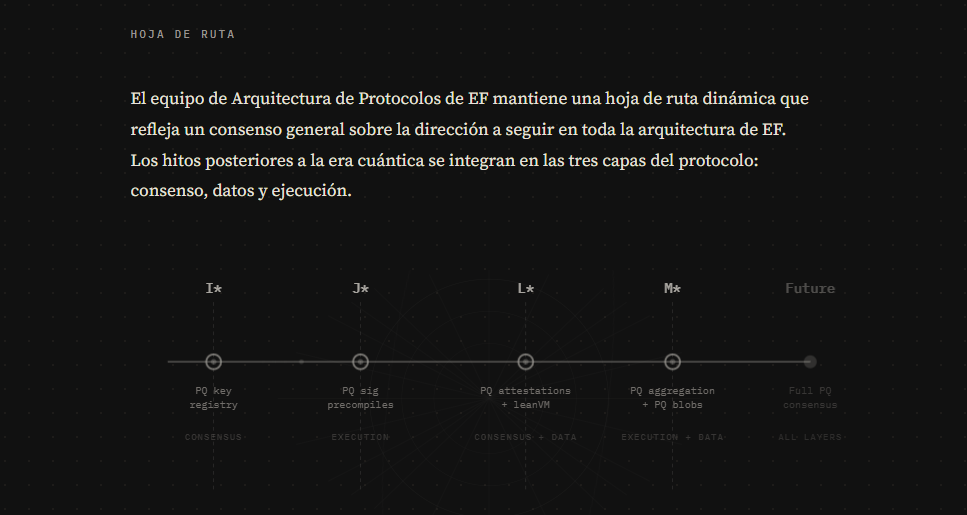
The EF published its post-quantum roadmap, structured in four sequential milestones that traverse the three layers of the Ethereum protocol: consensus, execution and data. None have a specific date assigned.
- The first milestone, I*: corresponds to the consensus layer and introduces a post-quantum key register (PQ Key Registryin English), which would function as the starting point for validators to begin the transition towards cryptographic schemes resistant to quantum attacks.
- The second milestone, J*– Targets the execution layer by introducing precompiled post-quantum signatures. They are modules integrated into Ethereum that would allow these types of signatures to be verified efficiently, enabling users to voluntarily migrate to quantum-resistant authentication without a forced outage event.
- The third milestone, L*: It is the most complex because it simultaneously encompasses the consensus and data layers. For the first, they propose replacing the BLS signature scheme used by Ethereum validators with signatures based on hash functions (leanXMSS), considered resistant to quantum attacks. On the other hand, for the data layer, the EF builds “leanVM”, a minimal virtual machine based on tests zkSNARKto restore scalability without sacrificing security. This milestone promises the introduction of post-quantum handling of blobsthe data packets that Ethereum uses for the availability of information from second layer (L2) networks.
- The fourth milestone, M*– Combines execution and data with full post-quantum aggregation. The final horizon, simply called “Future”, corresponds to the total post-quantum consensus in all layers, with no defined deadline.
What Vitalik already warned: four vulnerabilities and a date
As reported by CriptoNoticias, Vitalik Buterin, co-founder of Ethereum, published an analysis on February 26 in which he identified the four components of the network that considered vulnerable to quantum computing: the consensus system, data availability, digital signatures of user accounts, and zero-knowledge proofs used in applications.
For each one, he proposed concrete solutions: replacing BLS with signatures based on consensus hash functions; use STARK tests on data availability; introduce the mechanism account abstraction native to unify and make more flexible how accounts work on the network and that users can migrate to post-quantum signatures; and replace the individual verification of each cryptographic proof with a single compact proof that certifies that they are all valid, reducing the cost of processing on the network.
Those proposals They coincide with the roadmap that the EF has just publishedwhich suggests the same alignment between the vision of the co-founder and the work of the research teams.
Buterin’s most concrete piece of information is also the most urgent: the co-founder estimates that the quantum threat to ECDSAthe signature algorithm that protects the signatures of Ethereum transactions and also used in Bitcoin, could materialize in 2028. If that estimate is correct, all four milestones in the EF roadmap should be completed before then. For now, none have an assigned date.
From the EF, they were a little more cautious: «Quantum computing will end up breaking public key cryptography that guarantees ownership, authentication and consensus in all digital systems. However, “We do not believe that a quantum computer capable of doing so is imminent.”