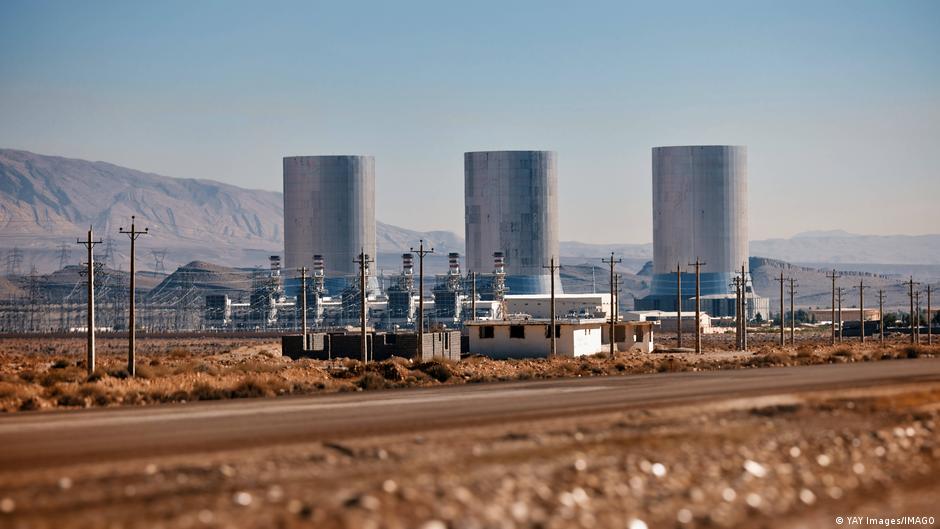
Less than 12 hours before the deadline set by US President Donald Trump to reopen the Strait of Hormuz to Iran, the Republican announced he would postpone planned attacks on the Islamic Republic’s power plants.
Trump claimed on Monday that the five-day delay resulted from “very good and fruitful” talks with Tehran, although Iranian news agencies contradicted his comments and reported that there had been “no contact” between the two sides.
Washington is trying to force Iran to end its effective blockade of the Strait of Hormuz, a vital waterway linking the Persian Gulf to the Indian Ocean through which a fifth of the world’s oil and gas supplies are shipped.
The closure of the strait left tankers stranded for weeks, sending fuel prices soaring. But after Trump’s latest announcement, the price of Brent crude – the international standard – fell more than 8% to about $103 (€88.8) a barrel.
Trump issued an ultimatum on his social media platform Truth Social late Saturday night, demanding that Iran fully reopen the Strait of Hormuz to commercial shipping to help end the war.
The US President warned that failure to comply within 48 hours would prompt the United States to “hit and destroy” Iranian power plants, “starting with the largest plant first.”
Where are Iran’s largest power plants?
Iran has 98 operating natural gas power plants across the country, according to data compiled by Bloomberg. The US Energy Information Administration (EIA) calculated that these plants account for about 85% of total electricity production.
If Trump fulfills his original pledge to target the largest site first, the Damavand Power Station will be firmly in the crosshairs.
Damavand, located in Pakdasht, about 50 kilometers (31 mi) southeast of the capital Tehran, has a generating capacity of about 2,868 megawatts (MW), making it Iran’s largest power plant.
Damavand primarily runs on natural gas with diesel backup. The Iran Open Data Center calculated that Damavand supplies about 43% of the electricity of Tehran, a city of more than 10 million people.
Other major potential targets include the Ramin power plant in the oil-rich southwest, the Shahid Salimi (Neka) on the Caspian Sea coast, the Kerman facility in the southeast and the Shahid Montazeri power station in Isfahan, Iran’s third-largest city.
Each of these plants has a power generation capacity of between 1,600 and 2,400 MW.
Several media outlets have speculated that Trump may have meant the Bushehr nuclear plant, Iran’s only operational nuclear power reactor.
According to the World Nuclear Association, Bushehr makes a much smaller contribution than Damavand to electricity generation, with a gross capacity of 1,000 MW.
International Atomic Energy Agency (IAEA) Director General Rafael Grossi warned that the attack on Bushehr would cross the “reddest line” of nuclear security.
He said damage to the reactor core could spread radioactivity, potentially requiring the evacuation of large areas. Radiation may also affect the waters of the Persian Gulf.
How serious should American attacks be?
US attacks on Damavand alone are unlikely to cause a nationwide blackout. Analysts say even major damage to a large plant would be absorbed by the broader power network.
If the entire facility were disabled by a US attack on Damavand, only 3% to 4% of Iran’s power capacity, totaling 98,802 MW, would be removed.
Achieving widespread or nationwide power outages would require coordinated attacks on multiple facilities, as well as transmission lines, substations, and transformers.
The simultaneous attacks would cause widespread blackouts for Iran’s roughly 90 million people, already stressed by weeks of conflict and years of US sanctions that have curbed the Islamic republic’s oil trade.
Prolonged power outages could seriously disrupt the Iranian economy, which already struggles with high inflation. They can also harm industrial production, communications, water supplies and military operations.
This could further escalate internal instability and Trump is betting that this threat will force Tehran to make concessions on Hormuz and even end the war.
How did Iran react to the threat?
Iran’s Fars news agency denied having direct or indirect communications with Washington on Monday, citing an unnamed source.
The source said Tehran had forced Trump to back off after warning of similar retaliation by Iran’s Islamic Revolutionary Guard Corps (IRGC).
IRGC spokesman Ibrahim Zolfkari had previously threatened attacks on all energy infrastructure, information technology systems and water desalination plants in the region. Electricity and desalinated sea water make the desert cities of the Gulf countries livable.
Parliament Speaker Mohammad Bagher Ghalibaf also warned that critical infrastructure, including energy and desalination plants, would face “irreversible destruction”. He said the headquarters and assets of financial institutions that buy US Treasury bonds would also be “legitimate targets”.
The IRGC warned that the Strait of Hormuz would remain closed until Iran’s destroyed power plants were rebuilt, a move that would certainly send global oil and gas prices higher.
Iran’s Defense Council stepped up its retaliatory threat on Monday, warning that it would lay sea mines, including floating mines, in the strait and the Persian Gulf.
What could be the regional impact?
The Gulf states, hit by Iranian attacks on their energy facilities, have so far stayed out of the conflict.
But Saudi Arabia and Qatar have already threatened serious retaliation, warning that any further attacks on their critical infrastructure – oil fields, refineries and desalination plants – would force them to respond militarily.
After Iran attacked a Saudi oil refinery and targeted Riyadh with ballistic missiles last week, Saudi Foreign Minister Prince Faisal bin Farhan warned that the Gulf kingdom was running out of patience with Tehran.
“This pressure from Iran will be politically and morally counterproductive, and we certainly reserve the right to take military action if deemed necessary,” he said.
Further escalation could potentially draw U.S.-led coalition forces into the Gulf, causing the crisis to escalate into a broader regional war.
Since the war began on February 28, Saudi Arabia, Qatar, the United Arab Emirates, Kuwait and Bahrain have been attacked by thousands of Iranian missiles and drones, causing significant but not limited damage to oil and gas facilities as well as civilian infrastructure.
According to the International Energy Agency (IEA), more than 40 energy sites in nine countries in the Middle East have been “severely or very severely” damaged.
Edited by: Srinivas Majumdaru