
Retail investor activity hits its lowest level since January 2025.
Historically, these declines in retail activity are associated with advanced corrections.
Retail participation in bitcoin (BTC) is experiencing a time of sustained weakness. The signal is derived from data from the CryptoQuant on-chain explorer, which uses transactions between $0 and $10,000 as a reference to estimate retail activity.
The market analyst, Darkfost, showed Based on data from March 21, 2026, the 30-day demand change indicator has decreased to approximately -10%.
This is its lowest point since the beginning of 2025, when it reached areas below -15%which confirms a relevant loss of dynamism in this market segment.
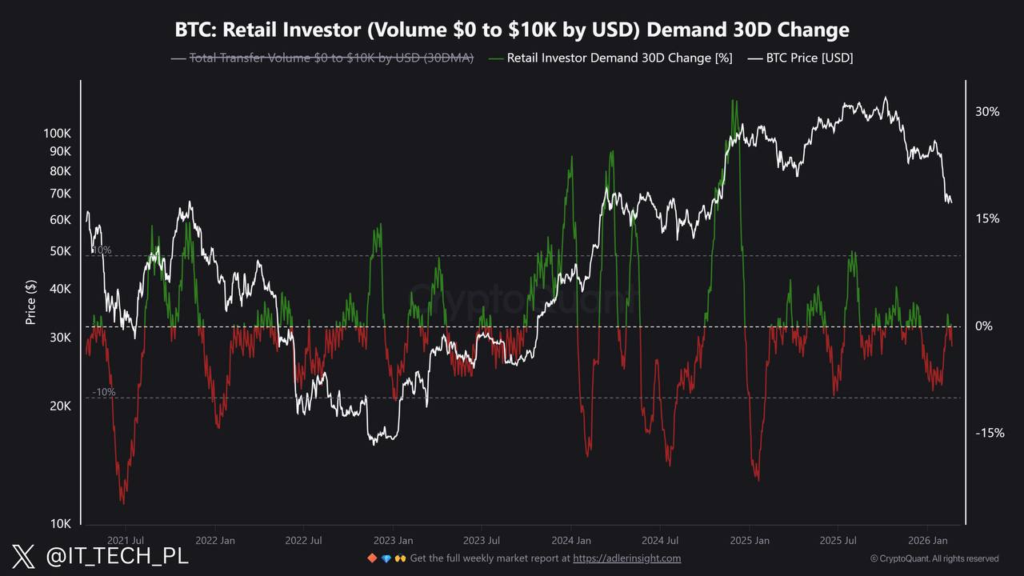
Reductions of such proportions were seen in the last stage of the previous bear market, which occurred between 2022 and early 2023, as shown in the following graph, which shows the relationship between the price of bitcoin and the activity of retail investors.
The white line represents the price of BTC, while the colors indicate changes in demand: in green, when interest and purchases by small investors increase, and in red, when that activity decreases. Altogether, it allows us to see how the behavior of the retail public accompanies or anticipates market movements.
Historically, retail investor participation tends to accelerate when price enters bullish cycles and contract when the market loses momentum or corrects. In that sense, what has happened in recent days partially fits with this dynamic.
At the beginning of last week, bitcoin reached close to $76,000, in a context of greater optimism and with positive flows towards ETFs, which reinforced the bullish narrative. However, that momentum failed to be sustained. External factors (such as macroeconomic and geopolitical tensions) ended up putting downward pressure on the price.
What is relevant is that, despite this movement (initial rise followed by correction), retail demand did not show a significant reaction at any time. Neither the rally toward $76,000 generated a sustained increase in retail participation, nor does the subsequent drop alone explain the indicator’s current weakness.
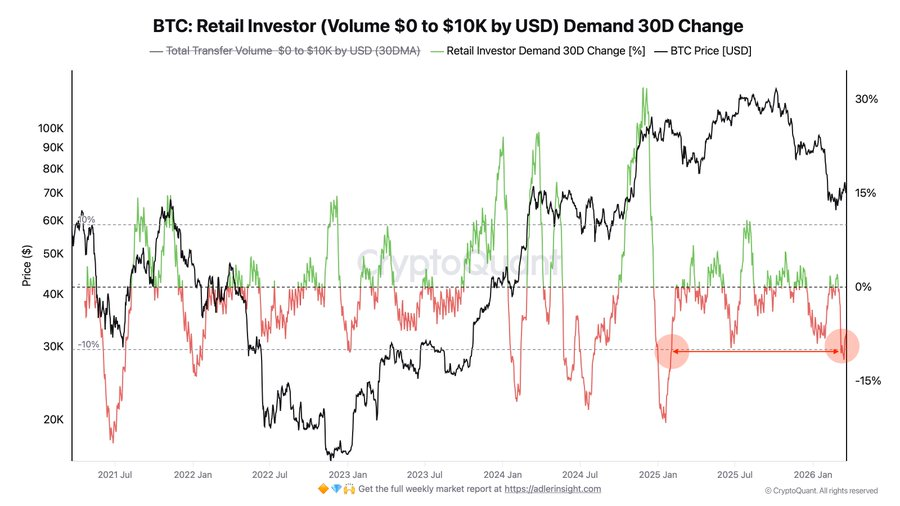
This suggests that the historical pattern remains in force.but with one key difference: the retail investor is not leading this cycle. Instead of reacting strongly to price movements, its activity remains weak even in times of recovery, which reinforces the reading of a market with less retail prominence.
Among the factors that may be influencing is the emergence of new investment vehicles, such as bitcoin ETFs, which allow exposure to the asset through regulated markets. This type of instruments is channeling part of the demand that was previously reflected directly in on-chain activity.
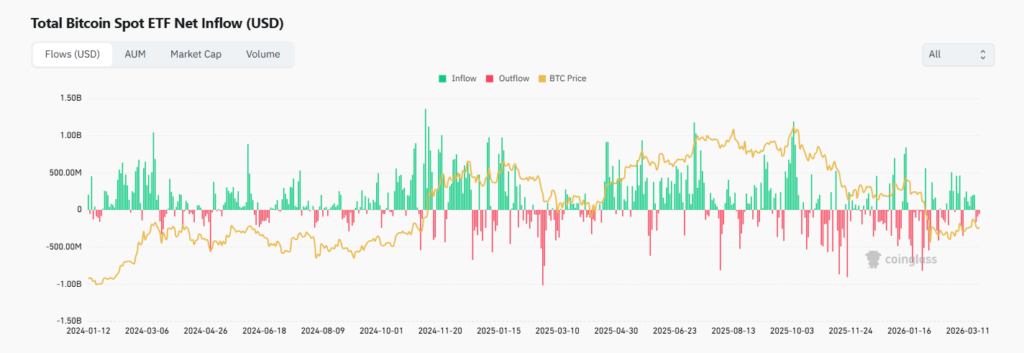
In the chart below, for example, we see how bitcoin ETFs recorded consecutive net outflows of approximately $164 million on March 18, $90 million the next day, and $52 million on March 20. All of this is trading activity linked to the price of bitcoin, but it does not necessarily have an immediate impact at the on-chain level (although it could if ETF managers buy or sell bitcoin to back their actions or redeem investors).
Institutional investors like Strategy accumulate bitcoin
The withdrawal of retail investors contrasts with the strategy of certain institutional players, who have taken advantage of the falls to continue increasing their exposure.
Among them, Strategy stands out, the publicly traded company with the most bitcoin in its treasury. On March 23, Strategy filed a new plan with the US Securities and Exchange Commission (SEC) to raise more capital by issuing shares. With this initiative, the company seeks to raise up to an additional $44.1 billion, with the aim of continuing to increase its position in the digital asset.
Long-term bullish fundamentals such as the scarcity of bitcoin encourage these purchases, against widespread sales pressure. The currency has a fixed supply of 21 million units. This facilitates its rise in the face of demand, unlike conventional currencies, such as the dollar, which have a growing supply. Those who have a long-term vision see these characteristics as attractive, beyond the short-term volatility.