
The change would apply to the entire system architecture, not just individual apps.
Google has been working on post-quantum cryptography since 2016 and sets 2029 as the migration deadline.
Google announced this March 25, 2026 that Android 17 will integrate post-quantum cryptography (PQC) improvements starting in the next beta version, followed by general availability in the production launch. The measure responds to the accelerated advance of quantum computing and the need to update the security foundations of the most used mobile operating system in the world, before this technology represents a real threat to current encryption.
He advertisement was posted on the Google Security Blog by Eric Lynch, Android Product Manager, and Dom Elliot, Google Play Product Group Manager. The goal is not simply to patch individual applications or transport protocols, but to ensure that the entire platform architecture is resilient for decades to come.
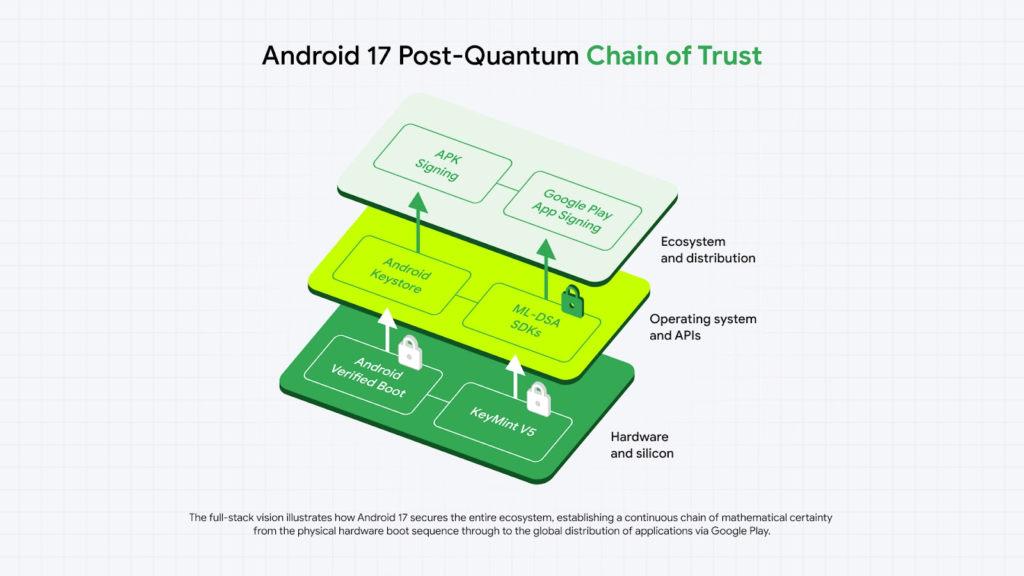
Android 17 strengthens its security with two key changes. First, improve the process of verified bootensuring that no one has tampered with the operating system before the phone turns on. Second, it updates the way the device demonstrates to external applications (such as those from banks) that it is secure; now uses a new type of anti-quantum ‘shielded’ cryptography that will be impossible to crack even for supercomputers of the future
As for developers, Android Keystore will incorporate native support for ML-DSA (post-quantum cryptography signatures), allowing applications to use secure signatures against quantum attacks directly from the secure hardware of the device, without developers having to implement their own cryptographic solutions. In practice, future cryptocurrency wallet apps will be able to run post-quantum secure signatures starting with Android 17.
Post-quantum cryptography: why now
Post-quantum cryptography is a set of algorithms designed to resist attacks by quantum computers, machines that, unlike classical ones, can simultaneously process multiple states and solve certain math problems exponentially faster. Current encryption systems—such as RSA or elliptic curves that protect wallets and communications—depend precisely on the difficulty of those problems to be secure.
The threat to encryption systems is already relevant today through so-called “store now, decrypt later” attacks, where malicious actors collect encrypted data today with the intention of deciphering them when they have a sufficiently powerful quantum computer. Digital signatures, in contrast, represent a future threat that requires completing the transition to PQC before a cryptographically relevant quantum computer exists.
Background: Google and the quantum horizon before 2030
The announcement of Android 17 comes a day after Google published another statement about the advancement of its quantum computers. As reported by CriptoNoticias, Google Quantum AI stated that it was “increasingly convinced” that quantum computers with commercial relevance They will be available before the end of this decadebeing the first time that the company has set such a specific time horizon.
However, it would not refer to equipment ready for the mass market, but to systems capable of solving problems of real value for industries such as pharmaceuticals, computational chemistry or finance.
The implementation of PQC in Android 17 is part of a broader roadmap that Google outlined in the same announcement. Next steps include integrating post-quantum key encapsulation into KeyMint, key attestation, and remote key provisioning, with the goal of strengthening the entire identity lifecycle in the Android ecosystem. Google indicated that it expects to share more updates on this transition in the coming months.