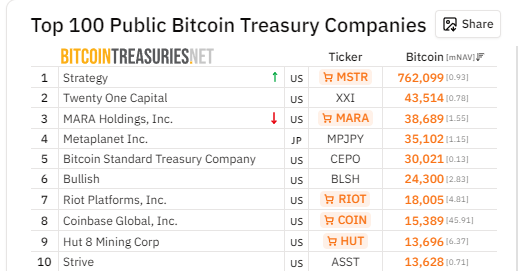
Twenty One Capital, with 43,514 BTC, takes second place from MARA in the global ranking.
Last February it formalized an alliance with Starwood Capital to build AI data centers.
MARA Holdings, one of the largest Bitcoin mining companies in the United States, sold 15,133 bitcoin (approximately 30% of its reserves) between March 4 and 25 for approximately $1.1 billion.
The company announced that it will use these funds mainly to repurchase nearly USD 1 billion in its own debt maturing in 2030 and 2031.
The sale implied a change in the global ranking of public companies with the largest bitcoin reserves. With approximately 38,689 BTC estimated after the sale, MARA is now below Twenty One Capital (43,514 BTC)which snatches second place. Strategy (MSTR) maintains the lead with 761,068 BTC, a distance that no public company comes close to closing.
Fred Thiel, president and CEO of MARA, indicated that the decision seeks to reduce potential dilution to shareholders and expand financial flexibility for new infrastructure projects.
The idea is protect ownership percentage and share value of current investors, preventing their participation in the company from decreasing drastically. To this end, they sold part of their BTC (a volatile asset) to repurchase convertible debt at a discount.
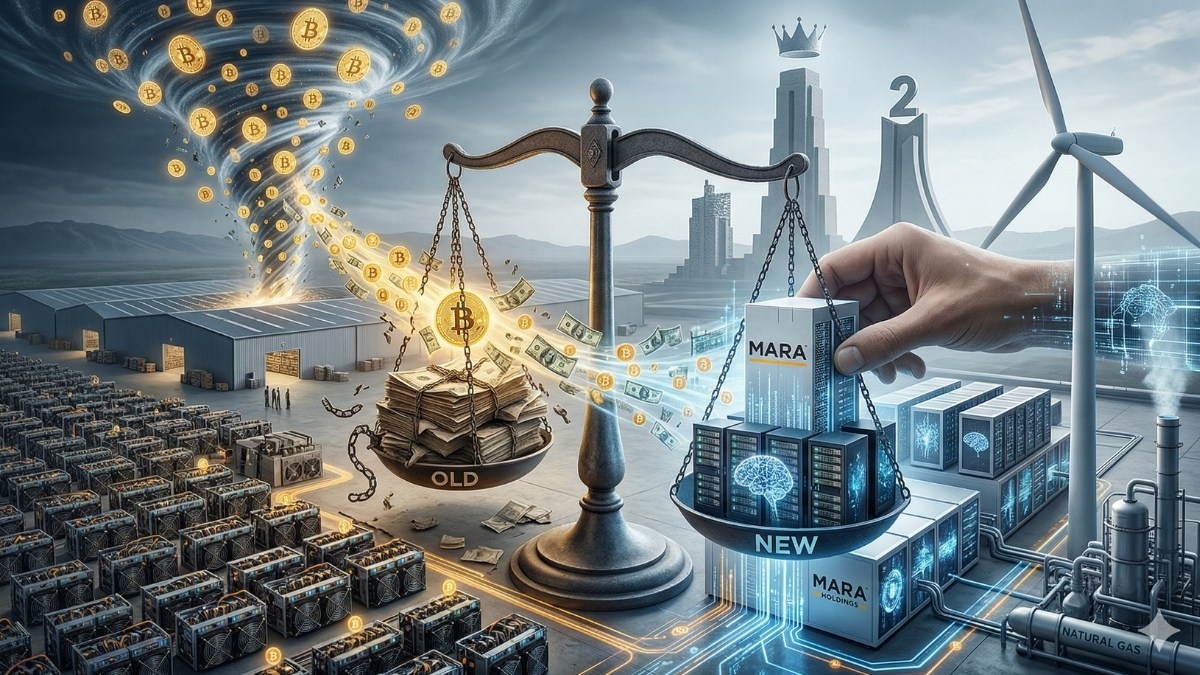
Although this operation responds mainly to financial objectives, it is part of a broader strategy that MARA has been developing. The company has been using part of the resources obtained from previous sales of bitcoin to finance its expansion into artificial intelligence (AI) and high-performance computing (HPC).
Dual strategy: bitcoin and artificial intelligence
The bitcoin sale announced by MARA this March 26 is not an isolated event. The company has been selling its reserves since the second half of 2025 to finance operations and growth. This 2026 he stated that he will continue to do so according to market conditions. This has allowed it to take new steps in its plans with AI.
Last February it formalized an alliance with Starwood Capital to convert facilities into data centers capable of deploying up to 2.5 gigawattsdesigned to switch between bitcoin mining and AI processing, depending on the profitability of each segment. The company also acquired a wind farm in Texas with 240 MW of capacity and signed an agreement with MPLX LP to expand its access to low-cost natural gas.
This diversification strategy follows a sector trend. Last month, miner Cango Inc. sold more than half of its bitcoin reserves — 4,451 BTC for approximately $305 million — to finance its transition to leasing graphics processing units and training AI language models.
The company argued that the new model will allow it to generate more predictable and stable income than Bitcoin mining. Riot Platforms also announced a technology alliance to expand the capacity of its data center in Rockdale, Texas, aimed at the same sector.
However, in the specific case of MARA, the firm insists that it is not a total shift towards AI but rather a a purely financial movement aimed at strengthening its balance sheet and reducing debt.
Through this strategy it seeks to balance the preservation of value for its shareholders with a pragmatic approach to long-term growth. His plan is to navigate with greater agility the next phases of the Bitcoin cycle and the growing opportunities emerging in the area of artificial intelligence.