Arguably, no form of technology has aroused both fear and excitement like nuclear energy.
In the 1950s, peaceful uses of nuclear fission increased rapidly and it remains the ultimate deterrent in military matters today.
Significant nuclear accidents at Three Mile Island (Pennsylvania, 1979), Chernobyl (Soviet Union, 1986), and Fukushima (Japan, 2011) reduced support for nuclear energy.
Recently it has been touted as a low carbon and hence environmentally friendly alternative to fossil fuels.
Africa currently has only one nuclear power station, at Koeberg near Cape Town, South Africa. But this may change soon.
African nuclear ambitions – from ‘definite’ to ‘unrealistic’
In 2025, South African journalist Tristan Taylor conducted an in-depth study of the nuclear ambitions of African countries.
His report Germany’s Green Party-Alliance was published by the Cape Town office of the Heinrich Böll Foundation.
“Africa is a blue-sky country for all vendors and especially South Korea, China and Russia,” Taylor told DW.
“This is where they will have a potential growth market. It’s just a matter of whether African countries can get together to tender, enter into contracts, set up financial mechanisms,” he said, before adding that the International Atomic Energy Agency helps countries with the necessary preparations.
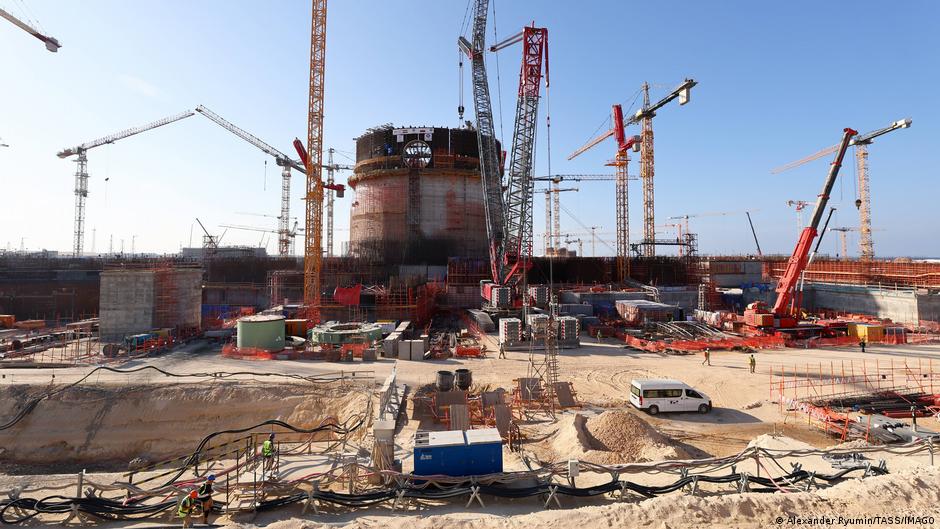
Egypt has the best chances of getting a nuclear reactor online, Taylor reports. Russian state nuclear energy corporation Rosatom began construction of a plant in Al-Dabaa on Egypt’s northern coast in 2022.
The nuclear ambitions of Sahel countries such as Niger, Mali and Burkina Faso remain unrealistic, Taylor said, despite those countries signing agreements with Rosatom.
“When they’re signing the nuclear deal with Russia, they’re basically saying that Russia supports them politically,” Taylor told DW. He said countries are “always signing nuclear deals.”
“They don’t really mean much in themselves. If you get, say, a long period of nuclear agreements where some action actually happens, you can start to say ‘Okay, maybe something is moving forward.'”
South Africa: new plans
Africa’s only nuclear power station is located near Cape Town. Two reactors at Koeberg came online with the support of a French consortium in the mid-1980s during the apartheid regime. The power plant is rated for just under 2,000 megawatts (MW), and produces about 4% of South Africa’s electricity.
Despite environmentalists’ concerns about Koeberg-2, Koeberg’s operating permit was extended for another 20 years, in 2025.
Francesca De Gasparis of the Southern African Faith Communities Environmental Institute (SAFCEI) said there were questions about safety standards and maintenance by operator Eskom, South Africa’s troubled state-owned electricity utility.
“When we look at the best practices of other countries where they take nuclear power plant risks seriously, there is a need to first do the necessary maintenance testing, making sure that monitoring equipment is up to date, and making sure that international upgrades are in place based on what we have learned from Fukushima and other disasters,” De Gasparis said.
“All this should have happened earlier, so that the risk, the burden, was put on the actual energy producer,” he told DW.
Critics say this did not happen in Koeberg. Meanwhile, Eskom is preparing to build a larger 4,000-MW facility in nearby Dunefontaine. De Gasparis criticized the lack of transparency and the use of what he said was outdated data.
Eskom told DW it would answer questions related to reactor safety. However, no statement had been received by the time this article was published.
Ghana: double jeopardy
In West Africa, Ghana has invited suppliers from France, China, South Korea, Russia or the United States to develop its nuclear power plans. Some reports suggest construction could begin in 2027, but details of the contracts have not been publicly released.
As well as a conventional power station, Ghana is exploring the use of small modular reactors (SMRs), which are much smaller, easier to operate and have lower safety risks.
So far, each of the more than 650 conventional reactors built around the world is unique and has its own specific risks.
Therefore, according to European data, the price per kilowatt-hour for nuclear power is significantly higher than for renewable energy sources – wind, solar and hydroelectricity – which have become much cheaper. SMRs can bridge this gap through mass production. But so far only prototypes exist.
Kenya: ambitious timeline for nuclear power
Kenyan President William Ruto announced in late March that construction would begin on a 2,000-megawatt nuclear plant at Siaya, on the shores of Lake Victoria near the border with Uganda. The project is expected to begin producing power in 2034, although delays and budget overruns are not uncommon in the industry.
According to researcher Tristan Taylor, challenges remain: in early 2025, Kenya’s cabinet dissolved the national nuclear authority, NuPEA, as part of broader austerity measures. But this decision has not yet taken effect because it was never approved by the Parliament.
“We need a comprehensive study to show what impact the nuclear power plant will have on the fishing communities dependent on Lake Victoria, as fishing is their main source of income,” Kenyan environmentalist Phyllis Omido told DW.
He said he feared that transporting nuclear fuel through the country could be dangerous for citizens.
Omido, who was awarded the 2023 Right Livelihood Award, and the Center for Justice Governance and Environmental Action (CJGEA), which he co-founded, have for years fought against efforts to build a nuclear power plant near Kilifi on the country’s Indian Ocean coast.
fear of nuclear waste
Figuring out what to do with radioactive nuclear waste, which lasts for millennia, is still a burning concern for all countries that use nuclear energy.
“We are against anything with nuclear energy until they give us a concrete solution on how this waste will be handled,” Omido told DW. “Going and burying it in communities is not a solution.”
South Africa stores its nuclear waste at Walputs, a sparsely populated area in the Northern Cape province. But this is only for some low-to-medium level contaminated waste. Highly radioactive nuclear fuel is still stored in Koeberg.
The government plans to have the final reserves operational by 2065, a target about which activists are skeptical.
“I don’t think there’s any easy solution to high-level waste,” SAFCEI’s De Gasparis said. This is why we don’t think we should plan to produce too much and cause ourselves even bigger problems in the future.
This article was originally published in German.