There are over 40 million tokens created, causing liquidity dilution.
Analyst believes that it may be a moment of opportunity if projects with potential are detected.
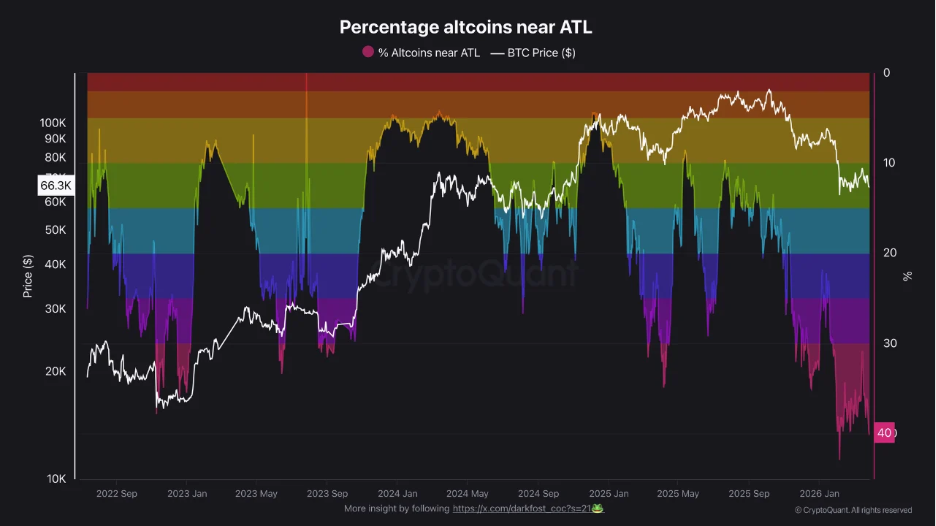
Between 38 and 40% of altcoins (cryptocurrencies excluding bitcoin) are trading near their historical minimum prices, according to data from CryptoQuant.
This figure is higher than the 38% recorded after the FTX collapse in 2022 and represents one of the greatest pressures on alternative cryptocurrencies in the entire current cycle.
Among the affected altcoins there are high capitalization projects such as Polkadot (DOT), that touched a new all-time low close to USD 1.13 in February 2026; Polygon (POL), which has quoted around USD 0.08 also in February; and Worldcoin (WLD), which fell to USD 0.24 during March. Additionally, there are thousands of low-cap tokens that are in the same situation.
The fall occurs within the framework of strong geopolitical tensionssuch as the armed conflict between the United States, Israel and Iran, with military attacks and threats on key oil routes. This has generated uncertainty in the financial markets and has reduced the appetite for high-risk investments, as CriptoNoticias has been explaining in recent days.
Added to this scenario is a historical pattern of the cryptocurrency market: the second year after bitcoin halving (BTC) It usually shows consolidation or correction phases, in which many altcoins suffer steeper declines than bitcoin. And 2026 is, precisely, the second year after the 2024 halving.
For the CryptoQuant analyst who identifies himself as “Darkfost”, beyond the macroeconomic context, the market also faces a growing structural challenge: the massive proliferation of tokens.
The analyst commented on March 30, 2026 that there are currently more than 40 million cryptocurrencies and tokens, with a significant concentration in networks such as Solana, Base and BNB Smart Chain. This expansion has reduced barriers to entry, but also has fragmented available liquidity.
For Darkfost, the result is a market where capital is distributed among an increasing number of projects, weakening its performance and increasing its fragility. This factor helps explain why the percentage of altcoins at all-time lows even exceeds levels seen in previous bearish cycles.
Although Darkfost points out that these extreme levels can open investment opportunities if projects with potential are detected, the context forces us to qualify this idea: evidence from previous cycles indicates that many altcoins They fail to recover their historical highs.
For example, Internet Computer (ICP) never has returned near its ATH of $700, Polkadot (DOT) and Algorand (ALGO) are well below their market peaks, and Cosmos (ATOM) also remains far from its previous highs.
These cases illustrate that identifying “winning” projects is a highly uncertain process, given that most tokens do not recover their previous price levels. In other words, although opportunities may exist, they coexist with a high risk of loss, in an increasingly saturated market.
In this scenario, the altcoin market seems to enter a more aggressive purging phase, where only a minority manages to remain relevant while the rest are exposed to prolonged declines.