
The investigation points to conflicts of interest at Brink, the NGO that finances Core.
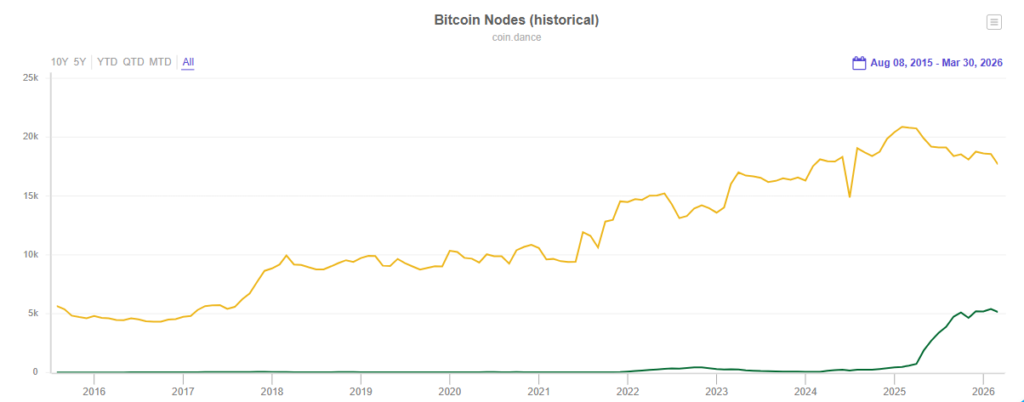
After a controversial change to Core in version 30, the adoption of the Knots client grew noticeably.
Hodlonaut, a bitcoiner known for his court case against the fake Satoshi Craig Wright, published in his own magazine Citadel21 the first of four articles in an investigative series titled The Capture (the capture).
The article, published on March 27, documents how a small network of people built and exercised informal control over who entered the development of Bitcoin Core, who received funding, and what changes were approved, between 2018 and 2025.
The event that triggered the investigation occurred in the fall of 2025, when Gloria Zhao, then maintainer of Bitcoin Core (who resigned in January 2026), merged a change that expanded arbitrary data limits which can be included in Bitcoin transactions using the OP_RETURN mechanism, from 83 bytes to 100,000 bytes in Core version 30.
The decision generated a notable rejection in part of the community, given that many bitcoiners consider these arbitrary data (images, text, files) as spamsince they occupy space in the blocks without involving monetary transactions.
So much so that that debate led to thousands of node operators migrating from Bitcoin Core to the Bitcoin Knots client, which went from representing around 2% of nodes in April 2025 to more than 20% todayalthough almost 78% of the total nodes still run Core (the rest in other implementations).
Hodlonaut’s approach exposed at Citadel21 must be read within the framework of his perspective, which is explicitly maximalist and cypherpunk, and he criticizes what he considers deviations from the ethos original of Bitcoin.
The spine pointed out by hodlonaut
He article from hodlonaut traces the structure of the network from three institutions:
- The first is Bitcoin Optecha technical newsletter co-founded in 2018 by John Newbery, an English software engineer and Bitcoin Core contributor. Optech hosts developer dinners and was initially funded by Wences Casares, founder of Xapo, and John Pfeffer, a venture capital investor, according to the hodlonaut statement.
- The second is Chaincode Labsa New York-based Bitcoin developer residency program, founded in 2014 and privately funded, that does not publish its selection criteria openly, says hodlonaut. According to their text, a significant fraction of current and recent Bitcoin Core maintainers went through their programs.
What the article documents is that the three institutions were connected by the same people and the same funders. Casares and Pfeffer, who funded Optech, also funded Brink’s launch. Adam Jonas, CEO of Chaincode Labs, was hired by Newbery. Newbery co-founded Brink, co-hosted Chaincode residencies, and ran the Bitcoin Core PR Review Club, a mentoring program for new contributors.
In practice, according to hodlonaut, Newbery controlled entry points to the Bitcoin Core development ecosystem: the dinners where contacts were made, the residency program where candidates were selected, the mentoring club where they were trained, and the organization that financed them.
Two cases pointed out by hodlonaut
Hodlonaut’s document exposes the cases of two developers whose trajectories followed an almost identical pattern, according to their research.
First, contributor Amiti Uttarwar applied to the Chaincode project in 2018 and was rejected. Later, he met Newbery at an Optech dinner. The following year She applied again and was accepted.in a residence that Newbery himself co-organized. His first financing, from Xapo, was managed according to his own account by Newbery and Jonas.
Second, Gloria Zhao applied to Chaincode in 2019 and was rejected. In January 2020, Jonas contacted her by email when she was, in her own words according to hodlonaut, “completely outside” the Bitcoin ecosystem and planned to delete any mention of blockchain from his resume. Jonas phoned her when she declined, arranged a meeting at Stanford, and introduced her to Newbery and Uttarwar.
Nine months later, Zhao was announced as part of Brink the week she graduated from college. Newbery was one of the three votes that made that decision, without a recusal process despite having been the one who recruited her, introduced her to the network and mentored her during those nine months in the same city where he resides.
For hodlonaut, The ideological profile that Zhao brought to the project before being recruited is relevant to understanding what happened next. Seven months before Jonas contacted her, in June 2019, she had published an essay on digital privacy in her Berkeley student organization’s publication.
Hodlonaut notes that the essay cites classic cypherpunk authors but reaches opposite conclusions: while the cypherpunk manifesto argues that privacy should be protected through individual technical tools without relying on institutions, Zhao concludes that “the right to privacy must be respected and protected by the empowered,” an institutionalist argument. The harms that Zhao identifies in the essay are not those of cypherpunk thinking either: does not mention financial censorship or the erosion of individual sovereignty, But algorithmic systems reproduce racial, gender and socioeconomic stereotypes.
For hodlonaut, that document is the earliest record of the values Zhao brought with him to Bitcoin Core, and its date, seven months before recruitment, makes it more reliable evidence than any later statements.
Nineteen months later, in July 2022, Zhao became the first female maintainer of Bitcoin Core, as reported by CriptoNoticias.
Additionally, hodlonaut explained that:
This article does not claim that Gloria Zhao is not a capable developer. He does not claim that Amiti Uttarwar lacks technical skill. Nor does he claim that John Newbery or Adam Jonas acted with malicious intent. People in positions of influence recommend those they know and trust. This is universal and is not automatically corrupt.
hodlonaut, bitcoiner developer.
Conflicts of interest and marginalized contributors
As documented by hodlonaut, Brink’s IRS forms from 2020 to 2023 state that the organization had no committees, contradicting public statements by Mike Schmidt, Brink’s CEO, who cited on multiple occasions a grants committee as a control mechanism.
That committee, according to hodlonaut, included Zhao as an evaluator of applications from other developers while she herself received funding from the organization. Asked by hodlonaut, Schmidt explained that the committee is “non-governing” because the board formally approves its recommendations, which according to his interpretation would exclude it from the IRS form reporting requirement. Jonathan Bier, current director of Brink confirmed that since he joined the board no recommendations from the committee have been rejected.
The article also includes the testimony of Jon Atack, one of the five most prolific contributors to Bitcoin Core between 2019 and 2021, who according to hodlonaut was rejected by Chaincode Labs despite his contribution history, worked without funding for thirteen months and saw his activity decline after a confrontation with Newbery on IRC. Hodlonaut further indicates that Newbery publicly backed a plan to remove Luke Dashjrlead maintainer of Knots, as a Bitcoin Improvement Proposal (BIP) editor in 2021.
The audit that validated the technical work
Finally, Citadel21’s investigation does not question the technical quality of the Bitcoin Core code but rather the power structure that decides who writes it and what changes in it.
In this context, Brink’s impact report published on March 26, as reported by CriptoNoticias, provided that the first independent security audit of Bitcoin Core in its 16-year history, carried out by Quarkslab for four months, did not find vulnerabilities of critical, high or medium severity.
That result validates the quality of the code review process that Core developers have built, regardless of how they were selected. They are two dimensions of the same problem: the audit answers whether the code is good; Citadel21 research asks who decides what code is written.