German Chancellor Friedrich Merz spoke of the “explosion of violence” in March during a session of the Bundestag, the lower house of Germany’s parliament, where he was asked about violence against women.
He said there is a need to talk about its causes, saying “a significant portion of this violence comes from immigrant groups.”
Merz continues to link violence and criminality to immigration. In October 2025 he said that his government had reduced the number of people seeking asylum in Germany by about 60%.
He added, “But of course we still have this problem in the urban landscape, and that is why the Interior Minister is working to carry out mass deportations. This must be maintained.”
Now, at the same time, his comments sparked a sharp reaction in Germany.
AfD has loosened the neck of the government
The electoral successes of the anti-immigrant Alternative for Germany party (AfD) are putting pressure on the conservative parties, Merz’s Christian Democratic Union (CDU) and its Bavarian counterpart the Christian Social Union (CSU). The AfD received about 19% of the vote in the first two parliamentary elections in five states this year.
When Jens Spahn, who leads the CDU/CSU bloc in the Bundestag, analyzes the AfD’s success, he immediately turns to the everyday experiences of Germans.
“It’s about the question of how safe I feel in my daily life, how comfortable I feel in my everyday routine, what is changing around me and how fast it is happening,” Spahn told mayors and district administrators during a conference of local leaders of his party held in Berlin.
Spahn defended the chancellor, saying that citizens could see that the landscape of the city had changed. “Christmas markets that look like castles, train stations, not just in big cities, market squares in many medium-sized cities, where things have changed, there has been an increase in shoplifting and other issues – you can’t pretend that irregular migration hasn’t changed cities.”
Why do Germans feel unsafe in public places?
According to a representative survey conducted by pollsters Infratest Dimap in late 2025, about 48% of citizens feel unsafe in public places such as parks, trains and buses. In 2017, only 23% felt this way. But will a restrictive asylum policy restore Germany’s sense of security?
What emerged at the conference of conservative mayors and other local representatives in Berlin casts some doubt on this theory. If the inner city looks neglected, it promotes a sense of insecurity and causes discomfort among the population.
“What most affects people’s subjective perception of safety in the city is not serious crime, but the socially inadequate behavior of certain groups,” said Thorsten Wunschmann, who leads the Order Office, the department responsible for public order in Hanau, a city near Frankfurt.
According to Wunschmann, this behavior is not a criminal or administrative offense, but “however, it intimidates people in public places.”
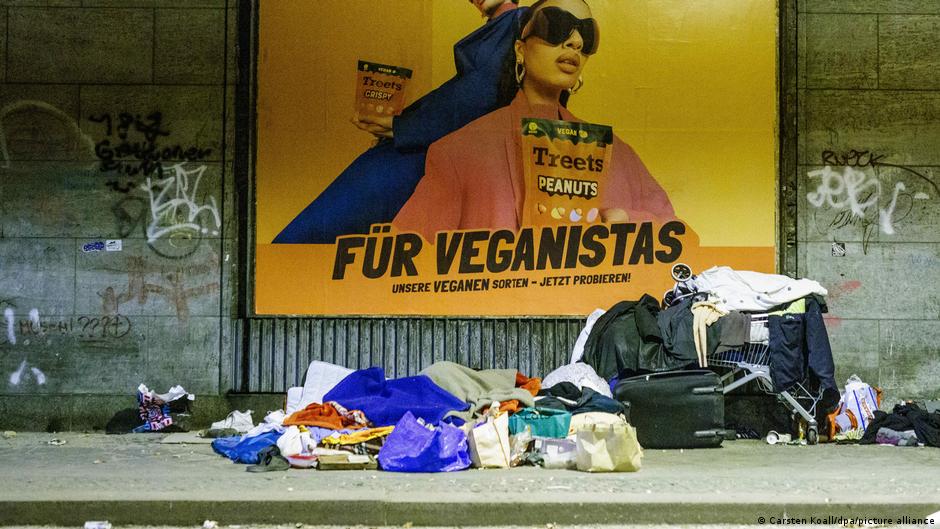
Examples of “socially inadequate behavior” include beggars, drug addicts, gangs of alcoholics, and homeless people. Vacant buildings, neglect, and litter on isolated streets often have a negative impact on entire neighborhoods.
When obsolescence creates fear
Rainer Wendt, head of the German police trade union (DPOLG), said at the conference in Berlin, “I have lived in AlexanderPlatz (a large public square and transport hub in central Berlin) for a long time. Anyone who has seen the mostly Eastern European migrant workers or the belongings they leave at the entryways of buildings in the morning knows what I’m talking about.”
Christoph de Vries (CDU), parliamentary state secretary at the Federal Interior Ministry, spoke of organized begging groups whose members deployed to the same place every morning in his home city of Hamburg. Often these were people from Eastern European Union countries. They cannot be deported.
Then Hamburg’s public order office started checking on them regularly, De Vries explained. “It didn’t take long at all for them to stop coming.”
De Vries reported that, especially in big cities, entire streets are becoming havens for drug addicts “where residents are now barricading their front doors, so that people don’t inject themselves, use or sell drugs there.”
“There are unbearable conditions there,” De Vries said. He argued, “It cannot be that public space is occupied by people on the margins of society, so that ordinary citizens fear going there.”
Citizens are also fearful of an increase in serious crime, he said, adding that organized crime, “often of foreign origin, presents itself as more violent than ever before, openly using firearms, grenades, robbery.”
How is German law enforcement structured
The police in Germany deal with serious crimes. Police forces are organized at the state and federal levels. Local governments have public order offices (Ordnungsamt), which are specialized institutions to handle regulatory matters, minor crimes, and business inspections. TeaThe police is a state authority responsible for preventing danger and prosecuting crime.
Wunschmann from the order office in Hanau explains the advantages of the municipal public order service in influencing certain groups in the city.
“Because we know people, we can talk to them much earlier and often we know the people there better than our colleagues in the police.”
Germany’s municipalities are trapped in a debt trap
However, ensuring security and order requires more personnel, more modern surveillance technology, and more funding from federal and state governments. Most municipalities are deep in debt. In 2024, they reported a combined record deficit of almost €25 billion ($28.6 billion); This increases by a further €20 billion in the first half of 2025.
The main drivers are social expenditure and personnel costs. At the same time, due to the economic crisis, local business tax revenue has declined. There is a shortage of money to invest in infrastructure.
For many years, state and federal governments have paid little attention to the concerns of municipalities. It seems that change is happening. Several ways to strengthen city and local governments are now being discussed in the Bundestag. Funding for urban development is set to increase from €1 billion to €1.6 billion.
This money can be used to pay for urban development projects that help prevent crime. For example, to eliminate “places of fear” where few people dare to go, especially after dark, enhance public spaces and convert vacant buildings to different uses.
This article was originally written in German.