
For now, the market seems more concerned about the war in Iran and the price of oil.
In the medium term, quantum risk will once again gain visibility in the price of bitcoin.
On March 30, 2026, Google published the report “Protecting Elliptic Curve Cryptocurrencies from Quantum Vulnerabilities:
resource estimates and mitigation measures.
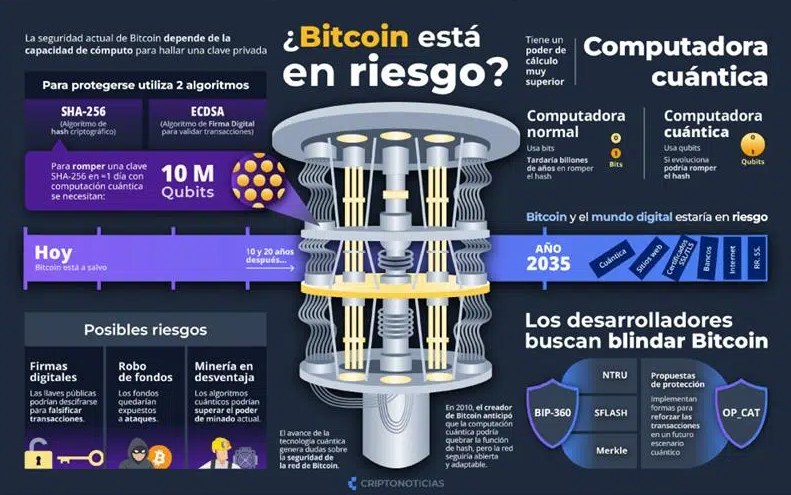
There, as CriptoNoticias reported this morning, it is claimed that a quantum computer could derive the private key of a Bitcoin wallet in about 9 minutesbelow the average mining time of a block (which is approximately 10 minutes).
The report estimates that would require fewer than 500,000 physical qubits, nearly 20 times less than the most efficient previous estimates calculated.
In this context, the question arises: How will the publication of this data affect the price of bitcoin (BTC)? Will the market begin to discount this risk, even though the necessary technology to decrypt the wallets does not yet exist?
Making the clarification that any answer given is speculative, we can think that In the short term, the price of bitcoin is driven by the macroeconomic environment, not quantum.
At the moment, Global financial markets are processing variables of an urgency that the quantum threat does not yet have: the conflict in Iran, the pressure on the price of oil and an inflation that does not stop.
The reason is quite simple: bitcoin, at least in its short-term price formation, today functions as an asset that is extremely sensitive to global liquidity and risk appetite.
When a conflict like the one in Iran pushes oil above $100, fears of more persistent inflation rise, expectations of interest rate cuts cool, and financial conditions tighten almost immediately.
In this context, investors and traders do not wait to see the outcome: they reduce exposure to bitcoin as soon as they perceive that there will be less liquidity and a higher cost of money. In other words, geopolitical and energy risk has a direct “transmission channel” to the market; the quantum threat, for now, no.
But once the current geopolitical conflict loses intensity—or when the market simply assimilates it as a background factor, as occurred with previous cycles of tension, for example, the COVID-19 pandemic— Google’s analysis and quantum risk will remain on the table, perhaps without other catalysts to cover it up.
He paper provides data that, in this scenario, will be difficult to ignore. The report quantifies that approximately 6.9 million BTC are vulnerable to attacks. Of that figure, 1.7 million BTC are deposited in P2PK scripts—the oldest format, which exposes the public key directly—and include mining rewards from the Satoshi era.
Google warns that these funds cannot be migrated if the private keys have been lost, making them a permanent and permanent target.
That projection has direct implications for the price: If an entity—whether state, criminal, or corporate—gains access to that capacity before Bitcoin has migrated to post-quantum computing, the reintroduction of that volume of bitcoin into circulation could generate selling pressure unprecedented in the history of the asset.
Even the actors who accumulate these funds would have their own incentives to reintroduce them slowly, since they themselves would become significant holders. Even so, the magnitude is enough to alter any valuation model based on scarcity (this, with nuances, since even in the case of a quantum attack, the circulation of bitcoin will never be able to exceed 21 million units).
Opinions divided on impact on bitcoin price
It is worth clarifying that there are those who disagree with the hypothesis put forward here (that the market is now more attentive to macroeconomic issues than to quantum risk).
Among them, Charles Edwards, CEO and founder of the financial company Capriole Investments, stands out for the insistence of his warnings.

In December of last year, Edwards said that “Bitcoin is on the quantum event horizon.” By that, he meant that The market was already discounting the quantum risk and that would explain the fall which, by then, had already begun.
Edwards called on the Bitcoin developer community to reach consensus on quantum protection proposals.
Today, after learning of the Google report, Edwards wrote in your X account:
This is the schedule I’ve been talking about for a long time. This is why I have said for the last year that we MUST upgrade Bitcoin in 2026. This implies broad consensus within Bitcoin Core to enable the 2-year implementation schedule.
Charles Edwards, CEO of Caprioe Investments.
The solution for bitcoin exists, but time is shortening
Google’s paper does not end in a diagnosis of collapse. The conclusion of the report is that the time available to migrate still exceeds what is necessarybut that the margin shrinks with each improvement in quantum computing.
Google makes it clear: it is urgent to start the transition now. Every month that bitcoin remains without consensus on BIP-360 or another solution is a month in which the 6.9 million vulnerable BTC remain a static target.
In the market, That urgency will take time to be quoted. But when he does it, he will do it suddenly.
Disclaimer: The views and opinions expressed in this article belong to its author and do not necessarily reflect those of CriptoNoticias. The author’s opinion is for informational purposes and under no circumstances constitutes an investment recommendation or financial advice.