“Thank you everyone. The score is 10-0. Serbia, thank you for your immense trust.”
With these words, Serbia’s President Aleksandar Vucic declared election victory from the headquarters of the Serbian Progressive Party (SNS) on Sunday night.
Local elections were held in 10 municipalities across Serbia, with 247,985 citizens eligible to vote.
On paper, the result amounts to another clean sweep: the SNS won all municipalities, extending its record of electoral dominance.
However, in practice, the picture is more complex – and potentially more troublesome for those in power.
From irregularities to open violence
The elections were once again influenced by long-standing concerns repeatedly highlighted in international reports: the ruling party’s heavy media dominance, the use of state resources in election campaigning, and so-called “functional campaigns” in which civil servants and elected officials took advantage of their positions to support the SNS, blurring the line between party and state.
Election day itself followed a familiar pattern of irregularities: allegations of vote buying, pressure on voters, parallel voter lists and “Bulgarian train” schemes, a type of electoral fraud where voters are given pre-filled ballots to vote. Observers reported widespread cases of compromised ballot secrecy, organized transportation of voters, and systematic tracking of voting, all pointing to coordinated efforts to influence voter behavior.
But this time, a clear increase in scale and intensity was seen.
“What happens when someone tries to document vote-buying or stop illegal activities? Poles come into play,” Rasa Nedeljkov, head of the election observation mission of the independent Center for Research, Transparency and Accountability (CRTA), told DW.
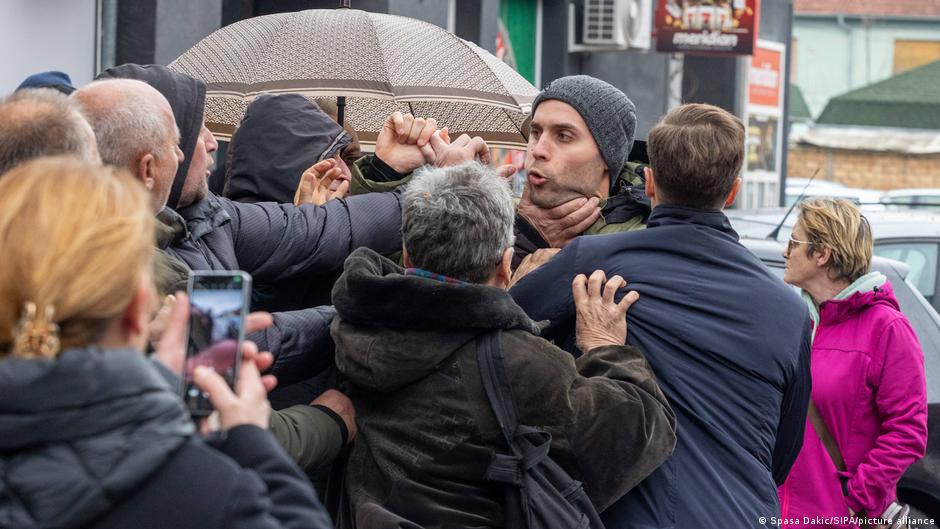
In many municipalities, reports point to organized groups active on the ground. Masked men armed with sticks and, in some cases, axes were seen chasing citizens through the streets, attacking journalists and confronting election observers attempting to document irregularities.
By the end of the day, not only were the ballots being counted, but so were the injuries – bloodied heads, hospitalized journalists and beaten observers.
‘Protecting democracy’
According to Nedeljkov, these events were not spontaneous. Their coordination and resources suggested political support. “You don’t need to be a sophisticated observer to see the connection,” he said, pointing to cases where individuals involved in violence were seen entering or leaving party premises and public institutions.
That’s why the CRTA ultimately described election day as “terror against citizens.”
But the violence was at times openly condemned by officials and pro-government media. Sharing footage of men dressed in black chasing citizens with batons, Serbia’s parliament speaker Ana Brnabić wrote on Twitter: “This is an attempt to protect democracy from blockades.”
Even the presence of police did not help in restoring order. In many cases, their response appeared inadequate or delayed, leading to the perception that the violence unfolded with limited institutional control.
narrow margins, deep changes
Despite the pressure, the SNS’s victory was much less credible than in previous elections.
In many municipalities, the SNS’s victory was decided by very narrow margins, sometimes by only a few hundred votes. In a political system long defined by comfortable and predictable victories for the ruling party, such outcomes are inevitable. They suggest that, despite the presence of full control, support for SNSs may be low.
“These are small municipalities where the SNS has traditionally been very strong. And yet, in at least three or four of them, the victory came down to one or two seats,” said Dusan Spasojević, a professor at the Faculty of Political Science in Belgrade. “In many respects, SNS will now depend on coalition partners. This is not the reality they are accustomed to, and it is certainly something they should be concerned about.”
Although it is still too early to talk about a turning point, the results point to emerging cracks in a system that has long appeared to be an unstoppable system. For Spasojević, the main lesson is the need for coordination between different actors – opposition parties, the student movement and civil society.
The priority for Rasa Nedeljkov is to continue the fight for fair electoral conditions.
“For those who believe that nothing can be achieved through elections, the opposite is true,” he argues. “If we give up, what we saw in these ten municipalities will become the rule, not the exception that demands condemnation and collective action.”
For now, the ruling party can still claim victory across the board. But attention is already turning to what comes next: the possibility of early parliamentary elections, widely seen by parts of the opposition as the next – and potentially decisive – test of strength.