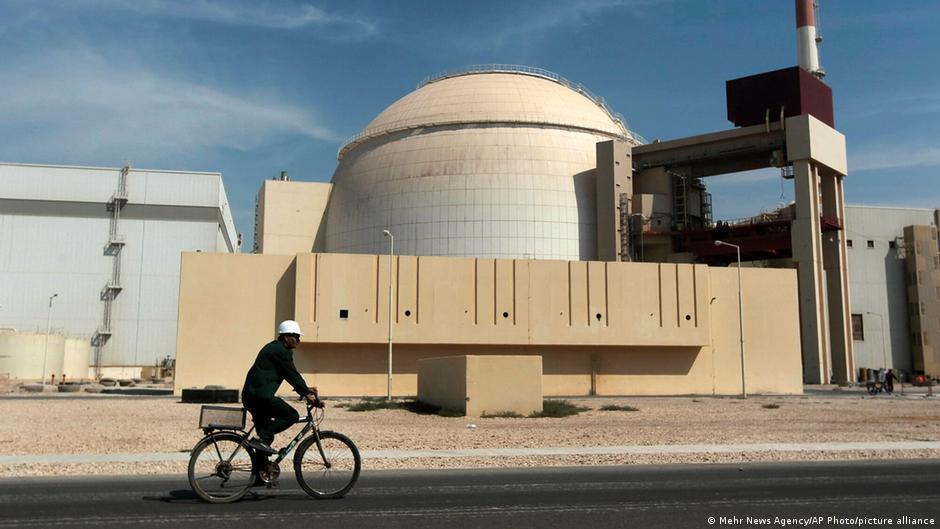
There is no doubt that the nuclear threat in the Middle East has increased during the current conflict.
During the war, which began in late February when the US and Israel attacked Iran, nuclear sites in both Iran and Israel were targeted.
US President Donald Trump has said that the war against Iran was started so that Iran could be prevented from getting nuclear weapons. But, experts suggest that it can also have the opposite effect.
Possession of nuclear weapons is considered a deterrent. The theory is that they prevent your enemies from acting against you.
Observers often cite the case of North Korea. It has developed nuclear weapons, which some argue make the dictatorship untouchable.
Ukraine provides an example of the contrary. In 1994, Ukraine agreed to give up the world’s third-largest nuclear arsenal in exchange for security guarantees from Russia, the US and Britain. Now the argument is that if Ukraine had possessed those weapons, Russia would not have been able to attack.
‘Nuclear latency’ is not enough
Iran was considered to be in a state called “nuclear weapons latency”. Nuclear weapons latency occurs when a country has all the equipment to build a nuclear weapon but has not yet done so.
“For years, Iran has maintained strategic ambiguity, staying just below the bomb threshold to avoid the attacks that would now occur,” Roopal Mehta, a US political science professor, wrote in a commentary. London School of Economics Earlier in March. “Tehran’s new leadership faces a grim reckoning: While pursuing nuclear weapons was dangerous, keeping the incomplete bomb was a fatal mistake.”
This week, Iranian politicians said the country could withdraw from the landmark treaty meant to prevent the spread of nuclear weapons. The 1968 Treaty on the Non-Proliferation of Nuclear Weapons, or NPT, has 191 member states.
Due to the changes that Iran has brought in security relations in the region, other countries may also aspire to nuclear weapons.
“There are a number of factors that would move Gulf states closer to nuclear weapons,” confirms Kelsey Davenport, director of nonproliferation policy at the Washington-based Arms Control Association.
The Gulf states are caught between the hegemonic desires of Iran and Israel and have at least partially lost confidence in their security alliances with the US.
“However,” Davenport continues, “it is unlikely that any state will immediately look forward to the bomb. There are significant technical and political hurdles that any state in the region will need to overcome if they wish to produce the weapon.”
Davenport said Gulf leaders would also be waiting for the conflict to end to see where Iran’s regime and its nuclear program end up. “But certainly this conflict will lead to thinking about the need for nuclear weapons for security.”
Who wants nuclear weapons?
Saudi Arabia took the first steps toward possible nuclear deferment last year. Recently, Saudi Arabia’s ruler Mohammed bin Salman had said that if Iran makes a nuclear bomb, then Saudi Arabia will also need a nuclear bomb. After a visit to the US in November, Salman reportedly returned with an agreement on nuclear cooperation that would allow his country to enrich uranium.
Noor Eid, an independent researcher based in Paris, points out that any such agreement with Saudi Arabia would first have to pass through the US Congress. published letter On nuclear ambitions in the Middle East for several think tanks.
Nearly all of the US’s 26 nuclear cooperation agreements, which cover about 155 countries, including Europe, include what is known as an “additional protocol” signed with the International Atomic Energy Agency, or IAEA. This gives the IAEA better oversight over a country’s nuclear activities. Although it has not yet been officially confirmed, it appears that the 123 agreement will only require a bilateral security agreement between the US and the Saudis, Eid told DW.
“This is without precedent,” said former IAEA director Robert Kelly. told media outlet Bloomberg This week. “The idea that the administration is willing to give Saudi Arabia the ability to do the things they are bombing Iran for seems hypocritical.”
Yet, as Eid points out, it will take about 10 to 20 years for the Saudis to develop nuclear power, let alone a weapon. There are other problems too such as lack of competent workforce. At the moment, he believes the Saudis view nuclear projects mostly as a source of domestic energy.
The UAE already has one nuclear power plant, Barakah. When they reached their agreement with the US in 2009, they agreed to abandon the Additional Protocol and uranium enrichment and reprocessing.
Eid says that for the UAE it was always about the prestige of being the first Arab nation to develop nuclear energy, rather than military ambitions. “But there is a clause in their agreement, a verbal clause that is not written into the final text, which says something along the lines of ‘if there is a more flexible agreement with a neighboring country they [the UAE] Reserve the right to renegotiate your terms,” she explains.
Eid notes that the reason for a more relaxed Saudi nuclear cooperation agreement in 2025 is likely due to US competition with China and Russia, which are the main nuclear suppliers globally. Eid points out that Trump promised to revitalize the US nuclear sector and so far nuclear agreements with Russia or China tend to have less stringent terms and interesting financial packages.
Davenport of the Arms Control Association said other countries in the Middle East that could be in line for nuclear latency include Egypt and Türkiye.
Egypt, in cooperation with Russia, is building a nuclear reactor on the Mediterranean coast. But observers say Egypt, which has officially advocated a nuclear weapons-free Middle East, is in financial difficulties and is unlikely to be able to incorporate nuclear energy into its weapons program.
Eid said Türkiye is currently developing a nuclear energy program with Russia and may soon start cooperating with China as well. “But I don’t understand why they would put the international community on their side just to get nuclear weapons,” Eid said. “Their defense industry is growing well and getting a lot of recognition.”
Eid told DW that Türkiye is a member of NATO and while they do not plan to leave that alliance, they also have a defense umbrella.
How to stop nuclear proliferation?
It’s also important to look at the bigger picture on nonproliferation, Davenport said.
“It is not in Chinese or Russian interests to allow the complete collapse of the nonproliferation regime,” he told DW. “If you zoom out from the Middle East, some of the states that are most likely to make weapons are in China’s backyard – like South Korea, Japan.”
He argues that although Russia and China can provide materials and technologies to help build nuclear weapons, and under less stringent regulations than the US has in the past, they will not actively assist.
Davenport added, “What is more likely is that the Gulf states may try to exploit the divisions between the US and Europe on the one hand, and Russia and China on the other, to mitigate the consequences of moving over the threshold to nuclear weapons.”
She emphasizes that regional dialogue is the solution to prevent more nuclear weapons. Davenport concluded, “I have no illusions that, post-conflict, regional security negotiations will be easy or straightforward.” “But it is the best option to prevent states from deciding that nuclear deterrents are necessary.”
Edited by: Andreas Illmer