
Bitcoin was approached as a system, protocol and tool, beyond the speculative.
“Bitcoin is being planted in one of the most relevant institutions in the country,” says the organizer.
Education about bitcoin (BTC), the first digital currency on the market, continues to expand in academic institutions in Latin America. On this occasion, the Industrial Engineering program at the Universidad Mayor de San Andrés (UMSA), one of the most prestigious educational institutions in Bolivia, created a formal space for teaching Bitcoin.
Unlike usual business approaches, The workshop focused on the architecture of the protocol and its functional usefulnessmoving away from the speculative narrative of financial markets.
The academic meeting was designed to present Bitcoin under three fundamental pillars: as a system, as a network protocol and as a privacy technological tool. The initiative, carried out by the local Bitcoin Research community, arises from the need to shift the public debate from price volatility to the robustness of its engineering.
Being taught in a technical college, the analysis allowed engineering students evaluate decentralization and security properties that the network offers, key elements for the development of professional solutions in the near future.
The relevance of this event lies in the institutional weight of the university where it took place. According to the organizers, the arrival of the digital asset to these classrooms represents a strategic advance for the country.
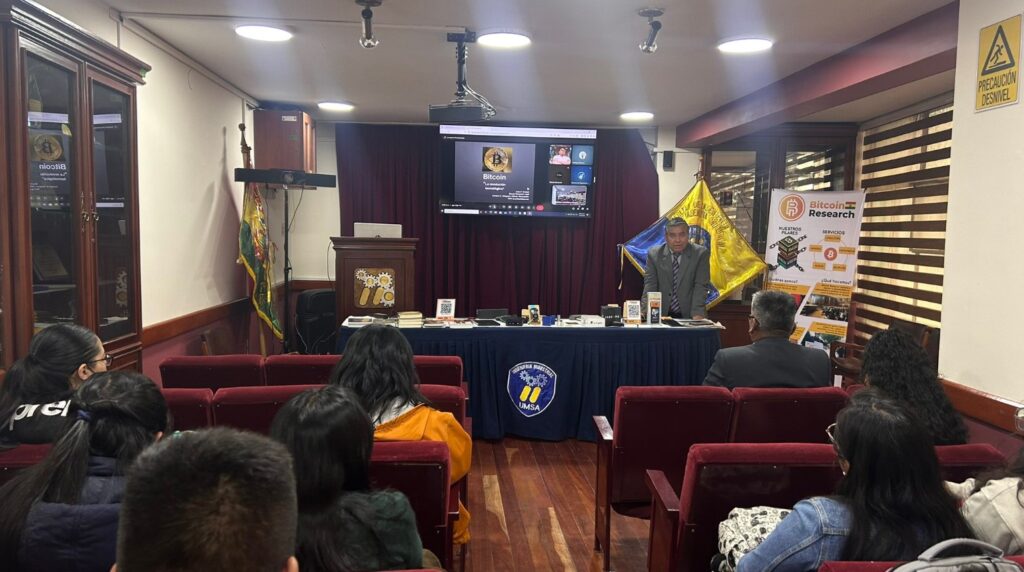
“Bitcoin is being planted in one of the most relevant institutions in the country,” they pointed out from Bitcoin Research through social networks after concluding the information day. For the promoters of this activity, the UMSA constitutes fertile ground for technological adoption due to its influence on the training of future Bolivian professionals.
During the workshop, taught by the educator identified as Juan Pablo (@juanpybtc), attendees not only received theoretical concepts, but also witnessed the technical operation of the network in real time.
One of the highlights of the training was performing an actual transfer of funds sent from the Middle East to Bolivia. This practical demonstration served to illustrate the efficiency of digital currency in sending cross-border remittanceseliminating intermediaries and reducing settlement times that usually affect the traditional banking system.
The success of this first academic foray has laid the foundations for continuity in the complementary studies program of the Faculty of Engineering. The organizers confirmed that The second part of this training is already in the preparation phasereaffirming the institution’s commitment to integrating knowledge about digital assets into its academic environment.
«The goal is to sow the seed of understanding Bitcoin»
In statements to CriptoNoticias, the Bitcoin Research team stated that with these workshops, The intention is to sow the seed of knowledge and understanding of Bitcoin. “Make people understand why bitcoin is important, and that in the future there will be people who have solid knowledge of bitcoin,” said the enthusiasts.
The bitcoiners pointed out that, in addition to the workshops, such as the one given at the UMSA, They give Bitcoin classes in rural and urban schoolsas well as in non-profit organizations. In fact, they teach bitcoin to blind people, which is complemented by the workshop at the university, where there are study programs for people with some difficulties.
“We only have to continue working on bitcoin,” indicated the organizers, who, through the Bitcoin Research initiative, have managed to implement nodes, wallets and even a P2P BTC exchange. with the support of entities such as Mostro and Cashu4Community.
«These tools help us understand bitcoin, and we do not focus on other technologies (cryptocurrencies, blockchain, tokenization). We carry all our disclosure with the three pillars: security, privacy and self-custody,” they said.
The integration of Bitcoin into the UMSA curriculum marks a milestone in Bolivian technological education. By focusing on protocol engineering and demonstrating real use cases, the university seeks to legitimize decentralized technology in the professional sphere.
In a local context, where more than 100 commercial establishments accept bitcoin as a payment method, specialized academic training becomes essential so that new generations of Bolivian engineers can lead the implementation of financial infrastructures based on open source.