Last week, an AI-generated video by Chinese state media showing Persian cats and bald eagles symbolizing the US-Israel war with Iran went viral, garnering nearly a million likes and flooding comment boards in a matter of hours.
The video offers a glimpse of how Beijing interprets the Iran conflict to shape domestic public opinion, and the main message conveyed to the Chinese public aligns with the commonly used narrative that the US is an aggressive, declining hegemon, while China remains a stable, peaceful rising power.
Viral video produced by CCTV shows tormented “Persian cats” seeking vengeance against the cocky “white eagle” that dominates the desert area called “Golden Flow Valley”. The Eagle forces the area to trade a rare resource, called “Black Iron Essence”, specifically using the “White Eagle Gold Ticket”.
After the eagle kills the leader of the Persian Cat, an asymmetrical war of attrition begins where the eagle spends expensive “anti-air golden needles” to kill cheaper “wooden birds”.
The thinly veiled symbolism has been implicit in Beijing’s overall political messaging since the war began, and this narrative has spread throughout China’s media apparatus.
“From the beginning, Chinese officials have been very clear in characterizing the war as illegal and a threat to global stability,” said WA Figueroa, an assistant professor of history and international relations at the University of Groningen in the Netherlands.
“The image presented is of a stable, engaged and diplomatic China in contrast to an aggressive and unpredictable United States,” he said.
China’s media strategy
In sharply worded comments, the official Xinhua news agency discussed Washington’s real goal as an “Iran without sovereignty”, characterizing the war as “not for security but for hegemony”.
On domestic social media, these grand geopolitical topics are chopped into highly digestible, nationalistic pieces.
“Jing Si You Wo”, a popular influencer on Chinese short video app Douyin, reaches a massive audience on social media. Recent videos gleefully declare that the US has “given up” in the face of the Iranian proposal, and that Iran’s greatest weapon is its will to “mutual destruction.”
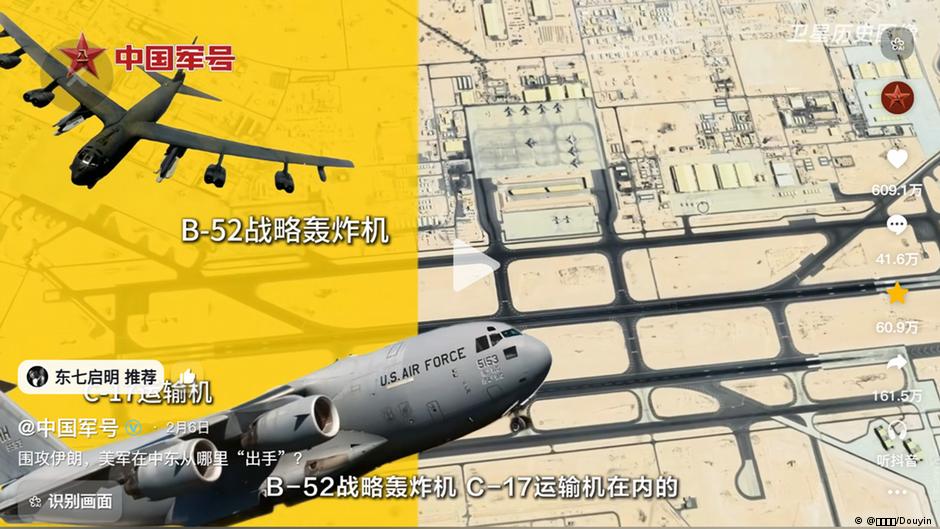
The Chinese military’s official Douyin account also published a video using high-definition satellite imagery to rigorously analyze the US deployment in the Gulf.
The post received more than 6 million likes, a possible indication that China’s domestic population is eager to study US military tactics and strategy.
Eliza Bachulska, China analyst at the European Council on Foreign Relations, told DW that CCTV’s AI video highlights developments in Chinese state propaganda by filtering it through a popular fantasy martial arts genre called “wuxia.”
Bachulska observed that the use of artificial intelligence makes official narratives “more palatable” and “fun” for local audiences than dry TV coverage.
By cleverly drawing on deep-rooted nostalgia for 1980s Hong Kong kung fu cinema tropes, state media have seamlessly incorporated geopolitical talking points into popular culture.
China creates its own story compared to America
Figueroa, whose research includes contemporary China-Middle East relations, said the political calculations behind China’s narrative on the conflict in the Middle East are part of a broader, long-term strategy.
He said the Chinese government should continue to respond to Washington’s allegations that China is a destabilizing force.
“This gives them an opportunity to demonstrate not only to the world but also to their own people that China is doing really well. China is moving forward and China is a stable power,” he said.
Bachulska said Chinese political elites view the world through the lens of existential rivalry.
“All global developments are being looked at from the perspective of how China can use these developments to strengthen the narrative that the US is a neo-imperialist power and it is a malign actor,” he said.
Ultimately, Beijing proudly offers its own geopolitical solution to the global chaos that it eagerly unleashes.
“Cat and Eagle” animated the brief conclusions with Chinese martial arts wisdom: “The ultimate essence of martial arts lies not in wielding weapons, but in restraining violence.”
And just as savvy traders bypass White Eagle’s trade barriers, the video contains veiled strategic promotion of China’s Belt and Road Initiative as the last route to escape US economic hegemony.
Edited by: Wesley Rahn