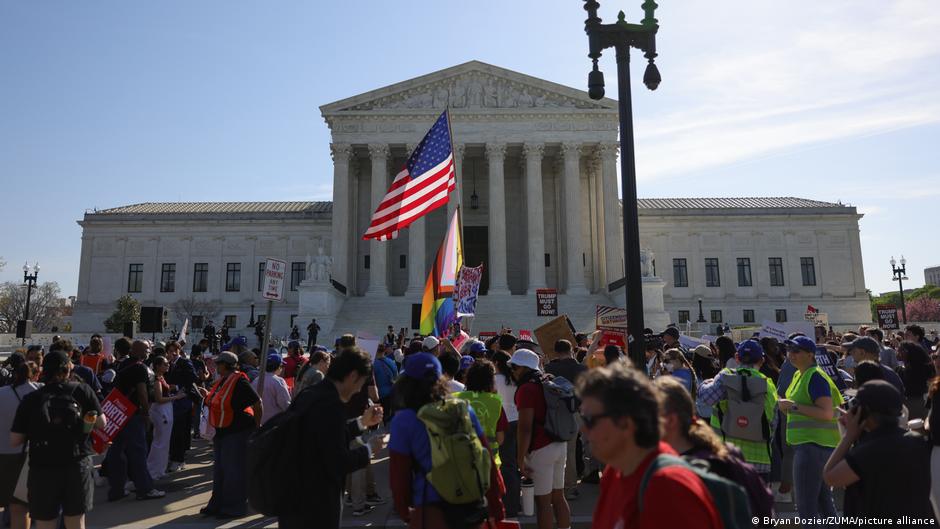
US President Donald Trump made a rare and historic appearance at the US Supreme Court on Wednesday, where he watched as his administration’s lawyer, Solicitor General John Sawyer, challenged the constitutionality of birthright citizenship during oral arguments.
Trump signed an executive order on his first day in office stripping citizenship from the children of undocumented immigrants, effectively granting citizenship to the parents’ legal status in the US.
But this order conflicted with the 14th Amendment to the Constitution, ratified in 1868, which states that “All persons born or naturalized in the United States, and subject to the jurisdiction thereof, are citizens of the United States, and of the State wherein they reside.”
The birthright citizenship order has been rejected by every lower court that has considered it. It is now before the Supreme Court, where a final decision on the issue is expected in June.
Trump becomes the first sitting president to attend a Supreme Court hearing
Trump is the first sitting president to participate in the oral debate. The last time presidents visited the court and argued cases was in the 19th century, but they all did so after leaving office.
Trump sat in the front row and was joined by Commerce Secretary Howard Lutnick, as the two listened to the court proceedings for a little more than an hour and a half. Outside the courthouse, protesters gathered with signs supporting birthright citizenship and rejecting Trump.
Sawyer argued in court that “unrestricted birthright citizenship contradicts the practice of the overwhelming majority of modern nations” and “insults the priceless and profound gift of American citizenship.”
“It serves as a powerful disincentive to illegal immigration and rewards illegal aliens who not only violate immigration laws but also jump ship in front of those who follow the rules,” he said.
Court expressed doubt on Trump’s case
Both conservative and liberal judges questioned Sawyer on Trump’s order, with the judges asking about the legal basis of the order and expressing practical concerns about its implementation.
“Are you suggesting that people should have documentation when a baby is born? Present documentation? Is this what’s happening in the delivery room? How are we determining whether a newborn baby is a citizen of the United States under your regime?” liberal Justice Ketanji Jackson asked Sawyer.
Conservative Chief Justice John Roberts told Sawyer that it seemed “strange” to limit those who qualify for citizenship at birth “subject to his jurisdiction” based on the language of the 14th Amendment.
Conservative Justice Brett Kavanaugh also suggested that federal citizenship laws support widespread birthright citizenship in the US.
Meanwhile, Justice Clarence Thomas, the most likely of the nine justices to side with Trump, pointed out that the amendment was intended to provide citizenship to black people, including freed slaves.
“How much of the debate around the 14th Amendment had anything to do with immigration?” he asked.
ACLU says US follows English common law
Sawyer argued in court that the US “stands out among modern countries” in terms of birthright citizenship, pointing to places in Europe that do not allow birthright citizenship.
Cecilia Wang of the American Civil Liberties Union, which is legally fighting the government, argued that the US follows English common law, which grants citizenship based on the legal concept of jus soli, or “right of soil”.
He said that when the issue was raised in 1898 “on substantially the same grounds that they are raised today, this Court said no,” adding that “This Court recognized that the 14th Amendment embodies the English common law rule: virtually everyone born on American soil is subject to its jurisdiction and is a citizen.”
Edited by: Alex Berry