With this system, cryptocurrencies will be integrated into the balance of treasuries.
The price of XRP has not risen after this announcement.
Ripple Labs advanced its integration strategy between traditional finance and digital assets by incorporating XRP and Ripple USD (RLUSD) yesterday, April 1, 2026, into its corporate treasury management system, Ripple Treasury.
In that way corporate finance teams can maintain and manage digital assets along with fiat money within the same system.
According to explained the firm, the new functions allow assets such as XRP and RLUSD (among others that are not detailed in the statement) to appear integrated within treasury accounts, with real-time valuation and automatic registration of operations, eliminating the need to use multiple platforms or external tools.
The proposal aims to make digital assets work like any other financial balance within a companywithout forcing teams to interact directly with wallets, exchanges or complex infrastructures.
The company’s CEO, Brad Garlinghouse, stood out that the platform already processed some 13 billion dollars in payments last year and now adds native capabilities for digital assets.

As CriptoNoticias has reported, Ripple Treasury was presented on January 28, 2026 as a solution aimed at integrating traditional financial management with digital asset infrastructure. The platform is supported by GTreasury, a software with more than 40 years of experience in corporate treasury management, acquired by Ripple in 2025 for $1 billion.
This system allows companies to manage liquidity, forecast cash flows, manage risks and process payments on a global scale, connecting to thousands of banks and processing trillions of dollars per year.
On that basis, Ripple incorporated what it calls payment “rails”: an infrastructure that allows international transfers with continuous settlement (24/7), avoiding the limitations of the traditional banking system.
One of the central points is that Ripple Treasury is not designed only for companies linked to the digital assets sector. The platform also targets traditional financial teams that manage fiat money, but can now incorporate digital assets into their regular operations.
This reduces friction in international payments, avoids the need for pre-funded accounts and allows for more efficient management of working capital.
From a technical point of view, XRP is part of this infrastructure. It is used to pay network commissions and It can function as a bridging asset in international transfers within the XRP Ledger.
In that sense, if Ripple Treasury achieves large-scale adoption, it could increase activity on these rails and, indirectly, operational demand for XRP.
However, there is a key point: using the platform does not necessarily mean that companies must hold XRP on their balance sheets.
This limits the direct impact on the price. Despite the announcement, XRP price has not shown a reaction and continues to trade below $1.40:
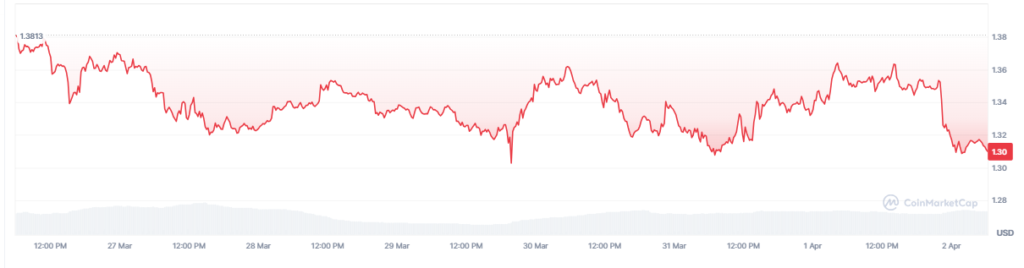
The lack of reaction in the price of XRP reflects precisely that dynamic. Despite this being a relevant advance in terms of institutional adoption, the market, for now, does not interpret it as a drivers immediate valuation.
This once again raises a tension that already appears in other Ripple movements: business and infrastructure growth does not translate into a rise in XRP.