
The study appeared on April 2, 2026 on the Zenodo platform.
The paper analyzes price, market capitalization, hash rate and adoption of Bitcoin since 2009.
The debate about whether the trajectory of the price of bitcoin (BTC) is purely erratic or responds to mathematical patterns has reached academic repositories. This April 2, 2026, physicists Giovanni Santostasi and Stephen Perrenod published a technical article on the Zenodo platform that formalizes the Power Law Theory applied to the pioneering digital currency.
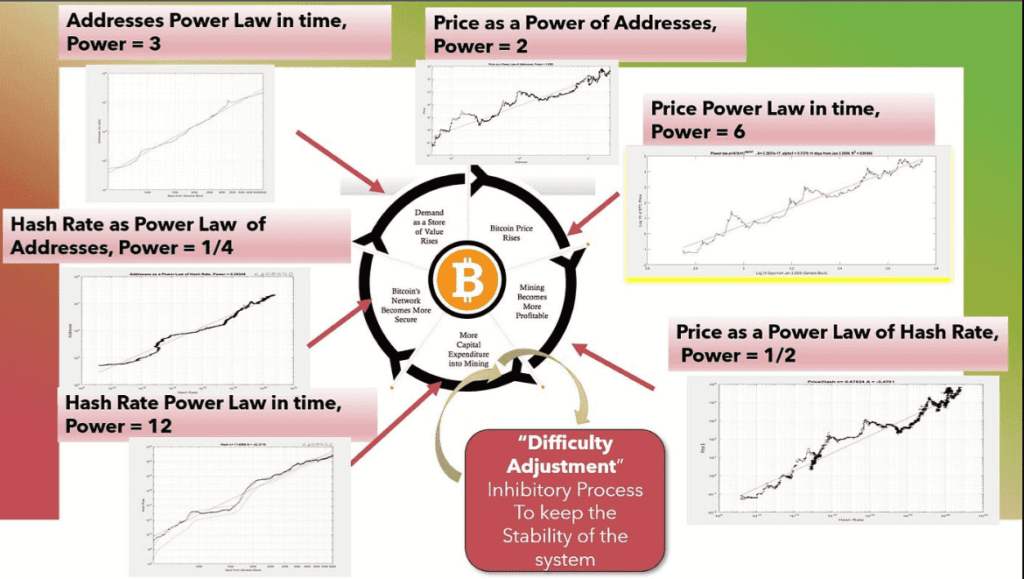
The study, whose main focus is to derive and explain mechanically why the price of bitcoin follows a power lawseeks to determine whether the digital asset evolves under statistical principles similar to complex systems observed in nature. According to the authors, this approach would allow Satoshi Nakamoto’s creation to be analyzed as a system in constant and measurable growth.
A power law describes a functional relationship where one quantity varies as a power of another. Santostasi and Perrenod maintain that, when analyzing variables such as price, hashrate (computing power), and user adoption, bitcoin shows a stable trajectory when projected on long-term time scales.
The central thesis suggests that the value of the network is linked to its own scale and the passage of time. For analysts who support this model, this offers a technical alternative to the traditional theory of halving cycles (emission reduction), providing a quantitative metric that could be used by institutional investors to assess risks.
The debate about the predictive capacity in bitcoin
Despite the statistical rigor presented, the scientific and financial community maintains divided positions. On social networks and specialized forums, some analysts receive the document as a step towards the professionalization of the sector.
As HEñto the Pius Sprenger, with experience on Wall Street and doctor in mathematics, the article demonstrates that the long-term price behavior of bitcoin can be largely explained by the growth of your network of users and how the value of that network increases according to Metcalfe’s Law.
This law, proposed by Bob Metcalfe (inventor of Ethernet) in the late 80s and early 90s, states that the value of a network is proportional to the square of the number of its users (V ∝ n²).
In this way, as more people join the Bitcoin network, the number of possible connections grows quadratically, leading to an exponential increase in the utility and perceived value of the currency.
Nevertheless, Model critics warn of risk of ‘data overlay’ (overfitting). They argue that a historical correlation, no matter how precise, does not imply causation or guarantee future behavior. External factors such as regulatory tightening or a global liquidity crisis are variables that the mathematical model cannot fully integrate.
«Santostasi overfits historical data to create the illusion of predictability. “His main argument is that the price of bitcoin is determined by human behavior, ETF flows, regulation, market psychology, and that fitting a physics-style regression to that data can look impressive without actually predicting anything,” noted analyst Trey Seller in his publication recent.
Publishing on Zenodo makes it easier for other researchers to audit the data and formulas used by Santostasi and Perrenod. It is important to note that, as it is an open access repository, the document now begins its scrutiny phase by the global academic community.
The emergence of this academic document invites an inevitable comparison with Plan B’s Stock-to-Flow (S2F) model, which for years dominated the Bitcoin investment narrative, as CriptoNoticias has reported.
While Plan B’s thesis focuses almost exclusively on programmed scarcity and the impact of halvings as drivers of value, Santostasi and Perrenod’s Power Law proposes a more holistic and less volatile view, suggesting that network growth is a continuous process of adoption and scale.
This transition from analysis based on “supply shocks” to “organic growth” models marks a point of maturity in the way quantitative analysts try to decipher the future of this asset.