
Despite the historical cycle, the derivatives market shows bullish data, according to Sigel.
“Much of the old supply of bitcoin has already been purged,” says the specialist.
Matthew Sigel, head of digital asset research at VanEck, assured that the bitcoin (BTC) market is showing positive signs, but that it is not yet time to adopt an extremely bullish stance.
The statement was made during an interview published this April 1, 2026, on the channel Anthony Pompliano’s YouTubeAmerican investor. There, Sigel reviewed his projections on BTC, the macroeconomic context, and the impact of geopolitics on the markets.
“We remain bullish, but we have not increased positions as much as could be expected, given that we respect the four-year cycle,” explained the analyst.
His vision is based on the historical behavior of bitcoin, which is usually structured in cycles of approximately four years in which bullish and bearish movements alternate. This pattern is linked to the halving, the scheduled event in the Bitcoin protocol that halves the issuance of new units of the digital currencyas CriptoNoticias has explained.
As new supply decreases, the market has tended (after the halvings of 2012, 2016, 2020 and 2024) to react with price increases in each year after the halving.
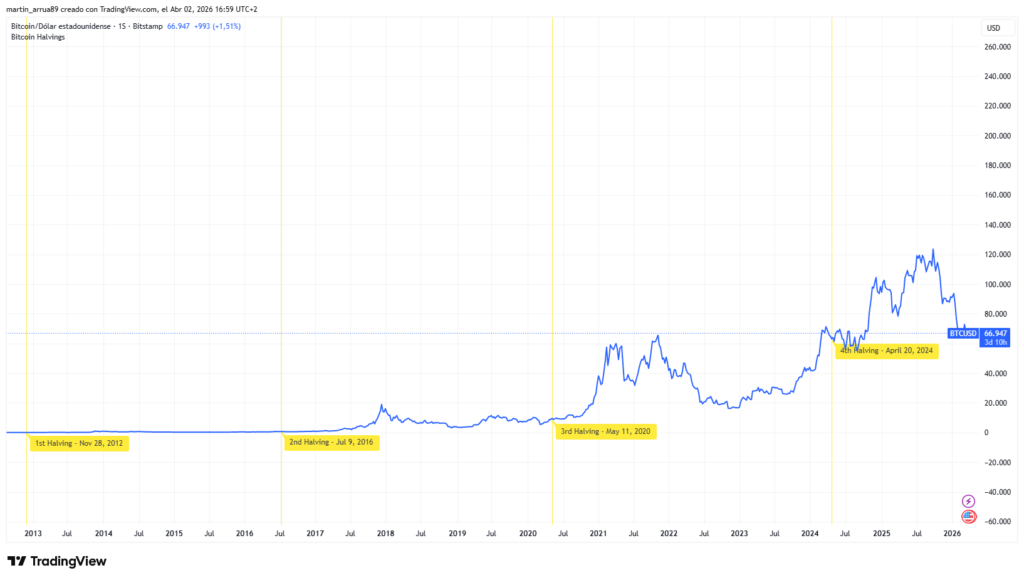
Likewise, the second year after each halving has always been bearish and 2026 is no exception. “On bitcoin, the four-year cycle prevents us from being ‘maximally bullish,’” he said, making it clear that The current context requires a more nuanced reading of the market.
Sigel remains optimistic
Despite this caution, the specialist identifies technical signs that reinforce a positive vision. One of the main ones comes from the derivatives market, where contracts such as futures and options are traded. These instruments allow investors to anticipate prices or protect themselves against adverse movements, and They usually offer relevant information about market positioning.
Sigel also supported his vision with specific data from the derivatives market. “The cost of puts versus calls is in the 99th percentile, which means people are paying a lot for protection,” he explained, adding, “The derivatives market makes me optimistic.”
In practical terms, this refers to the options market, where Investors use contracts to hedge against possible falls (puts) or bet on raises (calls). When put options become more expensive relative to call options, it indicates that there is strong hedging demand.
This data has a specific technical reading: when investors pay a lot for downside protection, it means that there is a high level of coverage in the market. In that context, If strong bearish movements do not materialize, selling pressure tends to reducewhich can favor price increases. This is what is known as a contrary signal.
Another central element in his analysis is the behavior of the supply of the most valuable digital asset on the market. Sigel noted that sales by historical BTC holders (better known as “OGs”) have declined in recent months. In this regard, he said:
Sales of “OG” (3-5 year old coins) have moderated recently. Although miners like MARA will continue to be sellers, much of that old supply has already been purged.
Matthew Sigel, Head of Digital Asset Research at VanEck
This point is key. Ancient coins, which remain dormant for years, They usually generate downward pressure when their owners decide to sell. If a relevant part of that supply has already been absorbed by the market, the risk of new massive sales decreases, which contributes to stabilizing the price of bitcoin.
Even so, Sigel acknowledged that miners continue to be structural sellers. In his analysis, he explained that these companies “have to sell bitcoin” to finance operations and adapt to new business models, such as the reconversion of part of their infrastructure towards artificial intelligence and high-performance computing.
Sigel’s idea about miners as a persistent source of supply finds echo in recent movements in the sector. As CriptoNoticias has reported, MARA Holdings sold 15,133 BTC between March 4 and 25, for about 1.1 billion dollars to repurchase convertible debt and gain financial flexibility. Although the company maintains that it is not abandoning its BTC-focused strategy, the operation is also linked to a broader process of diversification into infrastructure linked to AI and high-performance computing.
Thus, while the old supply seems to have lost weight as a factor of downward pressure, sales from miners continue to be a relevant component in market dynamics. Unlike large historical holders, however, this selling flow is usually more predictable.
Sigel’s analysis, in any case, is not limited to the offer: It also incorporates the macroeconomic and geopolitical context that hits the market squarely.
The conflict in the Middle East
Sigel mentioned the uncertainty around the Strait of Hormuz, a strategic passage through which 20% of the global energy supply circulates.

Tensions in that region can impact energy prices and, by extension, global inflation. This, in turn, influences the US Federal Reserve’s (FED) decisions on interest rates. A high rate environment reduces available liquidity and negatively affects assets considered riskylike BTC and cryptocurrencies.
This intersection of factors generates clear tension in the market. On the one hand, technical indicators such as derivatives and reduced supply suggest a favorable scenario; On the other hand, the historical cycle and macroeconomic conditions invite caution..
In this context, Sigel’s position lies somewhere in the middle. The analyst does not rule out a bullish scenario, but considers that the conditions for widespread euphoria are not yet in place.