When the Armenian Prime Minister, Nikol Pashinyan, got out of a car and headed towards his host, Turkish President Recep Tayyip Erdogan, in June 2025, it was truly a historic moment. The two politicians shook hands and faced the camera together. This was the first time that a representative of the Armenian government had visited Turkey, and he was invited by the Turkish head of state.
Türkiye and Armenia share an approximately 330-kilometre-long (200 mi) land border, but close ties between the two countries go back more than a century. Relations have always been affected by the genocide of the Armenian people in the Ottoman Empire in 1915, which Germany and several other Western countries officially recognized as genocide in 2016.
Ankara’s stance on the Nagorno-Karabakh conflict has deepened the rift. Turkey sided with Armenia’s rival Azerbaijan and closed the Turkish-Armenian border in 1993.
Peace agreement opens up new possibilities
However, a cautious adjustment is underway from 2022 onwards. Armenia no longer insists that Ankara recognize the events of 1915 as genocide.
Also last year, Armenia signed a peace deal with Azerbaijan, finally ending the decades-long war over Nagorno-Karabakh. Since then, Turkish companies have dared to hope for the normalization of relations in the region and the opening of the border with Armenia, which has been closed for more than thirty years.
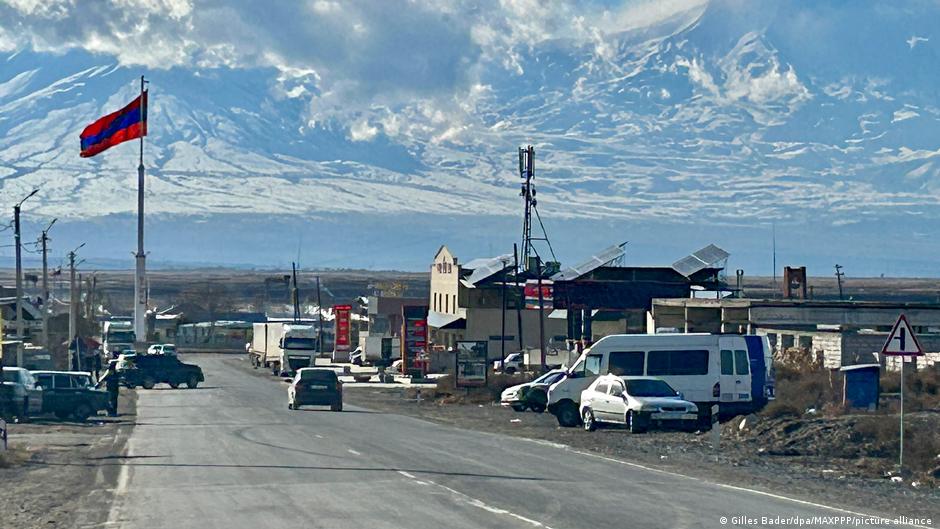
There are two border crossings from Türkiye to Armenia: Alikan, in Iğdır Province, and Akyaka, in Kars Province. Both have been closed since the first Nagorno-Karabakh war, but according to observers, they could be reopened within a few months.
Armenian media report that their government has already made the necessary preparations. On the Turkish side, work is still in progress, but already at an advanced stage.
If the crossing opens before Armenia’s parliamentary elections in June, it would be a major victory for Prime Minister Pashinyan. For years now, he has been pursuing reconciliation with Türkiye, and trying to bring Armenia closer to the West.
Alternative trade route through Georgia
Kan Soyk, head of the Turkish-Armenian Trade Development Council, says the two countries have had to trade indirectly for years due to the sealed border. He says that about 300-350 million US dollars (about 300 million euros) of trade passes between them through Georgia. Their statistics show that about 99% of this cargo is transported from Türkiye to Georgia, then to Armenia.
According to Soyk, these are mainly clothing, chemical products, foodstuffs and raw precious metals. He strongly believes that with the border open, bilateral trade volume can rapidly increase to one billion dollars. He also hopes for the rapid construction of logistics corridors, including energy and telecommunications lines that will directly connect the entire Caucasus.
But Iran has delayed the countdown. According to Soyak, the expansion of the war to affect the Gulf countries, Iraq and Lebanon has raised fears of a new wave of migration. As a result, progress on plans to open the land border between Armenia and Türkiye has slowed.
Anatolia hopes to boost tourism
Türkiye’s eastern provinces, including Kars, Iğdır, Agri, Ardahan and Van, are just a short distance from the Armenian border. They are also among the poorest regions of Anatolia. According to the Turkish Statistics Institute, they rank lowest in city rankings with a per capita GDP of only €3,250 to €4,350.
The people of the region therefore have high expectations for cross-border movement of goods and people and the arrival of visitors to Armenia and the Armenian diaspora from around the world. Many important historical and religious sites are located along the Turkish border, so opening it could provide many new opportunities for tourism.
Kadir Bozan, head of the Kars Chamber of Commerce and Industry, also emphasizes the importance of the so-called Trump Corridor. Members of his organization consider this route and its associated infrastructure to be extremely important.
The creation of the Trump Route for International Peace and Prosperity was agreed last August as part of a peace plan between Armenia and Azerbaijan brokered by US President Donald Trump. The plan envisages a 43-kilometre (26 mi) road and rail corridor through Armenia, connecting Azerbaijan with its Nakhchivan region, before continuing to Turkey.
Transport corridor between China and Europe
This corridor aims to strengthen the Trans-Caspian international transport route and reduce transportation time between China and Europe. Türkiye sees this as an opportunity to become a major player in global trade. Last August, it began construction of a 224-kilometre (139 mi) railway section as part of the route, intended to carry millions of passengers and millions of tonnes of freight each year.
Bozan emphasizes that, for this reason, many people in the region are hoping that the Iran war will end soon, so that the region can develop as a center of trade and tourism. Bozan points out that his city, Kars, already has a very good, popular train connection to Baku via Tbilisi.
People in the neighboring province of Ardahan, which shares two border crossings with Georgia, also have high hopes for Turkish-Armenian rapprochement. Ardahan is located just 20 kilometers (12 miles) from the Armenian border, and Cetin Demirci, head of the Ardahan Chamber of Commerce and Industry, believes it will soon be the site of new production facilities, factories, industrial zones and warehouses.
Demirci says his city has been shrinking for years, with many young people leaving the city. He believes opening the border here will create much-needed jobs and revive the economy.
Kamil Arslan, head of the Igdir Chamber of Commerce and Industry, is also optimistic about the future. “Business knows no nationalism,” he says – people just want more than thirty years of sympathy between Turkey and Armenia to end.
Arslan hopes to soon see food, construction materials, textiles and services flowing across the border into Armenia. Especially Igdir’s famous, sweet apricots – just like in the old days.
This article has been translated from German.