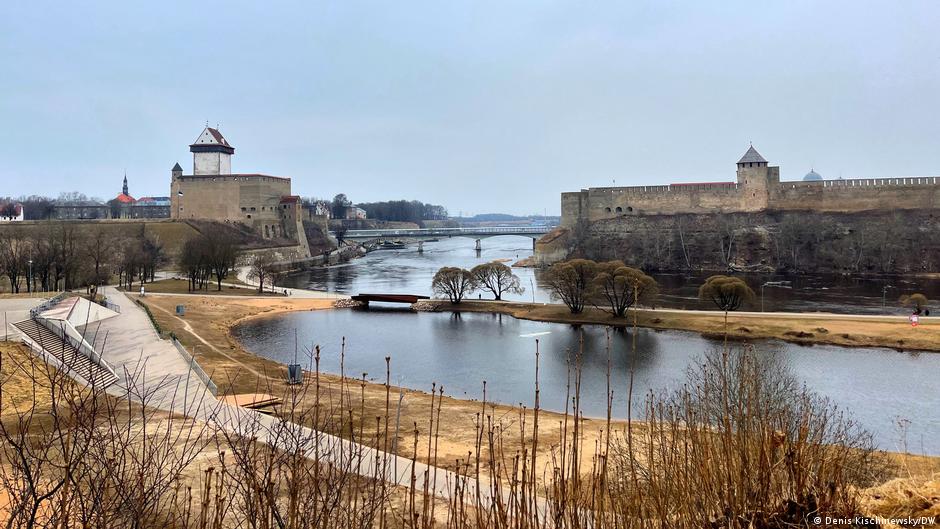
Looking at a simple map of Estonia, Narva is just another city on the eastern borders of the European Union. But in reality, the town of about 52,000 is much more important than that. Narva, in the Russian-speaking east of Estonia, is becoming a center of debate about European security, identity and the future of the bloc.
One reason for this is the demand on social media and platforms like Telegram to separate the city from EU member Estonia. These advocate the so-called “People’s Republic of Narva” and even include flag invocations and a coat of arms, reminding observers of pro-Russian propaganda about Crimea in Ukraine.
Estonian intelligence services have described the rumors as provocative and many locals have dismissed them as nonsense.
Are there separatists in Narva?
Life continues normally in Narva itself. The shop facades are an interesting mix of Soviet-era styles and contemporary European logos but today the streets are not crowded. Cold air from Finland blows across the Narva River. On the other side of the waterway is the Russian city of Ivangorod.
Narva still has a special connection with Russia. Only about 2% of its residents speak Estonian at home. Most speak Russian. One third of the population holds a Russian passport.
The Russian border is open but can only be crossed on foot during the day. Cars and buses cannot currently cross the bridge, which is undergoing maintenance until the end of the year. This decision to ban the vehicles was made by the Russian authorities.
For many residents of Narva, the bridge and border crossing are a regular part of daily life. Some go shopping, others visit relatives. The fact that the city borders Russia has an ethnic Russian majority, has led observers to draw parallels with Donbass and Crimea in Ukraine, and Transnistria, which is near Ukraine and Moldova. In each of these places there are locals who want to engage with Russia.
Important EU connections
But Narva also has strong ties to Europe. It is often described as the city where Europe begins and many locals are proud of this.
In September last year, Europe’s largest rare-earth magnet factory opened in Narva. It was funded by the EU and will produce magnets for electric vehicles, wind turbines and microelectronics. Until now, most of these magnets have been imported from China, so the Narva factory is an important step towards strategic autonomy for the EU.
For all these kinds of reasons, Narva’s mayor Katri Raik is not worried about any perceived separatist tendencies.
“The people of Narva are worried about the image of their city,” she says. “We get negative publicity from such reports and no one wants that. Our people love their city and they don’t have time to make up stories like this.”
On the streets, it is difficult to find anyone who wants to talk politics. “I’m not interested in it,” one elderly passerby told DW. “I’ve been living in Narva for a long time, and this city is the same. It will always be my city.”
If you ask locals about the idea of a “People’s Republic of Narva”, most will say it is fake or a joke.
“Complete nonsense,” says one local. “Unimaginable.”
Another protested, “I don’t think the residents of Narva would want to become part of Russia. I don’t know anyone who would want that.”
blame the bad economy
Local journalist Roman Vikulov could not imagine that there was so much support for separation from Estonia. “There are no separatists in Narva,” he says.
Vikulov admits that there may also be people in Narva who do not see many prospects for themselves in Estonia. “There’s a lot of despair and deep depression,” he said. “The mood is bad everywhere. But it is not aggressive.”
He argues that people move out of the city because they see no future for themselves here, not because they want to join Russia or leave Estonia.
They left, he adds, “out of despair and insecurity about the future of Narva”. “And this is directly related to the situation in our eastern neighbor [Russia] Is in. For a long time, we had good prospects as a border city. We expected people who would spend their money here. But that bubble burst a long time ago.”
Almost everyone you talk to says that life in Estonia is much better than in Russia. Those short trips across the border make this clear.
One of the examples pointed out by the locals is the construction of a promenade on both banks of the river, the European Union has actually contributed funding as part of a program to promote tourism and good relations between Ivangorod and Narva.
Estonian advantage over Russia
On the Estonian side there is now a pleasant walking path on the river bank. Meanwhile, city residents say the road on the Russian side is much shorter and the quality of construction is much worse.
This is despite the fact that the Russians received more money – $1.2 million (€1.04 million) – for the construction project than the Estonians: $830,000 (€720,000). A 2017 report by The New York Times concluded that corruption was responsible for the failures of the Russian resort.
These are the kind of comparisons you can easily make on a weekly basis, says Narva journalist Sergei Stepanov. Ivangorod is more depressed, people are poorer, pensions in the Russian region of Leningrad are almost three times lower than in Estonia.
This is why Stepanov cannot imagine that many locals would support separation from Estonia in the same way as Russian-speaking locals elsewhere did. “People don’t want to go to Russia,” he says.
City Council Vice President Jana Kondrashova sees it a little differently.
“There are always people who have a more radical worldview,” she admits. “Of course, we have people like that, but it’s not a widespread phenomenon.”
What does Russia think about Narva?
It does not mean that Russian imperialists and nationalists have forgotten about Narva.
In 2022, at the Saint Petersburg International Economic Forum, Russian President Vladimir Putin mentioned Narva as one of the Russian territories “recaptured” by Peter the Great in the 1704 battle. This statement caused protests in Estonia at the time.
Additionally, since the Russian invasion of Ukraine, the Russians have held a festival every year on May 9 on the banks of the Narva River, an occasion for Russian celebration commemorating the end of World War II.
It also featured Soviet symbols banned in Estonia, Russian pop stars, and a live broadcast of the parade on Red Square in Moscow, as well as Russian pop stars. In Ivangorod the stage and screen are always located on the river bank so it is clearly visible to people even in Narva.
This story was originally written in Russian.