Germany and Iran have been linked for a long time, as is visible today. At first, their relations were mostly cultural; Official diplomatic relations were established only later. Here’s a brief look at that shared history.
Goethe’s enthusiasm for Persian poetry
In 1814, at the age of 65, the German poet Johann Wolfgang von Goethe read a translation of the “Divan of Hafez” – a collection of poems by the Persian poet and mystic Hafez.
He was spellbound, writing: “And even if the whole world sinks, Hafiz, I only want to compete with you, only you do I want to compete with!”
Born around 1315, Hafiz’s real name was Mohammad Shemseddin. “Hafez” is an honorary title given to those who have memorized all 114 surahs (chapters) of the Quran. In Iran, Hafez remains a national poet, and many homes still have a copy of his “Divan”.
Goethe saw a kindred spirit in Hafez. In 1819, he published his own “West-Eastern Diwan”. Like Hafez’s work, it explores themes of love, human struggle, transcendence of life, and spiritual insight. It also advocates cultural openness and mutual understanding.
Goethe wrote, “Whoever knows himself and others will recognize here too: East and West can no longer be separated.”
Even after almost 200 years, that cultural bridge remains intact. In 2000, Iranian President Mohammad Khatami visited Germany and together with then-President of Germany Johannes Rau, he unveiled the Hafez-Goethe monument in Weimar.
Persia as a pawn of world powers
In ancient times, Persia was a vast empire, but over the centuries it lost its dominant position. In the 19th century, two new great powers gained influence on the Asian continent. The rivalry between the British Empire and the Russian Tsarist Empire became known as “The Great Game”. Persia became a pawn in his struggle.
Under the Qajar dynasty, the Persian court sought to form closer ties with the royal houses of Europe, while trying to break free from British and Russian influence. In 1857, Persia and the Kingdom of Prussia signed their first official trade and friendship agreement.
In 1873, the Persian ruler Nasser al-Din Shah became the first Middle Eastern monarch to visit Europe.
In Berlin, Emperor Wilhelm I welcomed him and recorded in his travel diary: “He [the Emperor, editor’s note] He works from early morning and then works till late night. We, the kings of the East, are grateful to our ancestors that they did not bring us into the world as such work horses. Allah has His prophets, and I have My servants.”
Yet Naser al-Din Shah was by no means passive: he strove for reforms in Persia and took an interest in European technology. He sought closer political and economic ties with the newly unified German Empire. In 1885 Germany opened its first diplomatic mission in Persia, further strengthening relations.
Wilhelm Wasmus: The German Lawrence of Arabia
British officer Thomas Edward Lawrence became famous for fighting alongside the Bedouins against the Ottoman Empire during the Arab Revolt instigated by the British in World War I. Less famous is Wilhelm Wasmus – a German diplomat who fought with the Persians against the British and is sometimes called the “German Lawrence of Arabia”.
Born in Ohlendorf, 60 kilometers from Hanover, in 1880, Wasmus joined the German Foreign Office and later served as vice-consul in Persia. He became familiar with the country and its people. He spoke Persian and developed close relations with local leaders. When World War I broke out, the German Empire tried to foment resistance against British influence in the region. German diplomat Max Freiherr von Oppenheim devised a secret plan aimed at weakening the enemies of the German Empire by inciting the Muslim world against them.
Wasmus took over the mission and managed to convince some local rulers to join the guerrilla war. In 1915, he and his allies took over the British Consulate in Bushehr, in what is today southwestern Iran. But it was only a matter of time before the Persians and Wasmus could not hold out against the advancing British troops and the mission failed.
After the war, Wasmus returned to Germany – but memories of Persia continued to haunt him. In 1924, he established a farm in Bushehr, in the hope that the income from the harvest would be used to compensate his former comrades for their participation in the resistance against the British, as he had once promised. The venture failed and in 1931, Wasmus returned to his homeland disappointed. He died soon after.
New Friends: Pahlavis
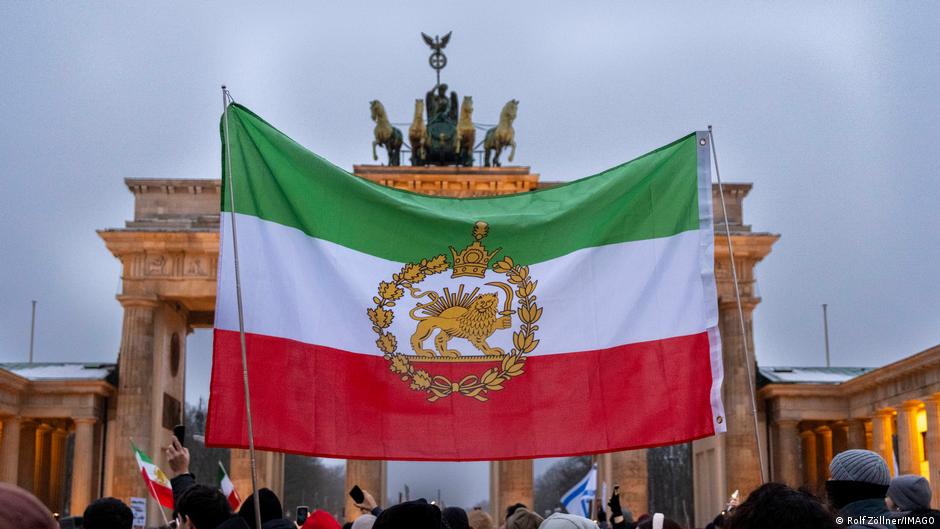
The German Kaiser abolished the monarchy in 1918, giving way to the Weimar Republic. In Persia, Reza Khan came to power amid domestic unrest and, in 1925, deposed the Qajar dynasty and became Reza Shah Pahlavi.
He began a program of modernization and centralization, seeking technical expertise and industrial models from Europe, especially Germany. German firms, including Junkers, contributed to early aviation development and air transport initiatives, while German engineers and companies participated in the construction of sections of the Trans-Iranian Railway. In 1929, Persia and the Weimar Republic signed a friendship and commercial treaty formalizing diplomatic and economic relations.
Reza Shah continued to maintain cordial economic relations with Germany after coming to power in 1933 following the Nazi scandal. In 1935, he officially requested that the country be called “Persia” instead of the original name “Iran”. During World War II, Iran declared itself neutral, but British and Soviet troops occupied the country in 1941 and forced the pro-German Reza Shah to abdicate. His son, Mohammad Raza Shah, took over the throne and cooperated with the Allies. Iran gained full sovereignty in 1946.
Soon economic relations between the two countries deepened. German companies built factories, hospitals, and roads in Iran. In 1966 the two countries signed an arms agreement and in 1974 construction of a nuclear power plant at Bushehr began with German participation.
Soraya: ‘Germany’s favorite queen’
In 1951, the Shah of Iran married Soraya Esfandiari-Bakhtiari, the daughter of an Iranian diplomat and his German wife. Soraya’s European background and striking appearance attracted widespread media attention both in Iran and abroad.
After seven years of lavish marriage, the marriage ended when it became clear that she could not bear children and provide a male heir, a central concern for the Pahlavi dynasty. The divorce prompted intense tabloid coverage in Germany, which had little positive to say about the Shah and Iran – straining bilateral relations. Iranian officials protested and threatened diplomatic consequences, and the German government also considered a law to protect foreign heads of state from insults, informally dubbed “Lex Soraya”. However, the law was never implemented.
The Shah’s visit to Germany in 1967 proved to be another turning point. For the first time, a state guest was welcomed not with joy but with vehement protest. Iranian students and expatriates demonstrated against political repression and human rights abuses in Iran, holding placards reading “All Persia is a concentration camp” and “Killer” and accused the emperor of oppressing his people. The Justice Ministry ultimately decided against prosecution, and unresolved issues with Iran were left to be settled through diplomatic channels. The march is also infamous for the violence used by German police against protesters. The officers stopped the protesters from leaving, beat them with sticks and even shot and killed one of them.
after the revolution
After the fall of the Shah in 1979, many Western countries distanced themselves from the new Islamic Republic, but West Germany pursued a policy of dialogue. In 1984, Foreign Minister Hans-Dietrich Genscher became the first high-ranking Western politician to visit the new regime, and other German politicians followed. However, political tensions, human rights violations, and the course of the Iranian leadership ultimately ended the once close German-Iranian partnership.
This article was originally written in German.