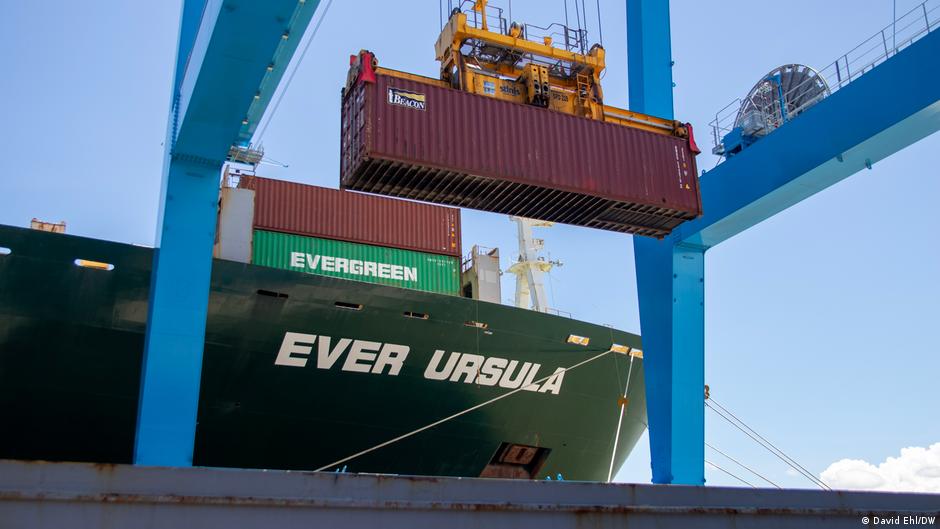
Gold, cocoa and oil are commodities that are in demand globally. And all of these can be found in abundance in Ghana. This explains why the West African country earns more from exports than it pays for imports.
To obtain advantageous export conditions, Ghana offered market access to trading partners for less than optimal returns.
Here’s an example that shows how complex the effects of such trade agreements can be – and why export surpluses may be a situation where some people will suffer losses.
For example, 80% of chickens in Ghana do not come from local producers, but are brought in frozen form from Europe, the US or Brazil, where breeders often use only the breast fillets domestically and sell the rest on foreign markets.
According to a 2023 study, despite paying a 30% import duty, imported chicken can still be up to 35% cheaper than local products, making chicken farming in Ghana increasingly unattractive.
“If you produce chicken, they are not buying it. So you can’t produce it,” said Charles K., chairman of the Poultry Farmers Association in the Ashanti region. said Donkor, who runs a farm with 200 employees that houses thousands of laying hens that supply eggs rather than meat.
“We can’t create jobs for youth like this,” he told DW.
Treaties: Free trade for much of Africa
To understand the context of the current situation, some background is necessary: for half a century now, an increasing number of treaties and agreements have been designed to ensure mutually beneficial trade between Europe and Africa – at least in theory.
It all started in 1975 with the Lomé Convention between the then European Community and the then newly established Organization of African, Caribbean and Pacific States (sometimes abbreviated as OACPS, sometimes as the ACP Group).
Nearly half of the 79 member countries of that conference are from sub-Saharan Africa.
The Lomé Convention and its successors – named after the respective summit locations: Cotonou (2000) and Samoa (2023) – are considered the framework agreements on which regional and bilateral free trade agreements are based.
A total of 44 of Africa’s 54 countries thus have duty-free access to the EU’s internal market, with many countries having to follow so-called “everything but arms” rules for trade with developing countries.
However, this overall arrangement does not always result in mutual benefits.
Trade between Europe and Africa is increasing
DW has analyzed trade flows over the past 25 years, although no data is yet available for 2025.
A clear trend has been developing since the beginning of the millennium: trade volumes between Africa and Europe have been increasing in both directions.
In the recent past, African economies have had an overall trade surplus with Europe. That is, they earned more euros from exports than they spent on imports of European goods.
However, there are major regional differences: these export surpluses are largely attributable to oil and gas from Libya and Algeria, while fossil fuel trade in Nigeria and Angola is also flowing European foreign exchange into state and private coffers.
From 2020 to 2022, the value of these exports to the EU more than doubled. At the beginning of the COVID-19 pandemic, crude oil traded very cheap at times; Then, with the beginning of the Russian invasion of Ukraine two years later, the commodity market saw a massive increase in prices.
There is also Côte d’Ivoire, an outlying region that generates a significant surplus with its cocoa and rubber exports.
However, in contrast, more than half of African countries have a negative trade balance with Europe.
Africa is still more dependent on foreign favors
There are also important factors beyond the overall balance: African exports to Europe fluctuate more strongly, while trade flows from North to South appear to evolve more evenly.
This is because Africa exports many raw materials, the price of which is formed on world markets, while Europe usually transfers at least part of the grown and most of the processed products.
Africa is therefore far more dependent on Europe as a buyer, explains Anja Beretta, head of the Africa regional economic program at the Konrad Adenauer Foundation, affiliated with Germany’s center-right Christian Democrats.
“The export of goods from Africa to Europe is about 25-30%. But the African market is negligible for Europe,” says Beretta.
“The products coming from Africa are largely unprocessed products, for example in the agricultural sector, but also other raw materials. In contrast, Africa imports industrial goods or products from Europe that already have some degree of manufacturing.”
A look at the data confirms this picture: if you only look at the largest product groups in the vegetables and minerals and processed goods sectors, you will see how these products have very one-way movements in either direction.
Opportunities for greater trade between the EU and Africa are growing
According to Beretta, “There is currently an imbalance that is detrimental to Africa.” “Not only with Europe, but also with China, the US and other regions of the world. But from my perspective, you cannot say that Africa is being kept structurally small.”
She says that most African economies have failed to reinvest past years’ commodity profits into their respective markets, and so have also failed to diversify their industries.
Beretta cites Ghana and Mauritius as positive examples, whose industrial policy is oriented towards diversification to ensure that individual price fluctuations will be minimized.
Joseph Matola, an economic expert at the South African Institute of International Affairs (SAIIA), believes that within this imbalance lies an opportunity to expand trade for mutual benefit.
“The EU is looking to diversify itself and reduce tensions [readiness to take] “Europe is actively looking at other markets. They are looking for suppliers of critical minerals. And I think there are a lot of minerals in Africa that the EU needs.”
The African Free Trade Area is still a work in progress
Matola also stressed the need for African governments to prioritize the export of processed products so that more value and growth can be created locally.
To this end, the EU has pledged its support with an investment of €150 billion ($173 billion) for infrastructure and energy production in Africa through its Global Gateway Initiative.
Africa is also trying to fully operationalize the African Continental Free Trade Area (AfCFTA), which came into force in 2021.
The 55-member free trade area is far from fulfilling its promise to remove barriers to economic exchange.
Beretta believes that the project holds great potential for European exporters, as the AfCFTA aims to standardize markets and reduce so-called non-tariff trade barriers.
“By this I mean, above all, long waits at the borders, sometimes completely different customs conditions, but also very poor infrastructure.
“For example, if you try to get your goods from Namibia to Kenya, it takes a really long time. Any improvements in this area will make African markets more attractive,” he says.
Could this free trade area eventually lead African governments to increase their diplomatic weight in economic agreements? Matola is optimistic.
“They should use AfCFTA as a forum for negotiations rather than acting alone,” he says. “It would be helpful if more African countries did so.”
The data, code, and methodology behind this story can be found in this Github repository.
Further data-driven stories by DW can be found here.
Isaac Kaledzi in Accra contributed reporting to this article.
Edited by: Serton Sanderson