
The map of Bitcoin mining in Latin America once had its epicenter in Venezuela, where low-cost hydroelectric power powered thousands of computing machines. Today, that landscape is one of empty warehouses and confiscated equipment.
Faced with this scenario of paralysis, the Cryptoassets Technical Table of the Venezuelan Chamber of Electronic Commerce (Cavecom-e) formalized a specialized committee; a first institutional step that seeks to rescue an industry that, after years of forced pause, longs for a framework of certainty to operate again.
This committee arises, in reality, to try to decipher what is left of the sector and how to reconcile private expectations with the fragility of the national electricity system.
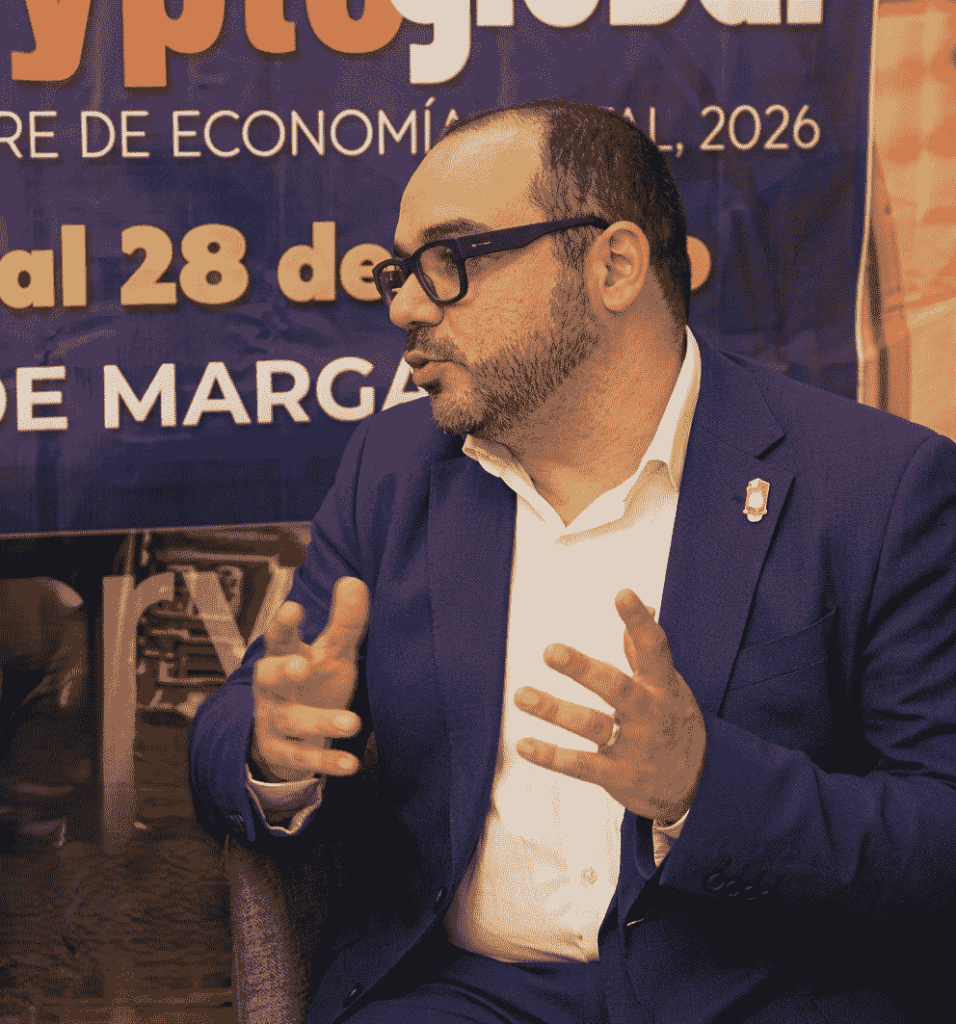
Eleazar Colmenares, who leads the Cryptoactive area at Cavecom-e, in an exclusive conversation with CriptoNoticias, said that The purpose is to bring together the initiatives that today survive in a dispersed way to transform them into projects that the state regulator can consider ‘potable’.
For Colmenares, the underlying challenge is to rebuild a fractured trust after the hard blows that the activity has received in recent years. The final breaking point occurred when the government, faced with a national electricity deficit of about 3,000 megawatts, began a massive wave of interventions.
In the state of Carabobo alone, Governor Rafael Lacava confirmed the seizure of 11,000 mining equipment under the argument that the sector was “stealing” the energy necessary for residential consumption.
This “zero tolerance” policy, added to the institutional paralysis after the intervention of Sunacrip due to corruption schemes, left the sector without a regulatory body and the miners in a legal limbo that today, Through these technical tables, a timid attempt is made to begin to correct.
The idea is to be able to bring together all those people who have these projects, discuss their feasibility and submit them to the regulatory body so that people in any part of the country can benefit from the benefits of digital assets.
Eleazar Colmenares.
Colmenares recognizes that the sector still bears the scars of the “attacks” suffered in previous years, which has left a deep crisis of credibility. For the manager, the only way to heal this fracture is through academic and technical training.
Trust is generated with knowledge. And if industry players are not able to take that learning to every corner of the country to dispel the fears of the past, any effort at dialogue will simply be a waste of time.
Eleazar Colmenares.

The tripod for the rescue of Bitcoin mining in Venezuela
From the perspective of Aníbal Garrido, advisor and director of the BT&C Academy of the Andrés Bello Catholic University (UCAB) and specialist in the area, Bitcoin mining in Venezuela is in a state of forced hibernation.
And beyond the availability of megawatts or not to restore it, Garrido maintains that the missing piece in the puzzle is legal certainty, an essential factor for operators to dare to turn their processors back on.
«It is important to clarify that the digital mining industrial sector in the country is completely stopped precisely due to the current restriction in energy matters. There are no miners in the shadows, only miners willing to reactivate a sector if measures exist to guarantee continuity and stability of operations in all its dimensions.
Anibal Garrido.
In an exclusive conversation with CriptoNoticias, Garrido maintains that for Bitcoin mining equipment to hum again in the country, the State must guarantee a tripod of basic conditions. The first is legal security that protects capital investments; the second, a regulatory framework shielded from discretionary interpretations; and finally, a strategic plan that ensures the stability of the national electrical system.
Among the solutions being considered to avoid saturating the public network, the use of flared gas (vent gas) in oil fields stands out, a technique that would allow electricity to be generated on site for digital mining farms without touching a single watt of the national hydroelectric network.
For now, although on the Cavecom-e table it is already assured that concrete proposals will soon be presented from entrepreneurs in areas such as Margarita Island, in the community that revolves around Bitcoin, Caution beats enthusiasm.
In a country where megawatts remain a scarce resource, the future of mining in Venezuela does not depend only on cheap energy. What the sector really needs today is something much more difficult to achieve, such as operational stability and clear rules of the game that no one can change midway.